

There is a shiny streak on the lapel, as if someone had just rubbed oil on it. Almost every suit that has been ironed in a hurry has that streak, and it is not because the cloth is poor. An iron that is too hot, pressed directly onto the face of the fabric, has flattened the wool fibres so they reflect light. If you are looking for how to iron a suit to avoid that outcome, the first thing to remember is this: a suit is not ironed like a shirt.
The short answer
Iron a suit using steam and a damp press cloth, at the temperature on the care label (about 150°C for ordinary wool), working from small areas to large: lining, shoulders and sleeves, back, front, and finally the collar and lapels. Never press the iron directly onto the face of the cloth, and never press the lapels flat, so the roll line keeps its natural curve.
Preparing before you iron a suit jacket
Good preparation solves half the problem.
- A steam iron with a continuous steam setting. Steam is wool's friend: it softens the fibres without needing pressure.
- A press cloth: a thin piece of white cotton or a large handkerchief. Dampen it and wring it out until barely wet.
- A wooden hanger or a wide-shoulder hanger to keep the shape of the shoulders while hanging.
- A rolled bath towel or a sleeve board to slide into the sleeves and shoulders. A rolled towel keeps the sleeves from picking up fold marks.
- A soft-bristle brush to brush the wool fibres back up after ironing.
First, check the label inside the jacket: it has an iron symbol with dots. One dot is low heat (about 110°C), two dots is medium (about 150°C), three dots is high (about 200°C).
| Material | Reference temperature | Notes |
|---|---|---|
| Wool | Two dots, about 150°C | Use steam and a press cloth |
| Wool-polyester blend | One to two dots, 110–150°C | Polyester shines easily; prefer a low setting |
| Linen | Three dots, about 200°C | Iron while the cloth is still slightly damp |
| Lining (viscose, acetate) | One dot, about 110°C | Iron lightly, without much steam |
| Velvet, lustrous cloth | Do not iron directly | Use steam, do not touch with the iron |
These figures are common reference values; always give priority to the label on the garment.
How to iron a men's suit jacket, step by step
The general rule is to go from the small, less important parts to the large ones, and to leave the lapels for last.
- Lining and pockets. Turn the inside pockets out and iron lightly on low heat. The lining is the thinnest part and the easiest to scorch.
- Shoulders and sleeves. Slide the rolled towel into the sleeve and iron half a sleeve at a time, rotating gradually so as not to create a sharp lengthwise crease. For the shoulders, place the shoulder over the rolled towel or the end of a sleeve board and steam along the curve of the shoulder to keep its roundness.
- Back. Lay the back flat, lay a damp cloth over it, and iron from top to bottom, lifting the iron up and setting it down rather than dragging it.
- Front. Also section by section. Avoid ironing close to the button edge and the pockets; only glide lightly over them.
- Collar and lapels. Iron the collar from the wrong side first, then from the right side through a damp cloth. For the lapels, use only steam and the press cloth, never pressing the iron directly on them. Smooth the lapel along its roll line with your hand while the cloth is still warm.
- Hang immediately after ironing. Hang the jacket on a wide-shoulder hanger and let it cool completely before wearing or storing it.
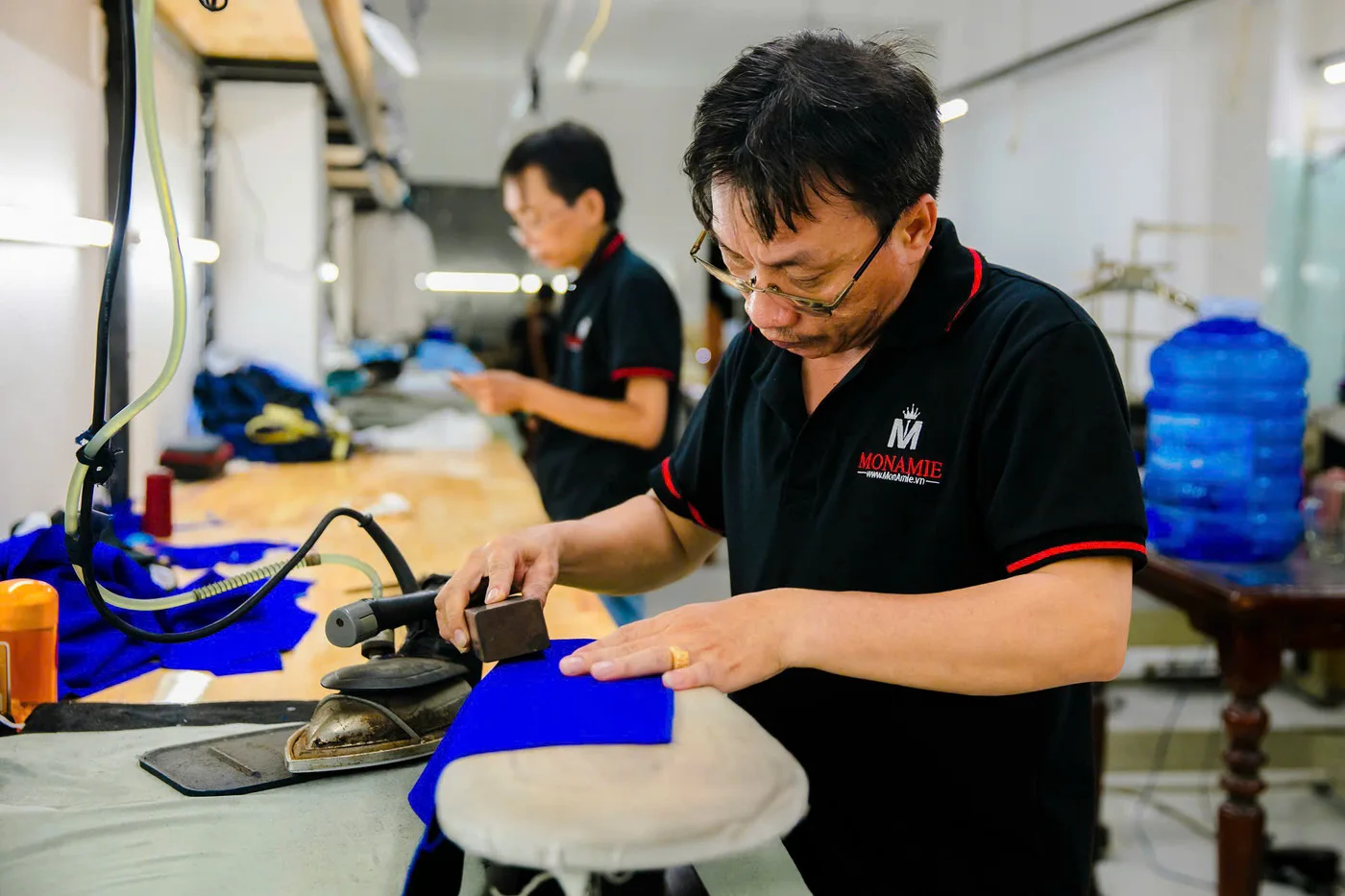
A small tip: hold the iron about 1 to 2 cm above the cloth and release steam, then smooth the cloth with your hand or a brush. For many suits, this is enough to flatten the garment without the iron ever touching it.
How to iron suit trousers and keep a sharp crease
Suit trousers need a straight crease down the centre of each leg. The method:
- Turn the trouser pockets out and iron the pocket linings on low heat.
- Iron the wrong side of the waistband and the front seams, since this area is easily flattened if ironed on the right side.
- Lay the two legs on top of each other with the side seams matching, then lay a damp cloth over them.
- Iron from the waistband down to the hem, section by section, along the original crease. If you iron off the crease, you will end up with two parallel creases that look very unpleasant.
- Hang the trousers by clips at the hem or drape them over a trouser hanger so the crease stays straight.
For a deeper dive, see the article how to iron men's dress trousers and keep the crease.
Why do lapels flatten and cloth get shiny?
Wool fibre has natural elasticity and tiny scales on its surface. When a hot iron presses down, the scales are crushed flat and the fibres flatten, so the cloth surface reflects more light, and that becomes a shiny mark. Lapels get flattened for two different reasons: the lapel is built to curve along a natural roll line, and the iron presses it flat right at that spot.
Common mistakes:
- Too much heat for wool-polyester blends.
- Ironing the right side directly without a press cloth.
- Pressing down hard with the iron instead of letting the steam do the work.
- Dragging the iron across the lapels.
- Ironing when the cloth is dry and cool, without enough moisture for the fibres to swell back up.
If a shiny mark has already appeared, try laying a damp cloth over the spot, steaming it and then brushing lightly along the grain with a soft brush. Some people use a cloth dampened with water mixed with a little white vinegar on dark cloth; test it on a hidden spot first. If the shine is severe, take the suit to a professional dry cleaner. Once a lapel with real canvas has lost its roll line, it is very hard to restore; see the article what is a roll line to understand why this line matters.
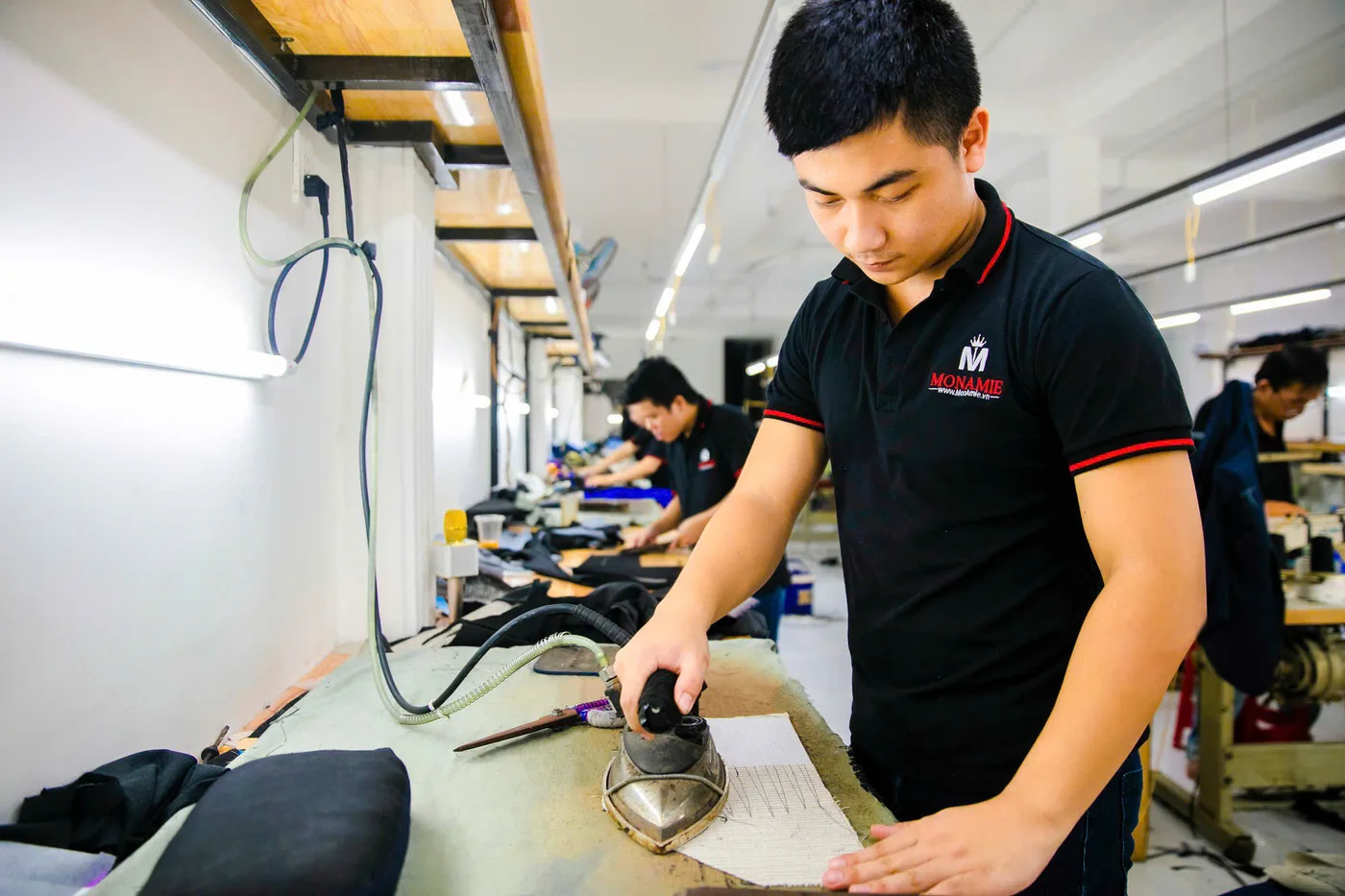
When do you not need to iron, only steam?
A suit should not be ironed after every wear; ironing often wears the cloth and robs it of elasticity. Most of the time, you only need to hang the jacket on a wide-shoulder hanger, let it rest at least one day after each wear, then use steam to smooth light creases. If you want to learn how to use a steam iron at home, the article steaming and pressing a suit at home with a steam iron gives more detailed instructions.
Frequently asked questions
Do you need a steam iron to iron a suit at home?
Not strictly, but a steam iron makes the job much easier. If you only have a dry iron, use a damp press cloth and set it to the wool setting, lifting and setting down rather than sliding. Never let a dry iron touch the surface of wool cloth directly.
What temperature is right for ironing a suit?
Wool usually takes the two-dot setting, about 150°C, with steam and a press cloth. Wool-polyester blends should be lower, from 110 to 150°C depending on the blend ratio. Always check the label inside the jacket, because each cloth has its own limit.
Why does a suit get shiny after ironing?
Because heat and pressure flatten the wool fibres. To avoid it, use a damp cloth underneath, moderate heat, lift and set down the iron, and favour steam. On dark cloth, the shine shows up more easily.
Do you need to iron the wrong side of a men's suit jacket?
Yes, you should iron the wrong side of the parts that shine easily, such as the lapels, the collar and the seams. On the right side, only iron through a damp press cloth. Ironing the wrong side protects the cloth surface and does not lose the shape.
Can ironing damage a suit's canvas?
It can, if you apply too much heat or press for too long, especially on a fused suit. The adhesive can bubble. Use moderate heat, lift the iron quickly, and do not press the lapels.
In closing
The right way to iron a suit comes down to three words: steam, press cloth, light hand. If your suit has fit problems or shine, or needs alterations, you can bring it to a Mon Amie showroom for a master tailor to look at in person, or find out about the long-term alteration warranty that comes with the Bespoke service.