
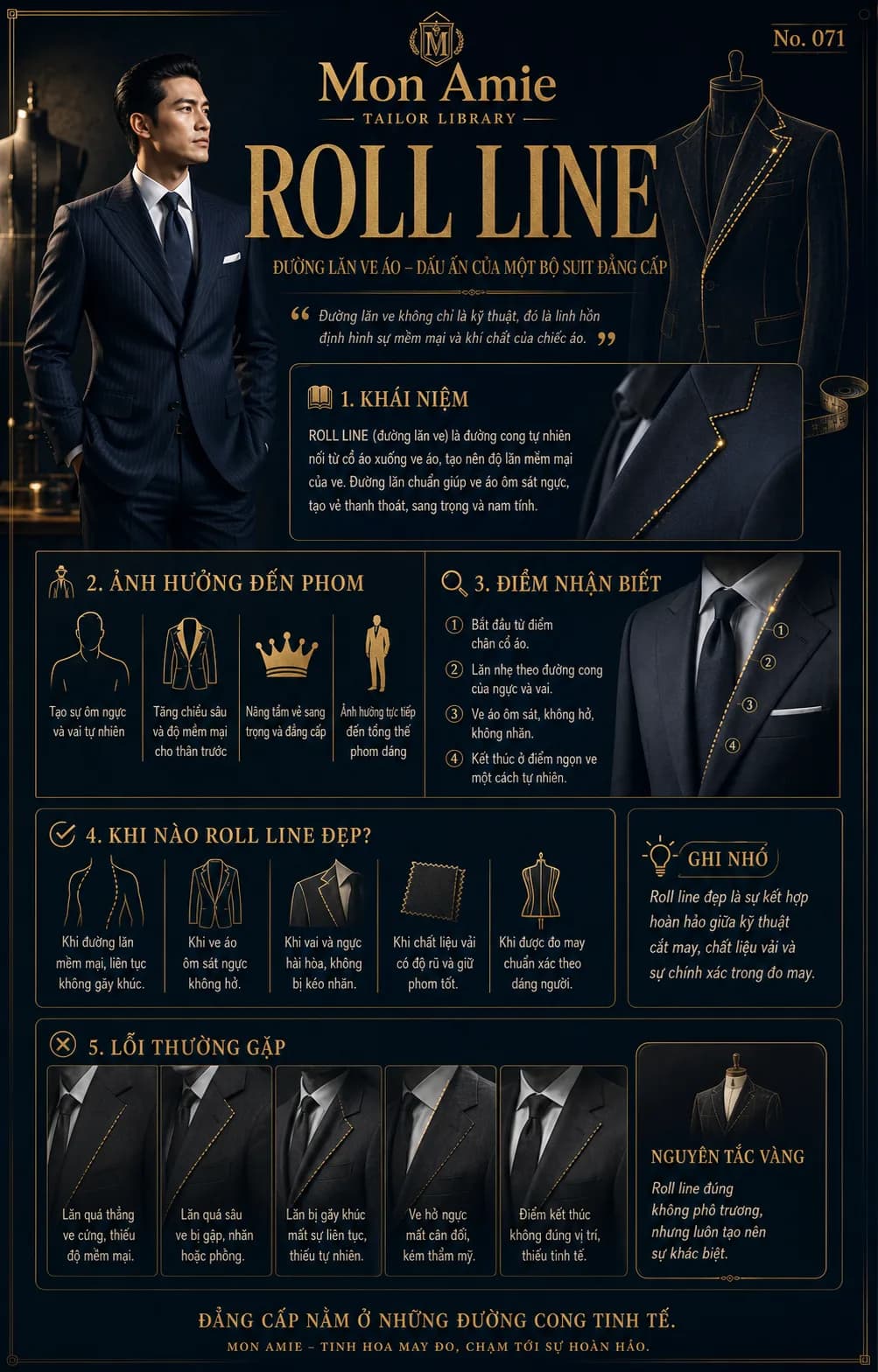
The roll line is the natural curve running from the collar down along the lapel, giving the lapel its soft turn. A true roll line lets the lapel hug the chest, lending the wearer an air that is light, refined and unmistakably masculine. In the tailoring trade, Mon Amie often tells clients that the roll line is not merely technique — it is the soul that shapes a jacket's softness and bearing.
What is a roll line?
Look at a jacket from the side and you will see that the lapel does not fold flat like a sheet of paper; it curls gently from the base of the collar down to the first button. That curl is the roll line, and three things create it at once:
- The internal structure of the body — the canvas and the pad stitching through the lapel decide whether it rolls or breaks.
- The tailor's pressing — heat and pressure teach the lapel to remember its curve.
- The cloth itself — a fabric with good drape and recovery gives a lively, natural roll.
A lapel fused with glue tends to be stiff and flat; a lapel with a genuine roll line always carries a fullness and springiness you can feel the moment you take it in your hand.
How the roll line shapes the silhouette
The roll line is not decoration. It bears directly on the whole silhouette of the suit:
- It creates a natural embrace of chest and shoulder — a properly rolled lapel stays against the front instead of springing away when you move.
- It adds depth and softness to the forepart — the cloth over the chest gains volume and shadow rather than lying flat.
- It elevates the sense of refinement — those who know suits can read the construction from the roll alone.
- It governs the overall line — a wayward roll drags with it a gaping collar, a creased chest and an unbalanced stance.
Four marks of a correct roll line
At a fitting you can check the roll line yourself on four points:
- The roll begins at the base of the collar, continuous with the back neck.
- The lapel rolls gently along the curve of chest and shoulder, never stiff and straight.
- The lapel stays close to the chest, without gaping or creasing, whether you stand still or raise your arms.
- The roll finishes naturally at the lapel point — usually just above the first button, neither cut short nor drawn out.
When is a roll line considered beautiful?
A fine roll line brings together several conditions:
- The curve is soft and continuous, with no break at any point.
- The lapel hugs the chest and shows no gap in profile.
- Shoulder and chest sit in harmony, with no drag lines across the cloth.
- The cloth drapes well and holds its shape — which is why fine worsted wools always yield a better roll than heavily blended synthetics.
- The jacket is measured and cut precisely to the body, because a roll line is only perfect when front length, shoulder slope and chest all match you exactly.
Put another way, a beautiful roll line is the perfect union of cutting technique, cloth and precision in measurement — remove any one of the three and the roll will betray the jacket at once.
Five common roll line faults
These are the faults Mon Amie sees most often when clients bring in ready-to-wear jackets, or garments made elsewhere, for alteration:
- Too straight — the lapel is stiff and lifeless, as though cut from cardboard.
- Too deep — the lapel folds, creases or bubbles, usually because the canvas does not match the chest shape.
- Broken roll — the curve loses continuity and looks unnatural, a sign of poor pad stitching or pressing.
- Gaping lapel — the lapel lifts away from the front when standing or sitting, unbalancing the whole line.
- Wrong finishing point — the roll stops too high or too low against the button, betraying a lack of refinement.
Most of these faults originate at the measuring and construction stage, so alteration after the jacket is finished can only improve matters so far. That is why the choice of tailor matters from the very first day.
A word from Mon Amie's artisans
Mon Amie's artisans hold to a golden rule: a correct roll line never announces itself, yet it always makes the difference. At a fitting, do not look only at the mirror head-on — turn to the side, fasten the button, raise your arms and sit down to see whether the lapel keeps its hold on the chest. If you are torn between two jackets, choose the one with the softer, more continuous roll, because that is the detail no amount of pressing can fake. With fine cloths such as Canonico, Holland & Sherry, Dormeuil or Scabal, the natural drape of the fabric brings the roll line to its highest finish when paired with proper bespoke construction.
The class of a suit lies in its subtle curves, and the roll line is the most important of them all. If you would like to see for yourself what a properly built lapel roll feels like, we invite you to book an appointment at one of Mon Amie's five showrooms in Ho Chi Minh City, or to read more about the tailoring process — our hotline 0888.111.118 is always ready to advise you.