
The shop's claim ticket carries a single short line: "1 jacket, giặt hấp, ready Friday." You nod and leave, but a question lingers: what exactly is giặt hấp, how does it differ from an ordinary wash, and why does one shop return a jacket crisp and flat while another returns it with flattened lapels and shiny shoulders? Understanding what goes on behind that glass door helps you ask for the right things.
Quick answer
In Vietnam, "giặt hấp" is the everyday name for a dry-cleaning process for a suit jacket: treating stains, washing in a machine with solvent instead of water, then steaming and pressing the garment back into shape. This keeps wool and the internal structure less prone to shrinking and distortion than a water wash. What decides the result is the finishing press and the technician at the shop.
What is giặt hấp for a suit jacket, and how does it differ from an ordinary wash
The word "giặt" here refers to the cleaning part; "hấp" refers to the finishing step with steam. In most shops, "giặt hấp" consists of two parts in sequence:
- Dry cleaning: washing with an organic solvent instead of water. The solvent dissolves oil and grease well, rarely makes wool fibres shrink and does not soak the internal interlining with water.
- Steaming and pressing: using steam and a press (or a professional iron) to bring the shoulders, lapels and sleeves back to their original shape.
A suit jacket is not a T-shirt. Inside it has interlining (canvas or fusible), shoulder pads and a lapel that has been shaped in advance. Water and hard wringing can make these layers shrink differently, bubble or shift. That is why a jacket is rarely advised to be water-washed whole, and why the article can a suit be machine washed is worth reading if you are thinking of washing one at home.
The shop process for dry cleaning a suit jacket: 6 steps
- Receiving and inspection. Staff check the label, then inspect stains, buttons, seams and pockets. This is when you should point out stains and say what caused them (coffee, red wine, sweat).
- Sorting and ticketing. Items are tagged and sorted by colour and fabric type so nothing gets mixed up.
- Pre-treating stains (spotting). Oil, wine and ink stains are blotted with a specialist solution before going into the machine. Old stains are usually harder than fresh ones.
- Dry cleaning in the machine. Garments tumble in solvent, then are spun and lightly dried so the solvent evaporates.
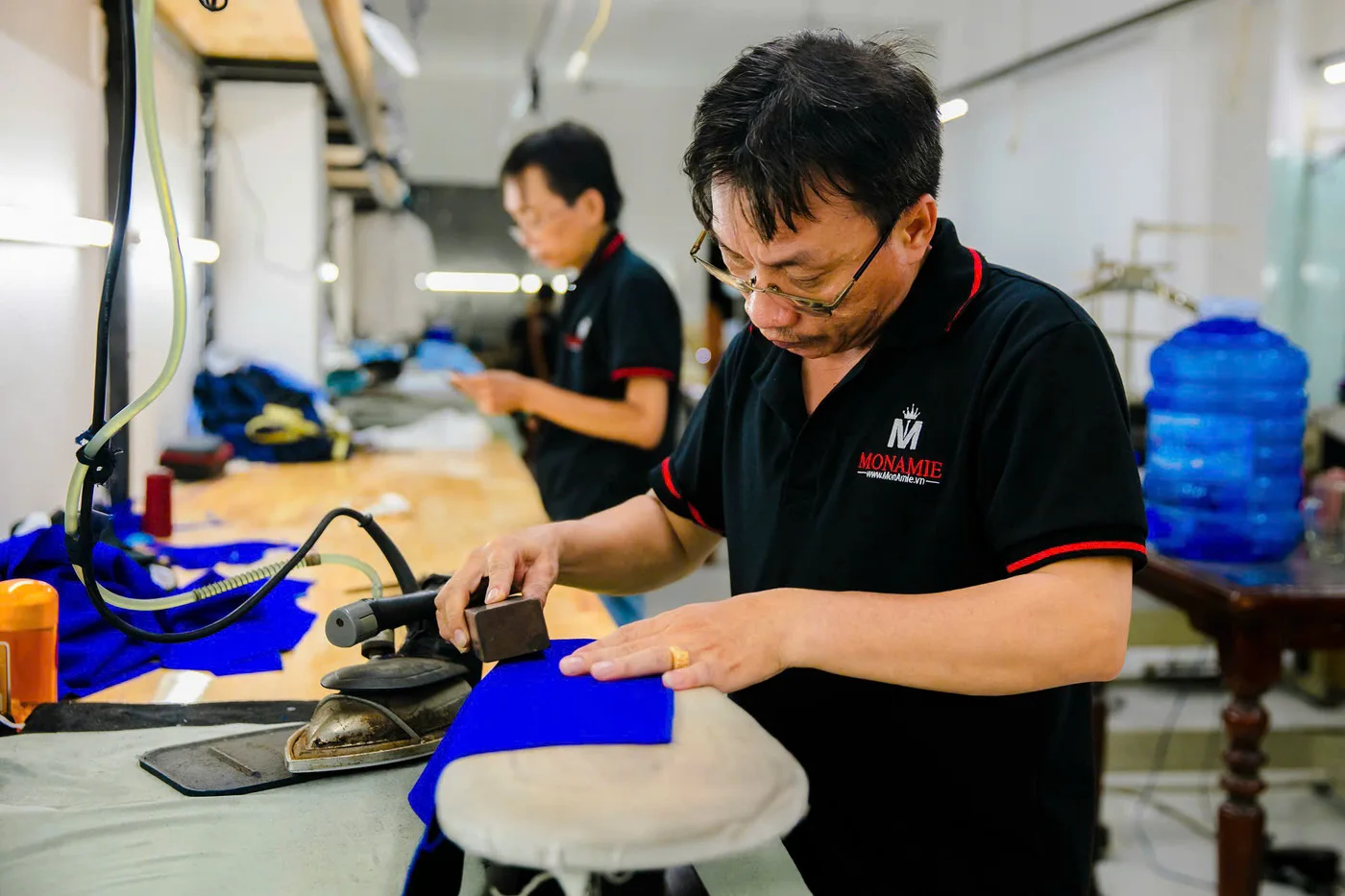
- Steaming and pressing. Steam softens the fibres, and the technician reshapes the shoulders, lapels, sleeves and trousers. This is the step where a good shop earns its fee.
- Inspection, bagging and return. Garments are hung and bagged to hold their shape until you collect them.
The process may differ slightly between shops, but this framework is fairly common. You do not need to remember it all; just know that step 3 and step 5 decide almost everything.
How to read the claim ticket
The claim ticket is a small contract between you and the shop. Look at four lines:
- Item type and quantity: "jacket" or "two-piece suit"? Is the waistcoat counted?
- Service: dry cleaning, steaming, or pressing only. Each is priced differently.
- Condition on receipt: stains, loose buttons, tears. If the shop does not note it, ask them to, or take a photo yourself.
- Pickup date and compensation terms: how far the shop is responsible if the garment is lost or damaged.
What to tell the shop so the jacket does not go shiny
Shine at the shoulders and lapels is the most common complaint after dry cleaning. It happens with hot pressing directly on the wool. You can ask for the following:
- Press through a cloth, or use steam, and do not press a hot plate directly on the fabric at the shoulders, lapels and elbows.
- Keep the roll of the lapel. A suit lapel has a natural roll; pressing it flat makes it lose its shape.
- Do not press over buttons or flap pockets, to avoid leaving marks.
- Mention stains in advance. Do not let the shop "guess", because a wrong treatment can spread the stain.
- Empty all the pockets, and remove lapel pins and pocket squares.
If the jacket is only creased and not yet dirty, sometimes steaming or a light press is enough, with no need for dry cleaning; frequent dry cleaning still wears the fabric down. You can read how to iron a suit without shiny shoulders to deal with light creases at home.
Collecting it: what to check before paying
Once your jacket has been dry cleaned, do not rush to pay. Take two minutes to check right at the counter:
- Shoulders and lapels: any shine, press marks, and whether the lapel keeps its natural roll.
- Old stains: whether they are gone, and whether there is a halo.
- Trouser creases: a straight crease line, with no double parallel creases.
- Buttons, stitching, lining: intact, not peeling or shrunk out of line.
- Smell: a faint solvent smell is normal and fades after a night hanging in the open air; a strong, harsh smell that lingers is a sign it was not dried properly.
- Pockets: retrieve anything you left in them (if you forgot), and check the inside pockets.
If there is a fault, say so right at the counter and take a photo. The shop is responsible for putting it right, especially when you noted the garment's condition on receipt. With shops you already trust, this is also how both sides come to understand each other better after every visit.
When to dry clean and when not to
A suit jacket that is worn regularly needs dry cleaning only a few times a year, usually when there is a visible stain or a smell that will not fade. Hanging the jacket in the breeze after each wearing, using a wide-shouldered hanger and letting the suit "rest" for at least one day between wearings will make it last far longer than sending it to be cleaned constantly.
Frequently asked questions
Are giặt hấp and dry cleaning a jacket the same thing?
In everyday Vietnamese usage, the two terms are often used interchangeably. Dry cleaning is the cleaning step with solvent; "hấp" usually refers to the steaming and pressing step that follows. Ask the shop for the exact name of the service so you know which part you are paying for.
Is laundering a suit jacket different from giặt hấp?
Yes. Laundering is usually a water wash followed by ironing, suited to shirts and everyday clothes. A suit jacket should be dry cleaned and steamed, because it has interlining and a shaped shoulder.
Can washing and ironing a suit make it shiny?
Yes, if the iron is hot and pressed directly onto the wool. Pressing through a cloth, steaming, and using an experienced technician greatly reduce this risk.
How long does dry cleaning a suit jacket take?
It depends on the shop, but usually a few days. If you need it urgently, ask first and book early. The article how much does it cost to dry clean a suit has a reference price range for this service.
Keeping a suit longer by cleaning it at the right time
Knowing what giặt hấp is also means knowing when not to use it. A good suit lasts long when it is cleaned rarely and pressed properly. Made-to-measure suits, whose cut and interlining are built to your own measurements, are all the more worth looking after: Mon Amie's Bespoke tailoring service includes a long-term alterations warranty after you collect the garment, and you can book an appointment for an artisan to review the cut when needed.