
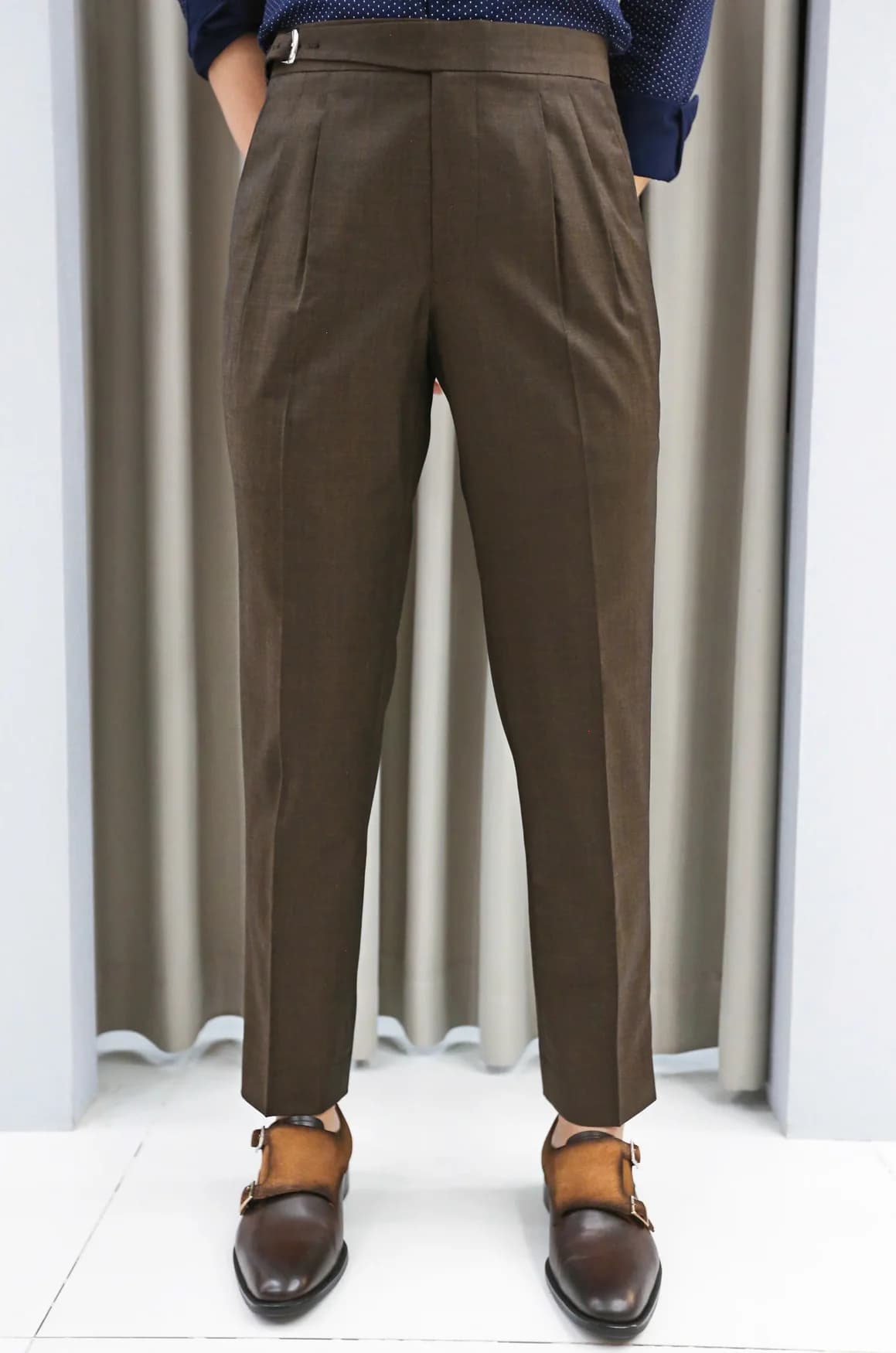
A crease in the right place runs from the waistband down to the middle of the instep of the shoe, straight as a ruled line. Off by a finger's width, and the trousers already look as though they were pressed in a hurry. How to iron dress trousers may sound like a kitchen-table chore, but it is a small technique that every tailor knows, and one you can learn in a single afternoon.
Quick answer
To iron dress trousers, remember three things: work in the order waistband, pockets, then legs; match up the old crease before you press; and always use a damp cloth, lifting the iron to press instead of dragging it across the fabric. Set the temperature to suit the material, about 150 °C with steam for wool. Done properly, the trousers keep a straight crease without turning shiny.
Find the true crease before you iron
Before you switch on the iron, you need to know where the crease will fall. Men's dress trousers usually have two kinds of fold:
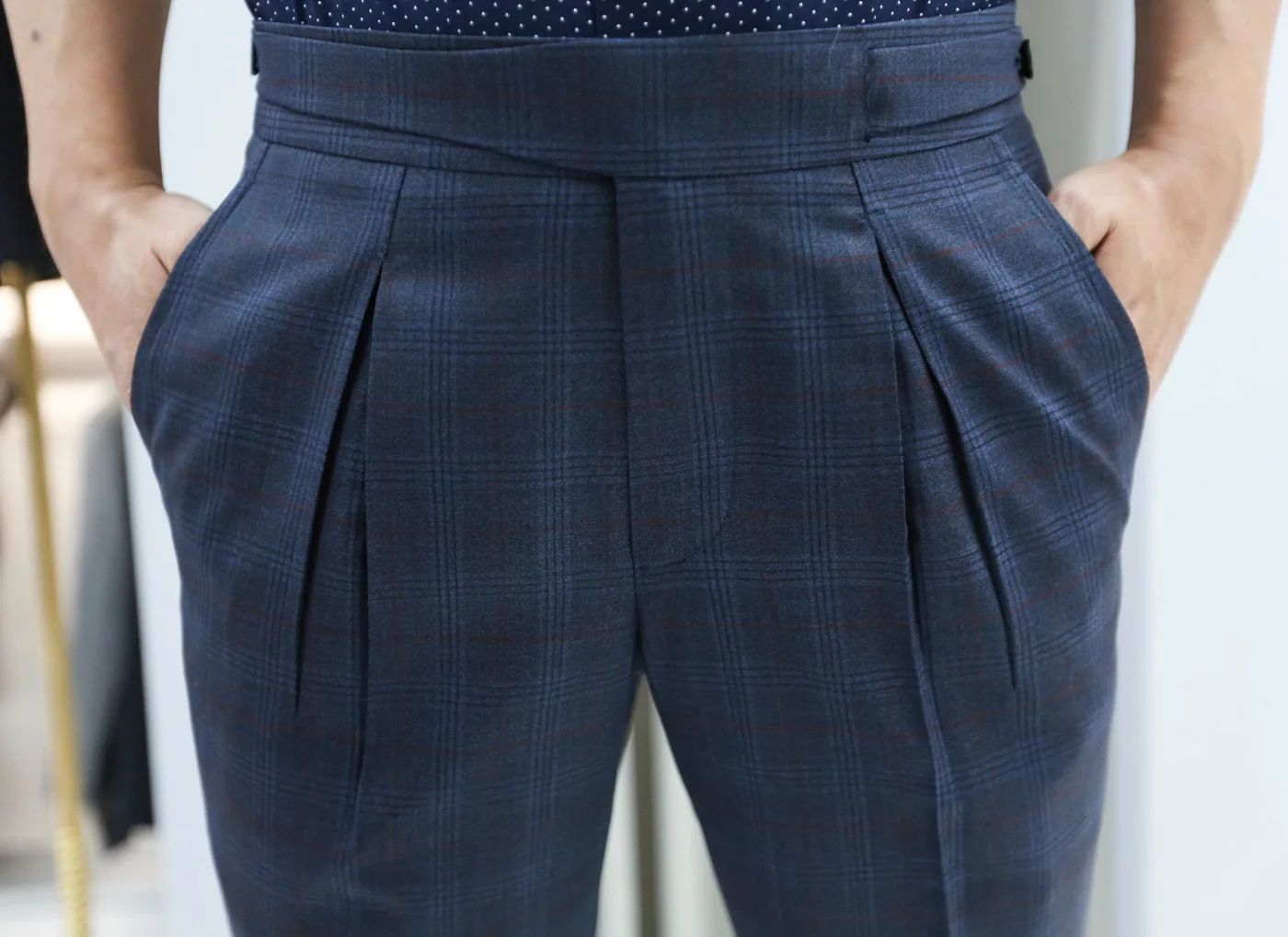
- Pleats: the folds at the front of the waistband, usually one or two.
- Crease: the straight fold running down the leg, from the pleat (or from the waistband if the trousers are flat-front) to the hem, passing through the middle of the knee.
How to find the crease: pick up both legs and let the inseam and the side seam sit opposite each other on either side. The front crease should then fall exactly at the centre of the front of the leg, and the back crease at the centre of the back. If the trousers have been ironed many times and the old fold has faded, spray them with steam, smooth them flat and start again from the beginning.
Preparing your tools
- A steam iron with a clean soleplate, free of residue.
- A press cloth: a thin piece of cotton or white linen, slightly damp.
- A spray bottle or the steam button on the iron.
- A flat, steady ironing board. If you do not have a dedicated one, a table covered with a thick cloth will also do.
- A trouser clip hanger to hang the trousers up after ironing.
Set the temperature by the fabric label. For wool trousers, about 150 °C with steam is right. Cotton can take more heat, while polyester blends need a lower heat so that the cloth does not melt into a shine. If you are not sure, test on a hidden spot, such as the inside of the waistband.
How to iron dress trousers, step by step
- Turn the trousers inside out. Iron the pocket linings, the seams and the waistband from the inside. This stops the pockets from printing through onto the outer face.
- Turn them right side out and iron the waistband. Lay the cloth down and press short sections at a time, from the zip to the waistband button.
- Iron the pocket and hip area. Press lightly only, and do not leave a mark at the pocket opening.
- Lay one leg on the board and match the seams. Let the inseam and the side seam sit opposite each other, and smooth the crease straight from the waistband to the hem.
- Lay the damp cloth and press from top to bottom. Lift the iron, set it down on the next section and press for 5–8 seconds without sliding. Do the same on the back.
- Turn the leg over and press the other side. Then move to the other leg and match the crease again so that both legs are identical.
- Hang them straight away. Use a clip hanger on the hem, or fold along the crease and drape the trousers over a bar, and let them cool completely before putting them away.
The order of waistband, pockets, legs is not arbitrary. Iron the small parts first and the long parts last, so that you do not crease again what you have just pressed.
How to stop trousers from going shiny
Shine happens when wool fibres are flattened under heat and weight. The surface then reflects light and looks worn. To avoid it:
- Always use a damp cloth when ironing the right side, especially along the crease and the seams.
- Lift, press, lift. Do not drag the iron in long strokes across the cloth.
- Prefer steam ironing at a moderate temperature rather than turning the heat up.
- Iron from the wrong side in sensitive areas such as the pockets and the waistband.
If the trousers already have a slight shine, spray them with steam, leave the cloth damp, then brush gently along the grain with a soft brush. A folk remedy is to dab gently with a cloth dipped in an evenly mixed solution of water and white vinegar, then iron with a press cloth, but test on a hidden spot first. Heavy shine is hard to reverse completely. To understand the materials used in dress trousers, you can also read what fabric men's dress trousers are made of and choose the right care.
Pleated dress trousers: how the ironing differs
Pleated trousers are slightly more complicated because there is an extra fold at the waistband.
- Open each pleat and smooth it so the folds lie in the right direction (pleats facing the pockets, if that is the style you wear).
- Press only the first 8–10 cm of each pleat lightly, and let the rest fall naturally over the thigh.
- Then continue the crease straight down the leg as in the process above.
Do not press the whole pleat flat, because you will lose the drape, which is what makes pleated trousers look good.
Flat-front trousers: do they need a crease?
Not every pair of flat-front trousers needs a crease down the leg. There are two directions:
- If you want a crease: iron as in the process above, from the waistband to the hem.
- If you want rounded legs with no crease: iron from the wrong side along the two side seams and the inseam, hold a hand inside the leg to keep it round, then spray with steam.
Modern dress trousers rarely have a razor-sharp crease. If you like a soft silhouette, a gentle line is enough.
Common mistakes
- Ironing straight onto the wool with no cloth. The quickest way to make trousers shiny.
- Ironing over the same area several times, out of line. This makes a double crease that is very hard to remove.
- Ironing when the trousers are too dry or too wet. Just enough steam, like a light mist, is ideal.
- Folding the trousers across and stacking them. This leaves a cross-fold that is hard to fix.
- Putting trousers away while they are still warm. The trapped moisture lets the crease fall flat again.
Tips from Mon Amie's master tailor
A master tailor has a simple rule: a crease is ironed only once, and ironed correctly. If you see two parallel lines, do not iron any more. Spray with steam, let the cloth dampen, open out the wrong fold, smooth it flat, let the cloth rest until it cools, and only then press again. And if you iron at home, you can also read about how to iron a suit jacket without shiny shoulders; the principle of using a cloth and lifting then pressing is exactly the same.
Frequently asked questions
Is ironing pleated dress trousers the same as ironing flat-front ones?
The same in principle: use a cloth, lift and press, and work from the waistband to the hem. The difference is that you have to open and smooth the pleats at the waistband, pressing only the first few centimetres of each pleat to keep the drape.
Do flat-front dress trousers need a crease?
Not necessarily. If you like a soft leg, simply iron from the wrong side along the seams. If you prefer something more formal, you can press a light crease from the waistband to the hem.
How do I deal with shiny dress trousers?
For a slight shine, spray with steam, leave the cloth damp, then brush along the grain with a soft brush. Heavy shine is hard to reverse and should be taken to an experienced tailor. From now on, always use a cloth when ironing the right side.
How often should I iron trousers?
Wool trousers do not need ironing after every wear. Hang them on a clip hanger so the creases drop out by themselves, and iron only when the crease has faded or there are clear wrinkles. Ironing too often thins the cloth over time.
Closing thoughts
Knowing how to iron dress trousers not only keeps the trousers looking good, it also keeps the cloth lasting for many more years. A straight crease is a small detail, but people see it from a distance. If you need a pair of trousers with the right fit for your work wardrobe, you are welcome to browse the product collection or book a fitting to have a pair made to your own measurements.