
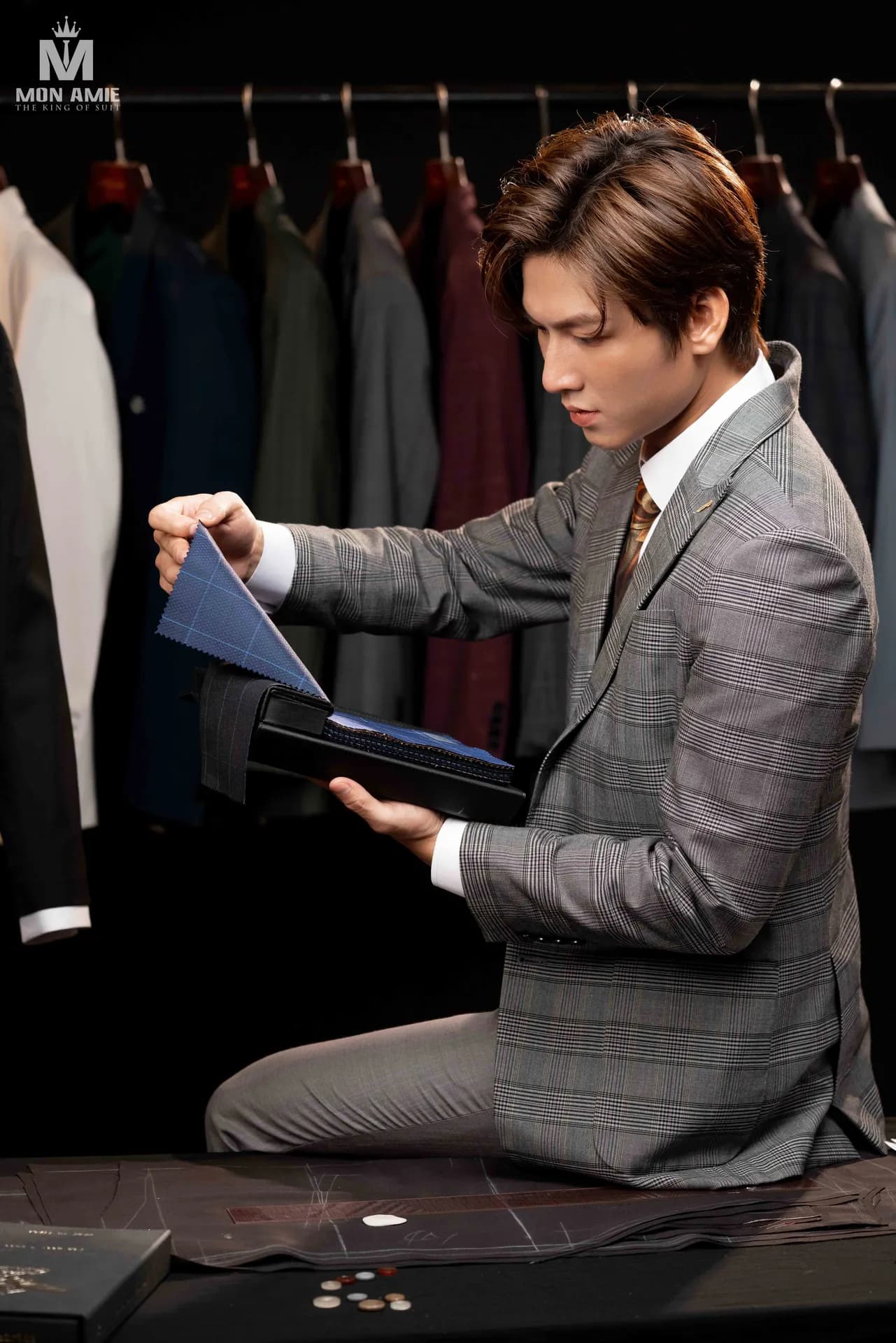
Two navy swatches lie side by side in the book, one marked Super 120s and the other Super 150s, with prices several million dong apart. To the touch, the second really is smoother. What you need to know is how much that smoothness is worth in Saigon, where you work five days a week, sit in air conditioning and rub against a chair all day.
The short answer
The Super number tells you how fine the wool fibre is: Super 100s is about 18.75 microns or finer, 120s about 17.75, 150s about 16.25. The higher the number, the smoother and softer the drape of the cloth, but it is no cooler, and it is usually less durable in daily wear. For many working days a week in Saigon, 120s to 140s is about right.
What the Super number means
Under the wool trade's labelling convention, each Super grade corresponds to a maximum fibre diameter measured in microns, thousandths of a millimetre. Each grade is about 0.5 micron finer than the one before. The finer the fibre, the softer, smoother and more fluid the cloth, but fine fibre also wears out sooner where it rubs.
With a blend, for example “50% wool Super 120s”, the Super number describes the wool part of the cloth and the rest is other fibre. In that case the wool percentage affects breathability more than the Super number does.
Chart: Super 100s, 120s, 150s and the grades around them
| Super number | Maximum fibre diameter, about | Feel in the hand | Daily wear | Suits |
|---|---|---|---|---|
| 100s | 18.75 microns | Firm, slightly dry | Durable | Heavy use, trousers worn constantly |
| 110s | 18.25 microns | Firm, a little smoother | Durable | As above |
| 120s | 17.75 microns | Moderately smooth | Fairly durable | A main suit, many working days |
| 130s | 17.25 microns | Smooth | Fair | Work, when you already have suits to rotate |
| 140s | 16.75 microns | Smooth, soft | Fair, if the wool percentage is high | Work from 3 days a week |
| 150s | 16.25 microns | Very smooth, fluid | Weaker where it rubs | Important occasions, or work when the wardrobe already has plenty to rotate |
| 180s | 14.75 microns | Soft, silky, a slight sheen | Needs careful handling | Little wear, for the feel of the cloth |
The last two columns are how the tailoring trade usually judges these grades, not a standard. At the same Super number, cloth from two different mills can still differ in durability.
Prices by grade at Mon Amie
In the Kevinlli line, the Super number comes with a wool percentage. Prices exclude 8% VAT.
| Cloth grade | Single jacket | 2-piece suit |
|---|---|---|
| Kevinlli 50% wool Super 100s, 110s | VND 4.35 million | VND 5.8 million |
| Kevinlli 50% wool Super 120s | VND 4.95 million | VND 6.6 million |
| Kevinlli 60% wool Super 120s | VND 5.6 million | VND 7.5 million |
| Kevinlli 70% wool Super 140s | VND 6.35 million | VND 8.5 million |
| Kevinlli 80% wool Super 140s | VND 8.4 million | VND 11.2 million |
| Kevinlli 90% wool Super 150s | VND 10.2 million | VND 13.6 million |
| Kevinlli 100% wool Super 150s | VND 12 million | VND 16 million |
| Vercelli (Italy), 95% wool Super 180s | VND 14.85 million | VND 19.8 million |
Read pair by pair, the table shows what the money buys. At the same 50% wool, going from Super 100s to 120s adds VND 600,000 to a single jacket for finer wool fibre. At the same Super 120s, going from 50% to 60% wool adds VND 650,000 for more wool, which means better breathability and better recovery of the cloth's shape. From 70% to 80% wool, at the same Super 140s, a single jacket adds VND 2.05 million, the biggest price step in this line, in exchange for a smoother cloth surface that suits someone with plenty of jackets to rotate. In Saigon, for the same extra spend, raising the wool percentage is usually more useful than raising the Super number.
How the Super number plays out in Saigon
| Situation | What happens with high-Super cloth | What to choose |
|---|---|---|
| Sitting in air conditioning all day | Smooth and comfortable, almost no difference in coolness | Choose by wool percentage, 60–70% |
| Sitting in a chair a lot | Seat, inner thigh and elbows wear shiny sooner | 120s–140s, and have a second pair of trousers made |
| Commuting by motorbike | You don't wear the jacket while riding, but the trousers still rub the seat | A firmer grade for trousers, a second pair to rotate |
| A few occasions a year | Little rubbing, so it lasts | 150s if you like smooth cloth |
| Business trips, folding into a suitcase | Fine, thinly woven cloth shows creases more | 110s–130s, firmly woven |
Trousers usually wear out before jackets, because they take the chair and the motorbike seat. Someone wearing a suit many days a week should plan a second pair of trousers from the start, rather than raising the Super number for the whole suit.
Three things the Super number doesn't tell you
- Weight. A length of Super 150s can be heavier than a length of Super 110s. Warmth depends more on weight, weave and lining; how to choose for coolness is in wearing a suit in summer.
- Fibre length and twist. Long, tightly twisted fibre makes durable cloth that pills less, which the Super label doesn't record.
- The mill's finishing. At the same Super number, two mills give two different cloth surfaces. Feeling a swatch, crumpling a corner and watching how the cloth recovers is still more reliable than reading a label.

How Mon Amie helps you choose
Working from 3 days a week, sitting a lot or often standing outdoors: 60% wool Super 120s or 70% wool Super 140s, a 2-piece suit at VND 7.5–8.5 million. Working 1–2 days a week: 50–60% wool, a suit at VND 5.8–7.5 million. Only wearing a suit a few occasions a year: 40–50% wool, a suit at VND 4.8–6.6 million is enough. Super 150s and Vercelli Super 180s are for those who like a smooth cloth surface and already have a few suits to rotate; don't choose them for your first work suit.
Kevinlli is in stock; some other collections are chosen from swatch books at the showroom, and full prices are on the price list. If what you need is to stay cool outdoors rather than smoothness, linen suits better than any Super number, as the comparison in men's linen suits for hot weather shows.
Frequently asked questions
Is Super 150s hotter than Super 100s?
Not because of the number. Heat comes from the weight of the cloth, the weave, the lining and the wool percentage. High-Super cloth is often woven thin and can even be lighter, but that is thanks to the weight, not the Super number.
Does high-Super cloth go shiny faster?
At points of friction such as elbows, seat and inner thighs it usually does, because fine fibre wears out sooner. Pressing directly with an iron also makes it shiny, so always use a pressing cloth, and keep a steamer a few centimetres from the cloth. Hanging the suit to rest for at least one night after each wear helps the cloth recover.
Is there Super 200s cloth, and should I have it made?
There is; the market has grades that high, with fibre so fine the cloth feels like silk. It is worth experiencing if you wear a suit a few times a year, but it doesn't suit a work suit worn daily in an office chair. Each grade higher means the cloth needs more careful handling.
What if the label says Super 120s but gives no wool percentage?
Ask. Super tells you the fineness of the wool fibre, not how much of the cloth is wool. At Mon Amie the Kevinlli line states both numbers, for example 60% wool Super 120s.
Choose by days worn, then by Super number
Super 100s, 120s and 150s are just three steps of fibre fineness; for someone working in Saigon, the wool percentage and the weight of the cloth decide more. Book an appointment to feel the swatches side by side, or look first in the fabric library.