
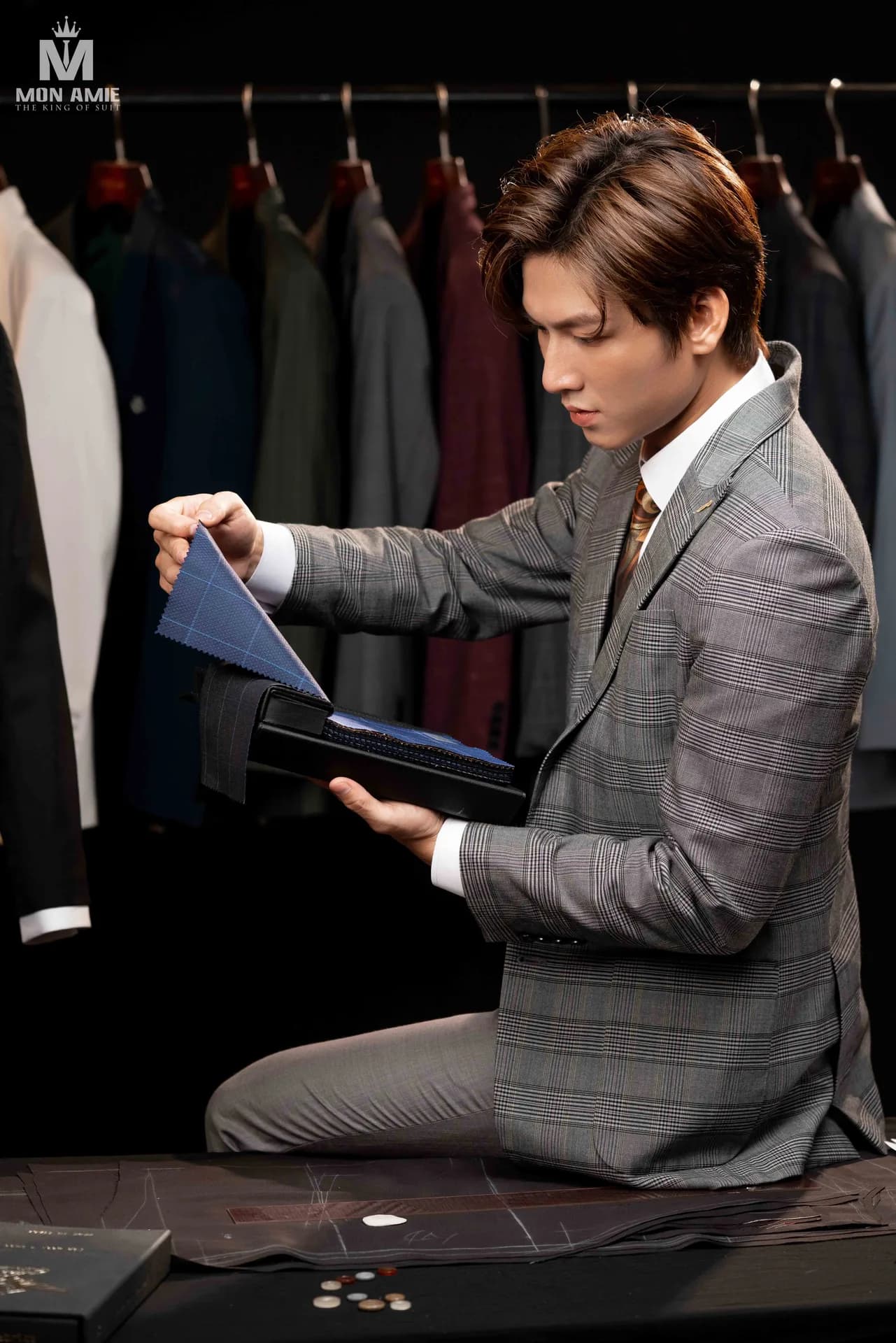
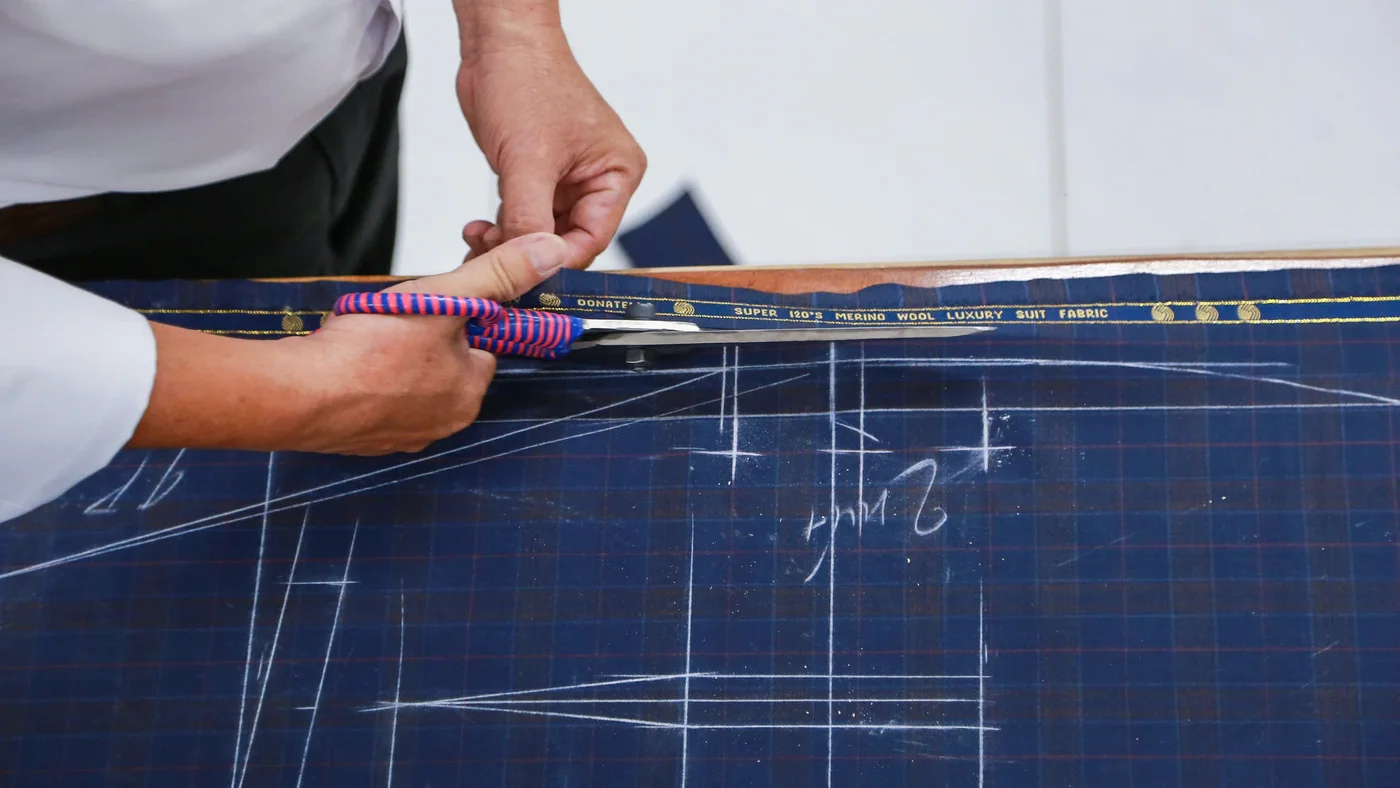
Turn up the edge of a length of suit cloth and you will find a narrow border with a line of print running along it, something like “100% Wool · Super 130’s · 270 g/m”. That is the selvedge, and almost everything you need to know about suit fabric is written in that small line. Someone who can read it avoids buying the wrong cloth; someone who cannot has no choice but to trust the seller’s word.
Quick answer
Suits are usually made from wool, pure or blended. Three figures on the selvedge are worth reading: the fibre content (how much of it is wool), the Super number from 100s to 150s (how fine the wool fibre is) and the weight in grams per metre (how heavy the cloth is). Add to that the mill’s name, which tells you where the cloth comes from.
What fabric is a suit made of?
“What fabric is a suit made of” has a short answer: mostly wool. But wool comes in several forms.
- Worsted wool: long fibres, combed smooth and woven into a flat, fine surface. This is the cloth of most office suits.
- Woollen and flannel: shorter fibres, with a soft, slightly fuzzy surface, and warm. Suited to cold-season suits.
- Blended wool: wool mixed with polyester, silk, mohair, cashmere or linen to change durability, sheen or breathability.
- Linen and cotton: not wool, but used for hot-season suits with a relaxed silhouette.
If you want a full picture of the fabrics, the article fabrics used for making suits lists each type.
Reading the selvedge and the label
The selvedge of cloth from a reputable mill usually prints the following information, though the order may vary:
| Information | Example | Meaning |
|---|---|---|
| Mill name | Vitale Barberis Canonico | Where the cloth comes from |
| Composition | 100% Pure Virgin Wool | The proportion of each fibre |
| Fineness | Super 130’s | How fine the wool fibre is |
| Weight | 270 g/m | How heavy the cloth is |
| Cloth code | A string of digits, a colour code | For lookup and reordering |
(The example line is only there to show how to read it; it is not a specific cloth code.)
If the selvedge says only “Super 150’s” with no composition, mill name or weight, be wary, because cloth of clear provenance usually states everything.
Fibre content: how much wool is enough?
The proportion of wool determines how the cloth feels to wear, how it drapes and how long it lasts.
| Composition | Characteristics | Suited to |
|---|---|---|
| 100% wool | Drapes beautifully, breathable, holds its shape well, higher price | Office suits, major occasions |
| 70–80% wool blended with polyester | Durable, resists creasing, friendly price, less breathable | Everyday suits, uniforms |
| Wool-silk blend | Smooth, with a faint sheen, soft | Party suits, wedding suits |
| Wool-mohair blend | Crisp hand, breathable, resists creasing | Summer suits, business travel |
| Wool-cashmere blend | Soft, warm, luxurious | Cold-season suits, blazers |
| Wool-linen blend | Breathable, creases naturally | Summer suits, a relaxed silhouette |
Mon Amie divides its cloth lines clearly by composition and mill. The Essential line uses Kevinlli cloth with 40–70% wool (100s–140s). The Signature line uses Kevinlli with 80–100% wool at 140s–150s, together with Dolce & Taylor, Luciano, Salford and Vercelli. The Heritage line uses cloth from Canonico, Holland Sherry, Dormeuil and Scabal, mills from Italy and England. You can see each line in detail in the made-to-measure price list.

What do Super 100s–150s mean?
The “Super” number tells you how fine the wool fibre is. The higher the number, the finer the fibre, and the softer, smoother and slightly more lustrous the cloth. But a high number does not mean durable.
- Super 100s–120s: a sturdy, durable fibre that resists creasing, suited to everyday suits.
- Super 130s–140s: softer, looks lovely worn, and is still durable enough for frequent use if cared for properly.
- Super 150s and above: very fine, light and lustrous but thin, prone to creasing and to wearing through if worn constantly. Suited to special occasions or alternating with other suits.
In other words, cloth for everyday wear should balance softness with durability. Choosing a very high Super for a suit worn every day is wasteful, because the cloth will wear out faster than a moderate Super.
Grams per metre: heavy or light cloth?
Tailors usually express thickness in grams per running metre, on a cloth width of about 150 cm. The reference points commonly used in the trade:
| Group | Weight (approx.) | Suited to season | Feel |
|---|---|---|---|
| Light | Under 250 g/m | Hot season, tropical | Airy, light, creases more easily |
| Medium | 250–300 g/m | All year round | Balanced, easy to wear |
| Heavy | Over 300 g/m | Cold season | Warm, heavy drape, firm structure |
For Ho Chi Minh City’s climate, medium or light cloth is usually the most comfortable choice. Heavy cloth suits those who often travel to cold places or who want a suit with a structured, upright silhouette.
The mill: where suit fabric is born
The mill’s name on the selvedge is like the appellation on a bottle of wine. Long-established mills in Italy and England such as Vitale Barberis Canonico, Loro Piana, Zegna, Holland Sherry, Dormeuil and Scabal are known for consistent cloth that is even from one roll to the next. You do not need to remember them all; just know that a selvedge carrying a clear mill name is good information. At Mon Amie, the fabric library includes Canonico, Vercelli and other Italian and English mills for you to choose from in person at the fabric library.
Signs of fake or low-quality cloth
- A vague label. It says only “wool” or “Super 150s” with no percentage, mill or weight.
- An unusual price. Cloth marked with a high Super but priced far below the market usually has a reason.
- It feels dry or plasticky in the hand. Real wool is soft and slightly warm to the touch, while cloth with a lot of polyester is often slick and cool.
- The crush test. Squeeze a corner of the cloth tightly for a few seconds, then let go. Good wool releases its creases by itself; poor cloth holds them.
- Smell. Real wool has a faint smell like animal hair. A strong chemical smell is a bad sign.
A tip from Mon Amie’s master tailors
Do not choose cloth by numbers or price alone. Choose according to how you wear it: whether you wear it to work every day or only on major occasions, whether you sit a lot or stand a lot, whether the weather where you live is hot or cold. A Super 120s suit that you wear comfortably all year is far better than a Super 150s suit worn three times and put away. When choosing cloth, touch the swatch, let it drape over your hand and ask the master tailor. Mon Amie’s bespoke tailoring service lets you choose from a fabric library of Italian and English cloth, with one-to-one advice.
Frequently asked questions
What fabric is a suit made of?
A suit is usually made from wool, pure or blended. Worsted wool is used for office suits, woollen and flannel for the cold season, and linen and cotton for the hot season. When choosing cloth, look at the composition, the Super fineness and the weight.
Which suit fabric is the most durable for men?
100% wool, or wool with a little polyester at Super 100s–130s, is usually the most durable for everyday wear. A very high Super is softer but wears through more easily. Choose according to how often you wear it.
Does suit fabric have to be wool?
No, but wool is the traditional material because it drapes beautifully, breathes and holds its shape. Summer suits can use linen or cotton, but they crease more.
How can I tell high-quality suit fabric?
Read the selvedge for the fibre content, Super, weight and mill name. Feel the cloth to see whether it is soft, warm to the hand and releases its creases when you squeeze it. And compare the price with the market: an unusually low price is a warning.
Closing thoughts
Knowing how to read the small print on the selvedge is the first step to choosing the right suit fabric and not paying for something you do not need. You can continue with the article premium wool, micron and Super for a deeper understanding, or visit a showroom to choose cloth in person with a master tailor.