

Opening a cloth swatch book for the first time, most customers stall on the third page. Pages one and two are easy: navy, grey, black. By page three come stripes, checks, herringbone, and unfamiliar names like glen check or birdseye. And the question comes up: which swatch is actually a good-looking men's suit fabric? There is no single answer, because “good-looking” also depends on the occasion, your age and the climate. The twelve swatches below are a short map so you can narrow things down before you touch real cloth.
Quick answer
A good men's suit fabric is wool that is fine enough, holds its shape, and has a colour and pattern that suit the occasion. The three easiest to wear are plain navy, plain charcoal and melange grey. Patterns such as pinstripe, glen check and herringbone are for those who already own one or two foundation suits. Choose by occasion and climate first, personal taste second.
12 men's suit fabrics by occasion and age
| # | Fabric | Suited to | Suited age | Notes |
|---|---|---|---|---|
| 1 | Plain navy | Work, interviews, weddings | Any age | The first foundation suit to own |
| 2 | Plain charcoal | Meetings, business partners, evening events | 28 and over | Subdued, shows little age |
| 3 | Melange grey | Everyday work | 25–45 | Blended colour, soft on the eye, less stiff |
| 4 | Pinstripe | Formal occasions, leadership | 30 and over | A fine stripe lengthens the figure |
| 5 | Glen check | Events, blazers | 30 and over | Classic pattern, takes confidence |
| 6 | Herringbone | Autumn–winter, work | 30–55 | Discreet texture, refined |
| 7 | Birdseye | Work, easy to coordinate | 25–50 | Tiny dots visible only up close |
| 8 | Windowpane check | Weekend blazers, events | 28–50 | Large squares, easy to stand out |
| 9 | Lightweight tropical wool | Work all year round in Saigon | Any age | Breathable, resists creasing |
| 10 | Linen or wool-linen blend | Outdoor events, the beach | 25–45 | Cool, wrinkles well if you know how to wear it |
| 11 | Flannel | Cold season, indoor evening events | 28 and over | Brushed surface, warm, soft |
| 12 | Velvet and earth tones (brown, moss green) | Evening blazers, weekends | 25–45 | Has personality, better as a second suit |
The table is there to orient you, not to lay down rules. The one that suits you most is still the one that feels comfortable when you put it on.
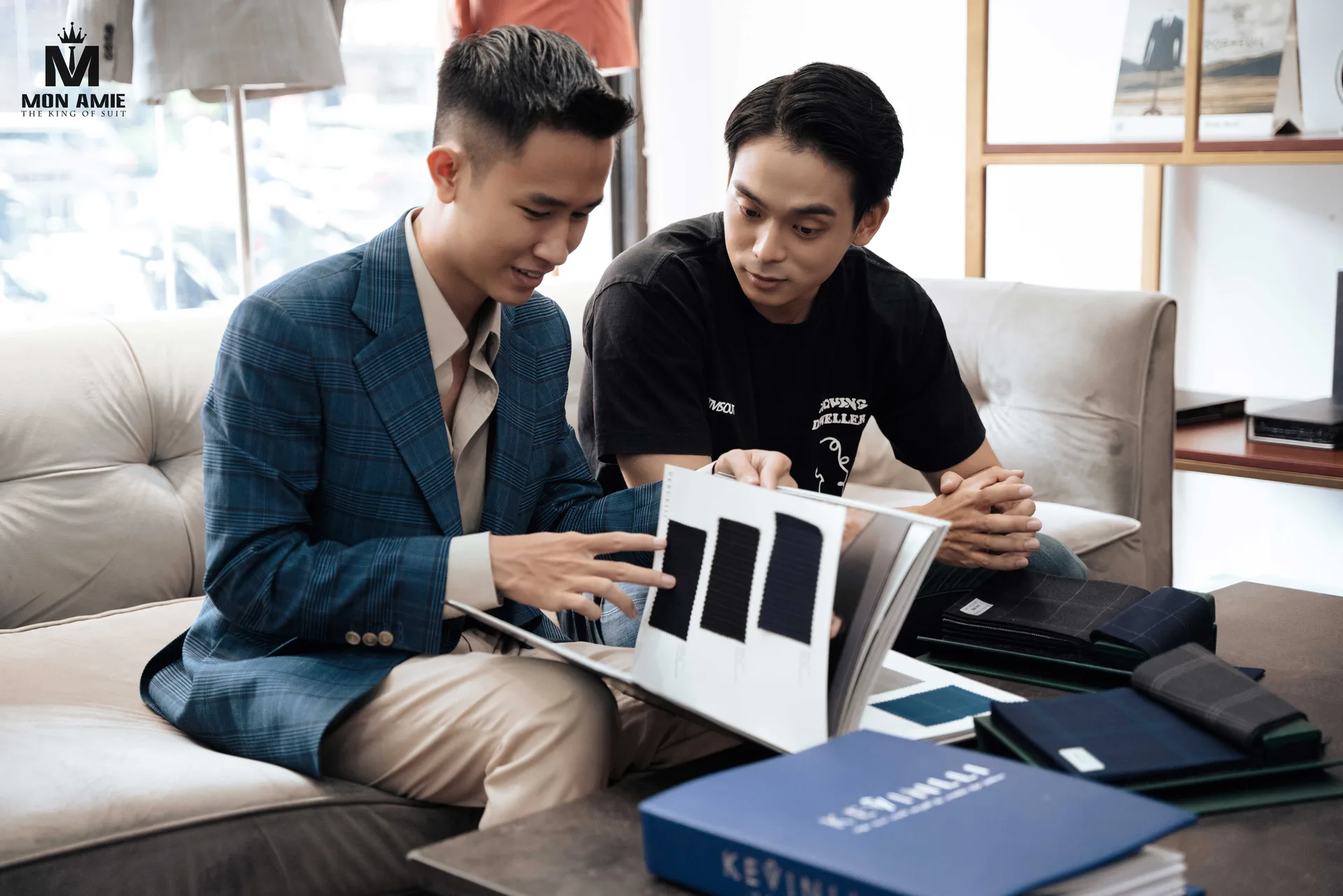
Three foundation fabrics: start here
Plain navy
Navy blue plays the role of the “white shirt” in the world of suits: it suits every skin tone, and goes with a white or light blue shirt and with a burgundy or deep blue tie, all without trouble. A navy suit in a lightweight wool twill can be worn to work, to weddings, to interviews and to parties.
Plain charcoal
Charcoal is a notch more subdued than navy, and suits occasions that call for seriousness: board meetings, meeting business partners, evening events. The colour shows little age and goes with many kinds of tie.
Melange grey
Grey blended from several yarns, it looks softer and has more depth than plain grey. It suits people who want a polished look without stiffness. For office workers, it is often the suit worn most in the week.
Patterned fabrics: choose later, choose deliberately
Pinstripe, glen check, herringbone
These three give a suit its “educated” look. Pinstripe creates a vertical axis, helping the figure look slimmer. Glen check (also called Prince of Wales) gives a classic English look. Herringbone gives a discreet texture and is usually used when the weather is cool. For all three, start with small or medium pattern sizes, because large patterns need build and confidence.
Birdseye and windowpane
Birdseye is a field of tiny dots that you only see up close; from a distance it looks like plain cloth, which suits people who want a little difference without showing off. Windowpane is a medium-large check, which suits a weekend blazer.

Seasonal fabrics: for the Saigon climate
- Lightweight tropical wool: an open weave that resists creasing, suited to work all year round.
- Linen or wool-linen blend: the coolest for a sunny day, suited to outdoor events. Linen's natural crease is a characteristic, not a flaw.
- Flannel: only for the cold, or in a strongly air-conditioned room.
- Velvet and earth tones: for evening blazers, the festive season, year end.
Choosing men's suit fabric by age
The same fabric can make a person look younger or older depending on how it is used. Three short suggestions:
- From 20 to 30: choose navy, melange grey, lightweight tropical wool. Light-coloured cloth and linen suit sunny days. Avoid swatches that are too dark or too shiny, which make the face look heavy.
- From 30 to 45: add pinstripe, birdseye, small glen check, charcoal. This is the age when fine cloth starts to “speak” alongside the wearer's role.
- From 45 upward: favour wool with good drape and smoothness, in muted colours such as charcoal, deep navy, herringbone. At this age, fine cloth lies in touch and durability more than in pattern.
How to read “good cloth” in a tailor's hands
A good swatch is not just about colour. The four specifications below decide quality when worn:
- Composition. The more wool, the more breathable the cloth, the better it holds its shape and drapes. Mon Amie's Essential line uses Kevinlli with 40–70% wool; the Signature line 80–100% wool.
- Yarn fineness (Super 100s, 120s, 150s). The higher the number, the finer the yarn, the softer and smoother the cloth, but it also creases more easily and is less durable for daily wear. The Essential line uses 100s–140s cloth, the Signature line 140s–150s.
- Weight. Light cloth is cooler but creases easily; heavy cloth holds its shape better but is hot. Choose according to where you will wear it.
- Weave. Twill is firm and resists creasing; plain weave is thin and light; hopsack is breathable; flannel is warm.
The article types of suit fabric covers each group of cloth in more detail. You can feel the material up close in the Mon Amie cloth library, which holds cloth from Kevinlli, Canonico, Vercelli and many other Italian and British mills.
Common mistakes and tips from Mon Amie's master tailors
- Choosing cloth from online photos. Colour and sheen on a screen differ from real life. Look at real cloth in daylight.
- Choosing very fine yarn for a daily suit. Fine cloth is precious but wears out when worn continuously; a suit for everyday work should use a moderate fineness, which lasts longer.
- Choosing a large pattern for your first suit. Large patterns are hard to coordinate and are quickly recognised when you wear the suit again.
- Forgetting the climate. A beautiful cloth that is hot can only be worn half the year.
- A tip from the master tailor: hold the swatch in your hand for at least a minute. Good cloth has drape and recovery: squeeze it and let go, and the creases gradually fade.
Frequently asked questions
What is a good suit fabric?
Wool with a high wool content and a moderate fineness, which holds its shape and suits the climate. Navy, charcoal and melange grey are the three easiest to wear and the hardest to go out of fashion.
Which pattern should a good men's suit fabric have?
For your first suit, choose plain or pinstripe. Only for the second suit think about glen check, herringbone or windowpane.
Is fine wool expensive?
Not necessarily. Price depends on the mill and the yarn fineness: the Essential line is from VND 4.8 to 10 million for a full suit, the Signature line VND 10 – 20 million, and the Heritage line over VND 20 million. You choose according to your needs, and you do not need the most expensive one.
Which suit fabric suits wearing in Ho Chi Minh City?
Lightweight tropical wool, wool-linen blends or breathable weaves, in neutral colours such as navy, grey and beige. You can look further at the price list to choose a suitable line.
Closing thoughts
A good fabric is one that suits the occasion, the person and the climate. If you would rather choose by hand than by eye, book a fitting or try colour and cloth combinations at home with the online suit design tool.