
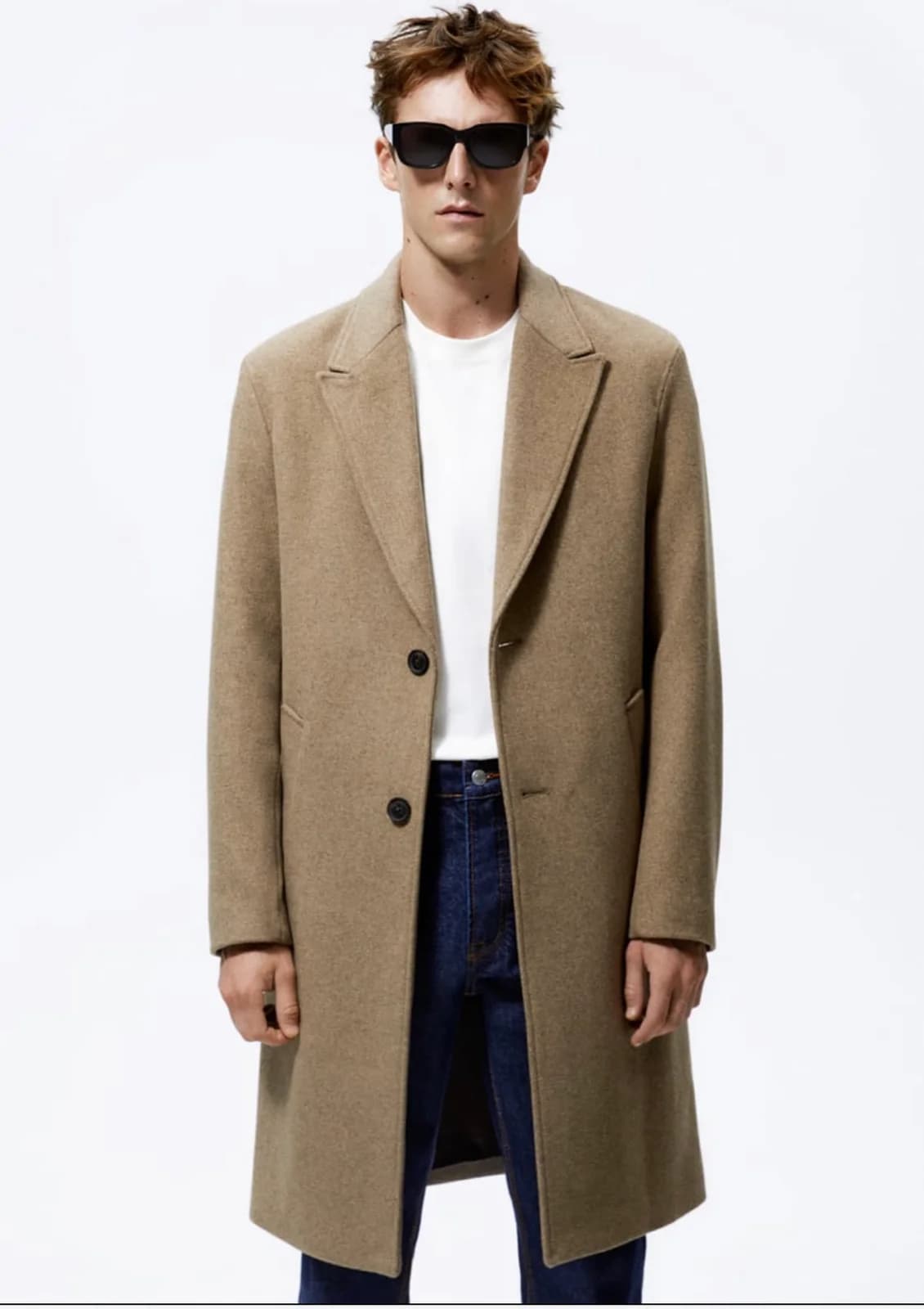
You turn the jacket over and read the small print on the inner label: 70% wool, 30% polyester. Should you be pleased or worried? The answer lies not in whether the cloth is blended but in the blend ratio. Wool polyester blend fabric is the cloth behind a great many suits worn to work every day: blended well, it outlasts pure wool; blended badly, it runs hot, turns shiny and quickly loses its shape.
Quick answer
Wool polyester blend fabric is more durable and creases less than pure wool, but it is warmer and prone to shine when pressed. A 70/30 ratio (70% wool) is the most balanced for a suit worn to work every day; 100% wool breathes and drapes most beautifully; 50/50 only suits heavily worn uniforms on a tight budget. For a premium suit, avoid anything under 40% wool.
What wool and polyester each give you
The two fibres complement each other, which is why they are blended.
| Fibre | Strengths | Weaknesses |
|---|---|---|
| Wool (sheep's wool) | Breathable, regulates temperature, absorbs moisture, soft, drapes well, creases fall out on their own | Higher price, needs care, prone to moths if stored badly |
| Polyester | Durable, resists creasing, holds colour, holds a pressed crease, low price | Hot and stuffy, poor moisture absorption, shines easily under a hot iron, builds static and pills |
One detail many people overlook: the “s” number, such as 100s, 120s or 150s, indicates the fineness of the wool fibre. The higher the number, the finer the fibre and the softer the cloth, but also the thinner it is and the more sensitive to friction. So a high-“s” wool is not necessarily more durable than a lower-“s” one.
That is why a master tailor's advice always begins with a question in return: where will you wear this suit, and how many times a week? A 70/30 suit worn for the right job will please you more than a pure wool suit worn at the wrong rhythm, because pure wool worn continuously with no rest days also loses its shape quickly.
Comparing 100% wool, 70/30 and 50/50
| Criterion | 100% wool | 70% wool / 30% poly | 50% wool / 50% poly |
|---|---|---|---|
| Breathability | Excellent | Good | Average, a little stuffy |
| Creasing | Light creasing, recovers on its own | Little creasing | Very little creasing |
| Shine from pressing | Little, if pressed correctly | Can shine if pressed hot | Shines easily, especially at the shoulders and elbows |
| Durability | Good, but needs rotation | Very good | Very good, little wear |
| Pilling | Little | Little to moderate | Pills more easily |
| Price | High | Moderate | Low |
| Care | Needs hanging and rest between wears | Easier to care for | Easiest |
In Mon Amie's cloth collections, the Essential line uses Kevinlli at 40–70% wool, while the Signature line steps up to Kevinlli at 80–100% wool alongside mills such as Dolce & Taylor, Luciano, Salford and Vercelli. The Heritage line uses Canonico, Holland Sherry, Dormeuil and Scabal. In other words, a blend is not a bad thing: it is a rung on the price ladder, and you should choose the right rung for your needs.
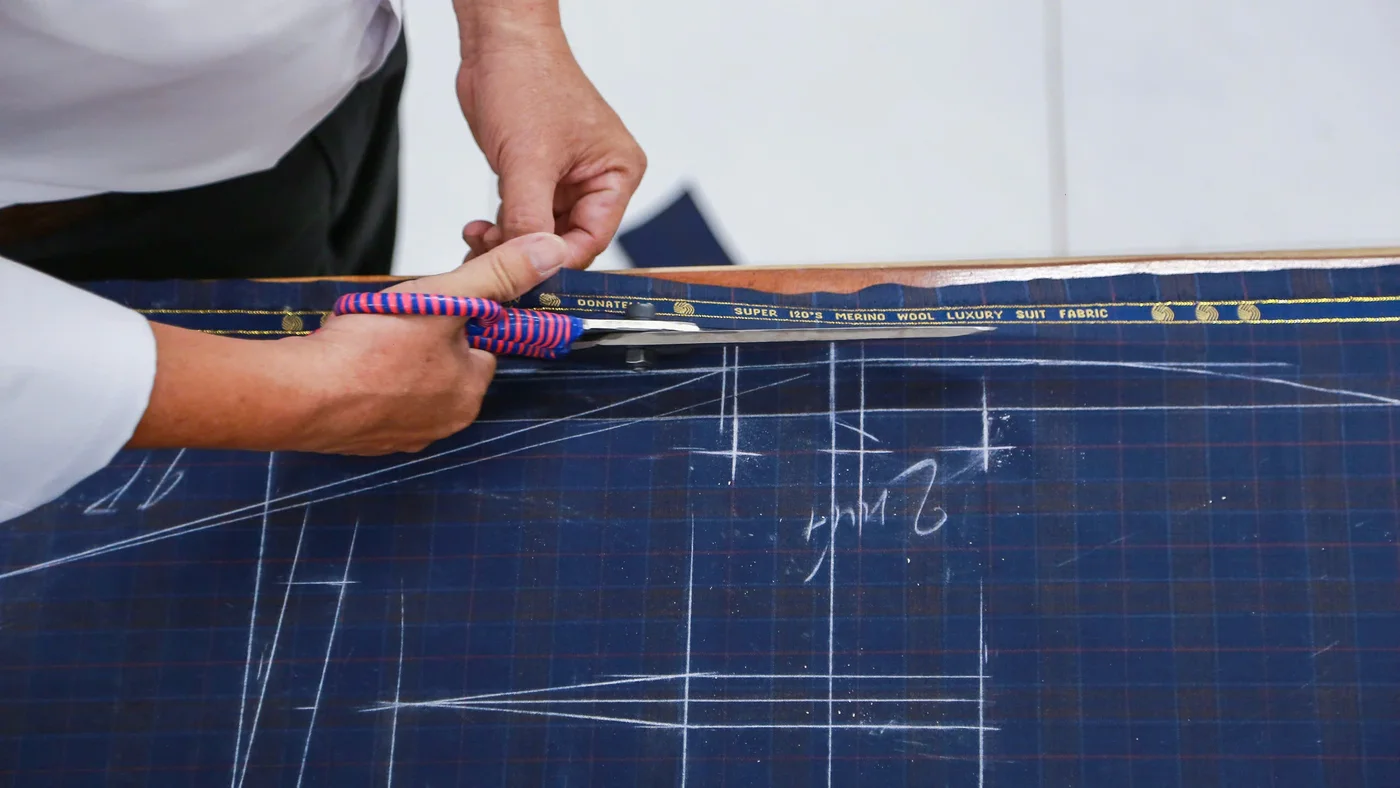
Choosing a blend ratio by how often you wear it
The most practical way to choose is to count how often you wear the suit.
- Wearing it 1–2 times a week, for important occasions: 100% wool or 80/20. You get the beautiful drape and the breathability. Store the suit properly and it will last a very long time.
- Wearing it 3–5 times a week: 70/30 is the sweet spot. Have two suits in rotation so the cloth can rest.
- Wearing it every day in the office, with little chance to look after it: 70/30 or 65/35; do not force pure wool.
- Uniforms for a team of staff: a 50/50 or 65/35 blend because it is easy to care for and durable, but choose a tightly woven cloth so it does not shine.
- Weddings and major events: pure wool or a low polyester share, because the sheen and drape will look more beautiful in photographs.
How to recognise a blend when choosing cloth
You do not need a laboratory; four steps at the cloth counter are enough:
- Read the composition label. The label must state the % of wool; do not trust words like “premium wool” with no number.
- Crush the cloth tightly in your hand for 5 seconds, then release. Wool wrinkles and then gradually recovers; cloth with a lot of poly barely wrinkles, and if it wrinkles and never recovers, it is cheap cloth.
- Look at the surface under the light. Poly has an even, plastic-like shine; wool has fine fibres and a matt glow.
- Feel it. Wool feels warm with a slight, fine grip; poly feels cool and slick.
The master tailor at the showroom can explain each sample in the Mon Amie cloth library in more detail, and you can touch each cloth in person.

When blending with polyester is good, and when it is a trap
Blending a small share, 5–10%, of polyester or nylon into fine wool is how mills add durability to a fine yarn without losing drape. That is a deliberate blend. Cloth with under 40% wool that is still called “wool” is the trap, because it wears almost like pure polyester: hot, stuffy and shiny.
One sign of a poor blend: a suit that has been worn for only a few months already shines at the elbows, shoulders and seat, and quickly pills in the areas of friction.
Caring for wool-polyester blend cloth so it does not shine
Polyester blends crease little but are sensitive to heat. Press with a steam iron at a moderate temperature, always place a damp cloth over the fabric and press from the wrong side. Never press directly on the face of the cloth at high heat, because the polyester fibres will be pressed into a shine that cannot be reversed. For details, see the article how to press a suit without shine at the shoulders.
Hang the jacket on a wide-shouldered hanger and let the cloth rest at least one day between wears. Any suit, polyester blend included, lasts longer when it is allowed to rest.
Mistakes when choosing blended cloth
- Choosing on price alone. The cloth with the lowest price on the list usually has the most poly, and loses its shape the soonest.
- Wanting “no creases” so badly that you forget breathability. Cloth so crease-resistant that it never springs back is also very stuffy.
- Ignoring weight. Summer cloth is typically about 220–260 g/m, four-season cloth about 270–300 g/m. Too light and the cloth is thin and crumples; too heavy and it is hot.
- Confusing “wool-like” with “wool blend”. A label saying “wool-like” means there is almost no wool at all.
Frequently asked questions
Is wool-polyester blend fabric good?
Yes, if the ratio is sensible. A 70/30 blend gives more durability and less creasing than pure wool while still breathing well enough. The more polyester in the ratio, the hotter the cloth and the more easily it shines.
Which blend ratio should I choose for suit cloth?
For a business suit worn often, 70/30 is the balanced choice. For a suit worn rarely or for important occasions, choose 100% wool or a blend with little polyester.
Is a wool-poly blend hot to wear?
Yes, it is warmer than pure wool because polyester breathes less well. In a hot, humid climate, choose a lightweight wool at 70–100% wool, or an open weave such as tropical.
Can wool-polyester blend fabric be machine washed?
Not for a suit jacket. The interlining and lining inside can shrink and ruin the shape. Only dry clean it or have it professionally steamed.
Is 100% wool always more expensive than a blend?
Usually, but the price also depends on the yarn count and the mill. Low-quality pure wool can be inferior to a good-quality blend.
Choosing your cloth once you know what you need
Once you know how many times a week you will wear it and in what climate, choosing cloth becomes much easier. Mon Amie groups its cloth into three lines, and the price of a full jacket-and-trouser suit is on the price list. To read further, see is wool fabric good and what is wool blend fabric. Visit a showroom to touch each sample before you decide.