
The fabric seller at the market holds up a bolt and strokes it lightly: “Korean wool, sir. So soft, it makes a lovely suit.” You ask: “What percentage wool is it, ma'am?” The answer is usually a smile and two words: “It's wool.” If you are wondering what Korean wool fabric is and whether it is worth making a suit from, the shortest answer is this: the name tells you where the cloth comes from, not what it is woven from.
The short answer
“Korean wool” is not the name of a standard fibre but a trade term used at fabric markets, usually meaning wool or wool-look cloth of Korean origin. The real composition can be a wool blend with a lot of polyester. Whether it is suitable for a suit depends on the wool percentage on the label, not on the word “Korean”.
What do “Korean wool” and “Japanese wool” really mean?
At fabric markets and on online fabric shops, you will come across names such as Korean wool, Korean woollen cloth, Japanese wool and Japanese woollen cloth. What they have in common is that they refer to origin or source of import, not to composition. Two bolts both sold under the name “Korean wool” may be:
- A wool-polyester blend with a fairly low wool percentage;
- Wool blended with viscose or nylon to be softer and crease less;
- Or sometimes almost entirely polyester but with a wool-like surface.
Origin only indicates where the cloth was woven or imported; it does not guarantee quality and says even less about composition. More reliable is the composition label printed on the selvedge or the supplier's document. The same goes for Japanese cloth: the Japanese textile industry is famous for refined technique, but the word “Japanese” on a market price board does not automatically mean that bolt is premium goods.
Four quick checks before you buy
To answer for certain what Korean wool fabric is, you don't need a laboratory. The four steps below can be done right in front of the bolt.
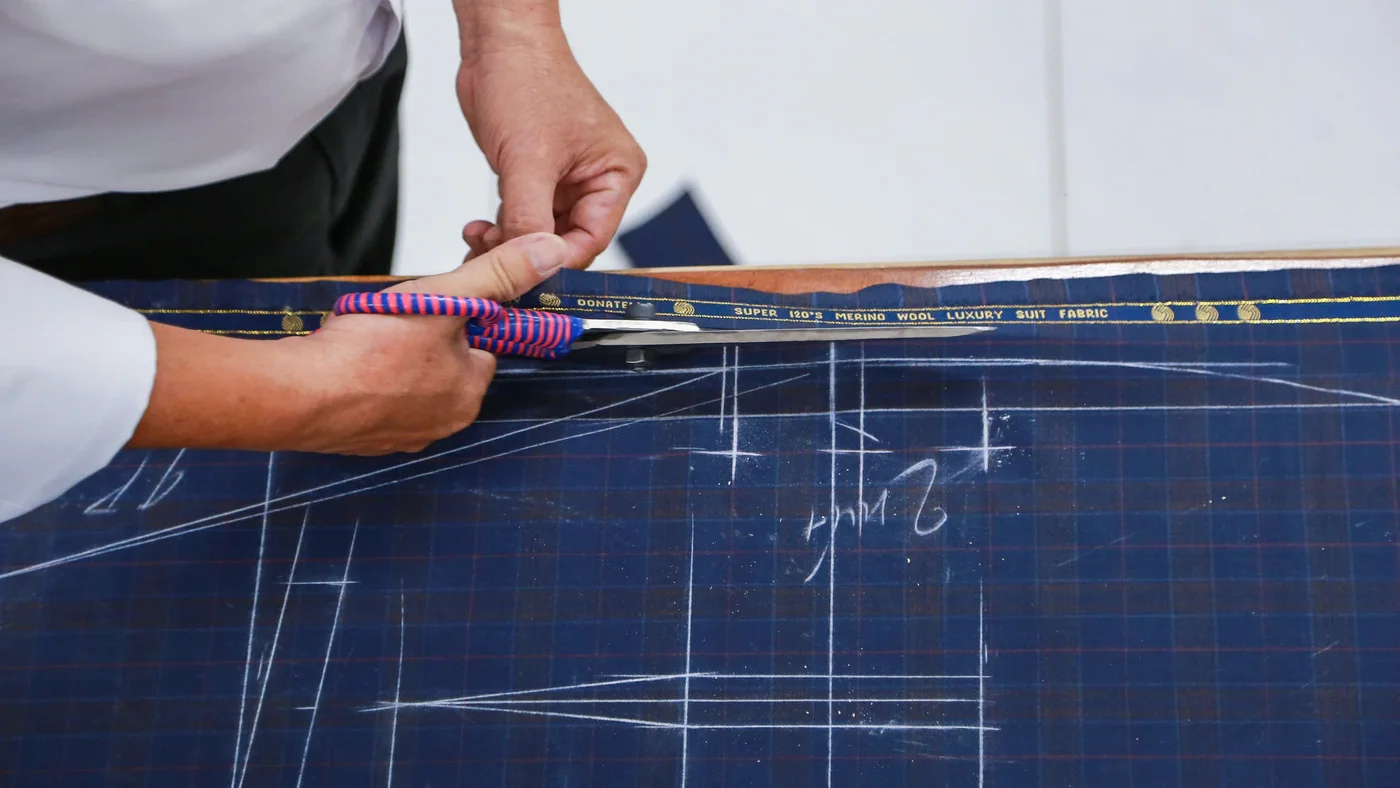
- Read the composition label. Ask directly: what percentage wool, what percentage polyester, and what is the rest. A seller with a label will answer at once. If all you hear is “Korean wool” with no figure, stop.
- Touch and look. Real wool is usually soft, slightly springy and warm to the touch, with tiny fibres on the surface lying slightly irregular. Polyester is usually smooth, cool and even, with a slightly “plastic” sheen under the light.
- Try burning a few threads. Pull a few threads from the edge of the fabric and burn them somewhere safe. Wool burns slowly, smells like burnt hair, and leaves a black ash that crumbles easily. Polyester melts and forms hard beads, with an acrid smell. Note: with a blend, this test only tells you whether there is any wool, not the proportion.
- Try it on. Put it on, sit down, stand up and look at the creases at the elbows, knees and belly area. Also ask: after two years of dry cleaning, does the surface pill or turn shiny?
If you would like to go deeper, the article Suit fabric: reading composition, Super numbers and gram weight on the selvedge explains each figure on the label.
“Korean wool” compared with labelled wool blends
The table below doesn't say Korean cloth is bad or good; it only compares three groups by how transparent they are about composition. The Mon Amie made-to-measure lines are taken from the price list for a full suit (jacket and trousers).
| Criterion | Cloth sold under the name “Korean wool” (composition unclear) | Clearly labelled wool blend, e.g. the Essential line | Wool 80–100%, e.g. the Signature line |
|---|---|---|---|
| Composition | May vary from bolt to bolt | Clearly stated: Kevinlli cloth, 40–70% wool, fineness 100s–140s | Clearly stated: Kevinlli 80–100% wool 140s–150s, Dolce & Taylor, Luciano, Salford, Vercelli |
| Breathability | Usually poorer if there is a lot of polyester | Fairly good, easy for everyday wear | Better, suited to a hot, humid climate |
| Shape retention | Depends heavily on the interlining and the tailoring | Holds its shape well with good interlining | Holds its shape and drapes well |
| Made-to-measure price for a full suit | Hard to estimate because the cloth isn't uniform | VND 4.8 – 10 million | VND 10 – 20 million |
Beyond these two lines, the Heritage line uses Canonico, Holland Sherry, Dormeuil and Scabal cloths, priced above VND 20 million and up to VND 60 million per suit.
Should you use Korean wool for a suit?
Our answer: it depends on the circumstances in which you plan to wear that suit.
- Worth considering when you need a suit for only a few wears, such as events or yearbook photo shoots, or you want to try an unusual style before a large investment, and the cloth has a clear label.
- Best avoided when you wear it weekly in Saigon, sit through long meetings during the day, or attend outdoor weddings. Cloth with a lot of polyester tends to trap heat and build static, and after a few seasons of dry cleaning it often turns shiny or pills.
- Not advisable: buying market cloth only because the price looks low and bringing it to a tailor without checking the composition. In that case the cloth and the workmanship are not of the same standard, and you pay tailoring fees for a material that doesn't deserve them.
If you are considering buying the cloth yourself, also read Where to buy suit fabric? Buy it yourself or choose at the tailor before you decide.
Common mistakes when buying “Korean wool” cloth
- Trusting the word “wool” without asking the percentage. “Wool” on a signboard may just be a name for a wool-like surface.
- Feeling the cloth only at the corner of the bolt. A bolt can feel soft but behave differently once sewn and worn; ask for a sample or try on a ready-made suit in the same cloth.
- Comparing price per metre and forgetting the tailoring fee. A suit takes the same labour whatever the cloth is; investing in good cloth is usually worth more.
- Forgetting the lining and the interlining. However good the cloth, if the lining is hot and the interlining is poor, the jacket is still uncomfortable to wear.
Tips from Mon Amie's master tailors
Hold two swatches, one you believe is good and one you suspect, and press them against your cheek or the inside of your wrist. Real wool usually feels warm and “breathes”, while polyester usually feels cool and then gradually stuffy. Then crush the cloth lightly in your palm for a few seconds: good wool recovers its creases considerably, while poor cloth leaves stiff creases. It isn't a scientific test, but it is enough to narrow your options in a few minutes.

Frequently asked questions
Is Korean wool fabric any good?
You can't conclude from the name alone. Korea has both mid-range wool blends and polyester cloth imitating wool. The only way is to read the composition and try the cloth on, then compare it with your intended use.
How do Japanese wool and Japanese woollen cloth differ from Korean wool?
In terms of naming, both only indicate origin. Japanese cloth is famous for its refined weaving technique, but the market still has every segment. Don't equate “Japanese” with “premium”; check the label and the wool percentage as you would with any other cloth.
Why is Korean wool usually cheaper than Italian wool blends?
Usually because of a higher polyester percentage, less fine yarn, and a simpler weaving and finishing process. A low price isn't bad if the composition is clear and you use the cloth for the right purpose; just don't expect the breathability and durability of real wool.
Does Korean wool crease?
It depends on the composition: cloth with a lot of polyester creases less, but its fold lines tend to set stubbornly, while cloth with more wool recovers more naturally. Try it on and sit for a while to find out.
Closing thoughts
What is Korean wool fabric? Only a name; the composition is the substance. Before choosing cloth for a suit, ask for the percentage, touch it for real and try it on. If you would like to place two kinds side by side and feel the difference yourself, view real swatches in Mon Amie's fabric library or visit a showroom so a stylist can show you how to read each type.