
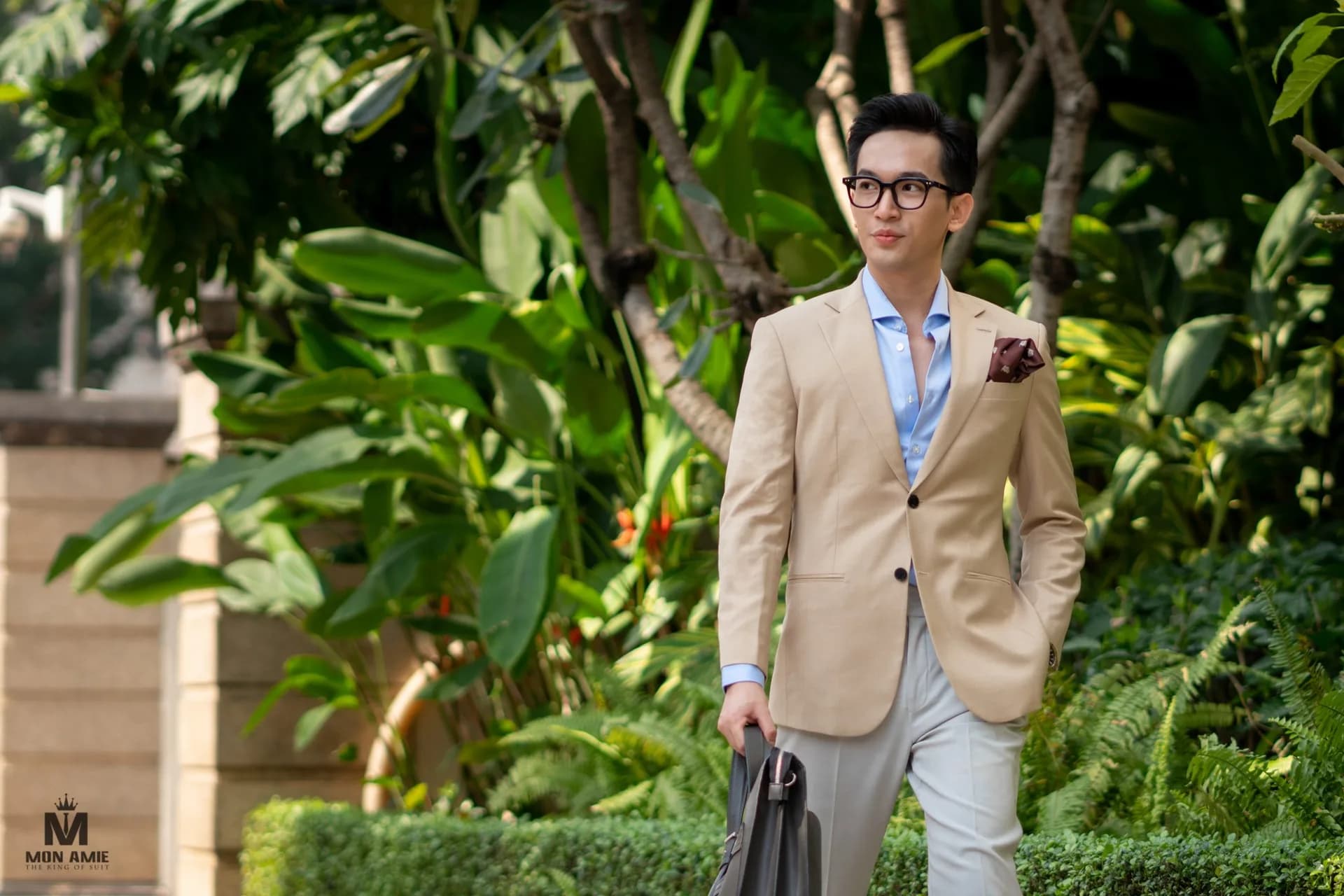
Almost everyone has worn khaki trousers, but how many people dare try a khaki jacket? Questions about khaki fabric for suits usually come from those who are tired of heavy wool suits in a hot, humid climate. The answer is that it can be done, but khaki is not just a “scaled-down wool”: it has a character of its own that you need to know before you decide.
The short answer
A khaki or cotton suit looks better than a wool suit on relaxed occasions such as a café, travel or an outdoor party, because it is cool and light. In return, cotton creases more, fades over time and holds its shape less well than wool. Choose a firmly woven khaki in beige, olive or light blue, and let the master tailor build the jacket with enough structure to hold its cut.
What is khaki fabric?
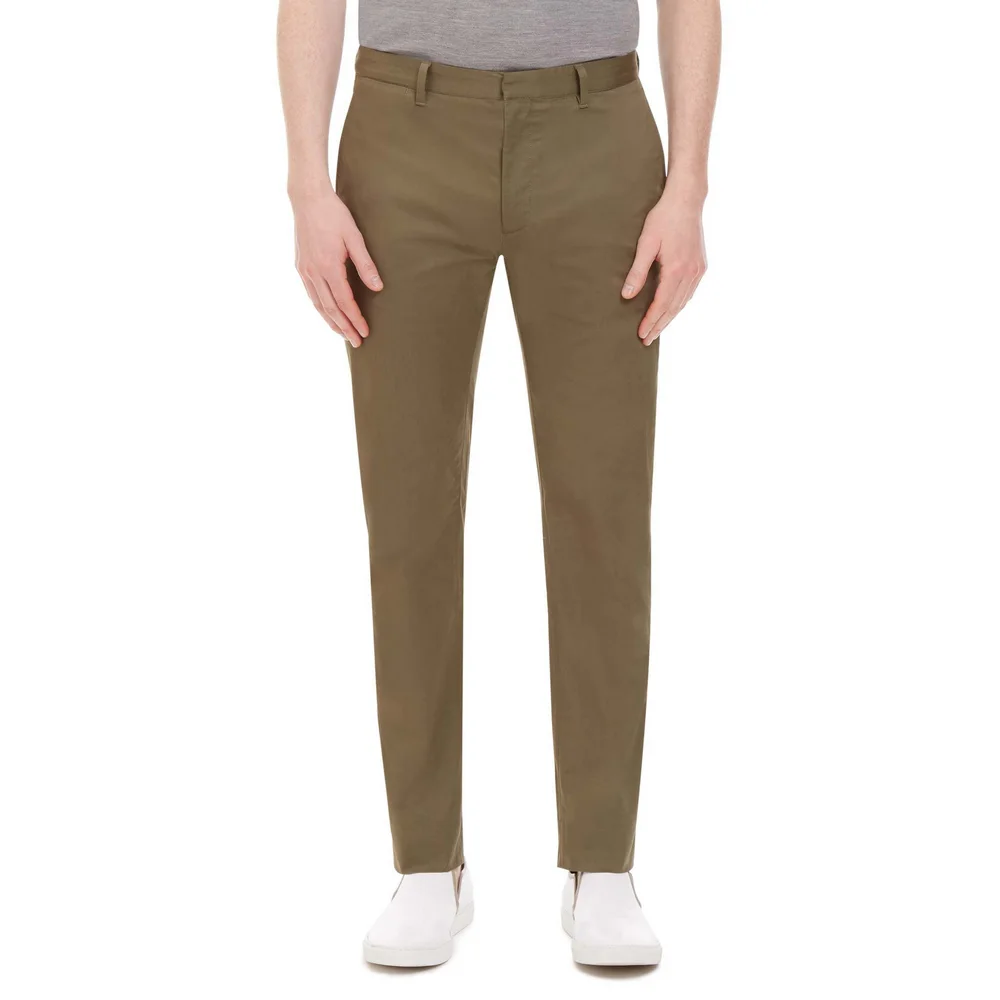
“Khaki” was originally a dust-coloured shade, and the word came to name the sturdy twill-weave cotton once widely used in military uniforms. In tailoring today, you will meet four closely related families:
- Khaki cotton: twill weave, the surface slightly stiff when new and softening after many wears.
- Chino: a softer, lighter khaki, usually used for trousers but also made into blazers.
- Cotton gabardine: a tightly woven twill with a smooth surface, draping better than ordinary khaki.
- Blended cotton: cotton blended with linen, wool or a little stretch fibre to make it easier to wear.
Read the specifications carefully when choosing, because “khaki fabric” can be any of these, each with completely different thickness and drape.
Pros and cons of khaki fabric for suits and cotton suits
Advantages
- Breathable and absorbs sweat well, comfortable all day.
- Light, durable, resistant to wear.
- Suits a relaxed style, looking youthful and approachable.
- The twill surface wears well, and is less prone to shiny wear at the elbows than thin plain-weave fabric.
Disadvantages
- Creasing: cotton lacks the elasticity that lets wool spring back. One car ride and you have creases at the elbows and thighs.
- Fading: dark colours fade gradually with repeated washing, and beige stains easily at the cuffs and underarms.
- Weaker shape than wool: the lapels collapse easily and the shoulders slump if the structure is insufficient.
- Shows sweat marks: pale colours and light blue show damp marks easily.
Cotton suit versus wool suit
| Criterion | Khaki or cotton suit | Wool suit |
|---|---|---|
| Breathability | Very good | Good (depending on the wool) |
| Creasing | A lot | Little, recovers well |
| Shape retention | Medium, needs careful structure | Very good |
| Colour fastness | Fades gradually | Holds colour well |
| Formality | Relaxed, smart casual | Formal to everyday |
| Suited climate | Hot and humid, travel | Air-conditioned rooms, work |
In other words, wool wins on polish and khaki wins on comfort. The two don't replace each other; they complement each other. To understand more about why wool holds its shape so well, you can also read the article on cotton fabric for suits to compare the different kinds of cotton.
When a cotton suit looks better than a wool suit
Consider a cotton suit on these occasions:
- Smart casual: coffee, meeting friends, weekend outings.
- Travel and light business trips: cotton folded into a suitcase takes the knocks better.
- Daytime outdoor events: garden parties, garden weddings.
- Fridays at a company that allows relaxed dress.
For board meetings, signings, ceremonies or interviews in formal settings, a wool suit remains the safer choice.
Easy colours to style for a khaki suit
Cotton looks its most flattering in earthy and neutral colours:
- Beige, cream: easy on the eye, pairs easily with light blue or white shirts.
- Olive, moss green: masculine, goes well with chinos and a white shirt.
- Earth brown, caramel: warm, suits brown leather shoes.
- Light navy, stone grey: formal enough for easygoing office wear.
The lighter the colour, the more easily it shows creases and sweat. If you travel a lot and sit for long stretches, earth brown or olive will hide the weaknesses better than cream white.
How to keep a cotton suit jacket in shape
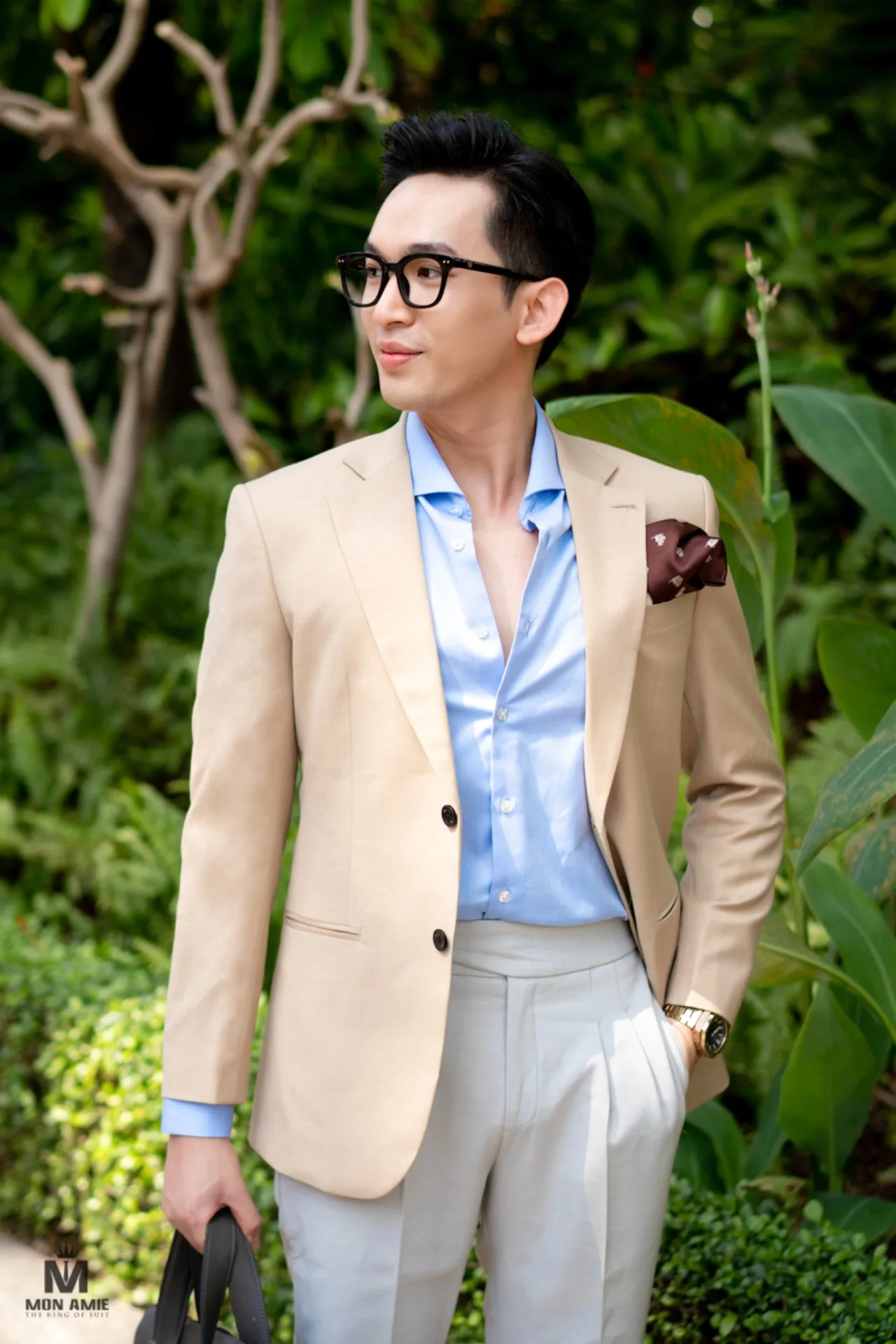
Because cotton doesn't spring back by itself, the jacket's shape has to rely on its internal structure and on how you care for it:
- Enough structure, but not heavy: a moderate chest canvas stops the lapels and chest from collapsing, while staying light enough for the jacket to breathe. This is where the master tailor's finesse matters.
- Half lining: reduces heat and lets the sleeves slide on easily.
- Hang it on a wide-shouldered hanger straight after wearing; don't fold it in a bag.
- Steam lightly to flatten it rather than pressing hard. Hard pressing makes the cloth shiny and hardens the creases of the lapels.
- Dry-clean periodically, and avoid soaking the jacket in water when it has canvas.
- Avoid harsh sun so the colour doesn't fade.
Three ways to check a khaki cloth before tailoring
- Squeeze tightly, then release: if deep creases remain after a few seconds, the cloth will crease heavily when worn. Choose a piece with better recovery, or a wool blend.
- Hold it up to the light: if you can see through it a lot, it is thin. Too thin and it will show the pocket edges and seam lines.
- Crumple the surface lightly and look at the twill lines: even, tight diagonal lines mean good weaving. Loose, skewed lines mean the jacket will sag after a few washes or steamings.
These tests take only a minute but spare you most of the disappointment when the jacket arrives.
A tip from Mon Amie's master tailor
With cotton, look for a cloth that is firmly woven and of medium weight, not too thin. Cloth that is too thin creases like paper and shows the pocket edges. Also choose a soft shoulder for the jacket, because cotton with a heavily padded shoulder tends to look unnaturally stiff. If you want a cotton or khaki blazer made, ask the stylist about the materials currently available in the fabric library; the master tailor will let you hold swatches in your hand and do a baste fitting to adjust the cut, just as in the bespoke tailoring experience.
Common mistakes
- Choosing a khaki that is too thick because you assume it is durable; the result is a jacket that is both stiff and hot.
- Choosing white or cream, then worrying about stains, and ending up wearing it only twice.
- Pairing a cotton suit with shiny leather shoes, a silk shirt and a wool tie: all of it too serious for the cloth.
- Forcing cotton into a business suit, when it was born to be relaxed.
Frequently asked questions
Can a khaki men's suit be worn to work?
Yes, in a workplace that allows relaxed dress. Choose a neutral colour and pair it with a plain shirt and dress trousers or chinos, and it is polite enough for an ordinary working day.
Does a khaki men's jacket crease a lot?
Yes, more than wool. Hanging it properly and steaming it lightly after each wear will help it flatten again. If you can't tolerate any creases at all, a wool blend is the more comfortable choice.
Is cotton fabric for suits durable?
Durable in fibre, but the colour fades gradually over time. Dry cleaning, avoiding harsh sun and letting the jacket rest between wears will extend its life.
Does a cotton suit jacket go with jeans?
Yes, if you choose dark blue jeans without rips and either suede shoes or minimalist white sneakers. It is the easiest smart casual formula.
Cotton or linen suit for the hot season?
Linen is cooler but creases more heavily. Cotton holds its shape a little better. You can compare further in the article linen suits for the hot season.
Choose cloth by occasion, not by habit
Khaki fabric for suits can't replace wool, but it is a companion well worth having in your wardrobe. Every cloth has an occasion in which it shines. If you want to talk directly about cotton or wool for your next suit, book through the booking page and bring photos of the occasions you often dress for; the master tailor will choose cloth to suit each one.