
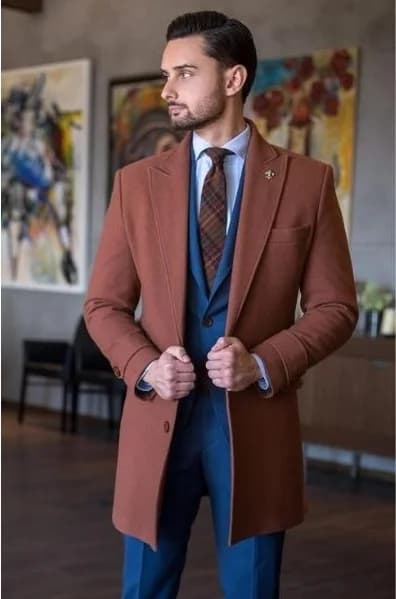
Five a.m. at the airport. You wheel your suitcase to the door, and a business trip to Hanoi is waiting in temperatures below fifteen degrees. The suit you are wearing underneath is lovely, but the winter wind slips through every seam. That is when the long coat, which Vietnamese call by a name borrowed from French, “măng tô” (manteau), proves why it exists. But the types of men's overcoats are not all alike: a khaki trench coat, a wool overcoat, a chesterfield and a short coat each answer a different need.
Quick answer
Men's overcoats fall into four groups: the khaki trench coat (windproof, lightly rain-resistant, for between seasons), the wool overcoat (thick, warm, for cold climates), the chesterfield (velvet collar, formal) and the short-length coat (mid-thigh, compact). Choose by climate, by height and by whether you wear a suit underneath.
What is a men's măng tô?
The word “măng tô” comes from the French “manteau,” meaning a long coat worn over other clothes. In Vietnamese it usually refers to long coats, typically passing the hips and reaching close to the knee, used in cold seasons or worn over a suit. Unlike a bomber jacket or a parka, a măng tô has the lines of tailored clothing: accurate shoulders, lapels, buttons, lining, and usually a thick wool or khaki fabric.
For gentlemen in Saigon, the overcoat is not an everyday garment. But for business trips to Hanoi, Đà Lạt in the cold season, or trips abroad, it is the most worthwhile investment for keeping warm while keeping a polished image.
Quick classification table
| Type | Material | Usual length | Features | Suited to |
|---|---|---|---|---|
| Khaki trench coat | Khaki (thick cotton twill) | To the knee or below | Epaulettes, belt, double-breasted buttons, storm flap at the back | Rainy season, between seasons, worn over a shirt or a light suit |
| Wool overcoat | Wool (dạ len), wool blend | To the knee | Notch or peak lapel, single or double-breasted, thick lining | Cold climates, worn over a suit |
| Chesterfield | Wool, velvet collar | To the knee | Black velvet collar, straight body, closed front with concealed buttons | Formal occasions, evening parties, worn over a suit |
| Short-length coat (short topcoat, car coat) | Light wool, khaki, tweed | Mid-thigh or just below the seat | Compact, easy to move in | Getting around, driving, shorter men |
| Light coat | Thin wool or blend | Knee or mid-thigh | Light, less warm | Between seasons, air-conditioned offices |
Each type in closer detail
Khaki trench coat: the coat for between-season days
The trench coat originates from coats made for soldiers in the First World War, and it still keeps many practical details: epaulettes, a belt, double-breasted buttons and a storm flap at the back. Khaki is a thick cotton twill, durable, windproof and lightly rain-resistant thanks to its tight weave. Familiar colors are beige, khaki and navy.
Suited to: between seasons, light rain, worn over a shirt or a light suit. It is not warm enough for deep cold, unless there is a detachable lining inside.
Wool overcoat: warm and full
The wool overcoat is the traditional long coat for cold seasons: thick wool or wool-blend fabric, a solid lining, and lapels notched like a suit's. It reaches the knee, single-breasted or double-breasted. Colors are usually black, charcoal, navy and camel. This is the one to choose when you travel somewhere truly cold and need to wear it over a suit.
Chesterfield: elegance in a velvet collar
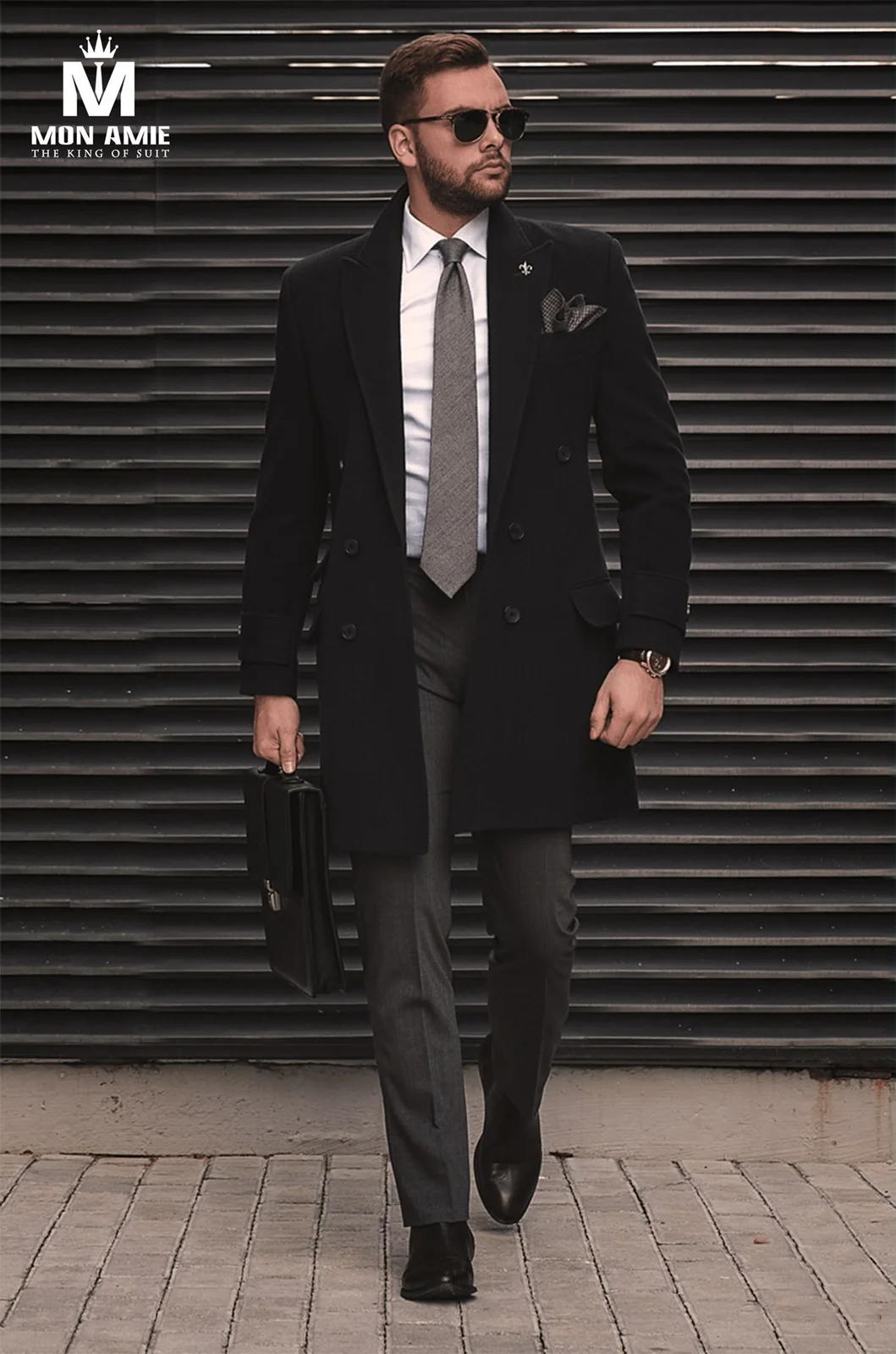
The chesterfield is a well-known kind of overcoat with a contrasting black velvet collar, a straight body, and a closed front with concealed buttons. It carries a strongly formal air, suited to evening parties and worn over a dark suit. It suits gentlemen who like classic style, but is less flexible for relaxed occasions.
Short-length coat: compact and easy to move in
A short-length coat reaches mid-thigh or just below the seat, and is sometimes called a short topcoat or car coat. Its advantages are lightness and ease when sitting and driving, and it suits shorter men because it does not “swallow” height. It can be made from light wool, khaki or tweed. Suited to work, outings and business trips that are not too cold.
Long and short men's overcoats: choosing by height
- Long (to the knee, slightly below): formal and warmer, suited to tall or well-proportioned men. Shorter men should choose knee-length and avoid anything too long, which easily swallows the figure.
- Short or mid-length (mid-thigh, just under the seat): young and compact, suited to shorter men and to people who need to move a lot.
An easy marker: with a short-length coat, the hem stops level with or above the knee; with a long coat, the hem stops level with the knee or slightly below. Stand straight in front of a mirror and look at the overall picture: the hem should not cut across exactly the middle of the calf.
Choosing the fabric: khaki, wool, tweed or wool blend
- Khaki (cotton): light, windproof, suited to between seasons; not warm enough for cold climates.
- Wool (dạ len): thick, warm, holds its shape well; the first choice for cold seasons. The article What Is Woollen Cloth? Milled Wool vs Felt vs Suiting Wool explains the differences between woollen cloth (dạ), felt (nỉ) and wool yarn (len).
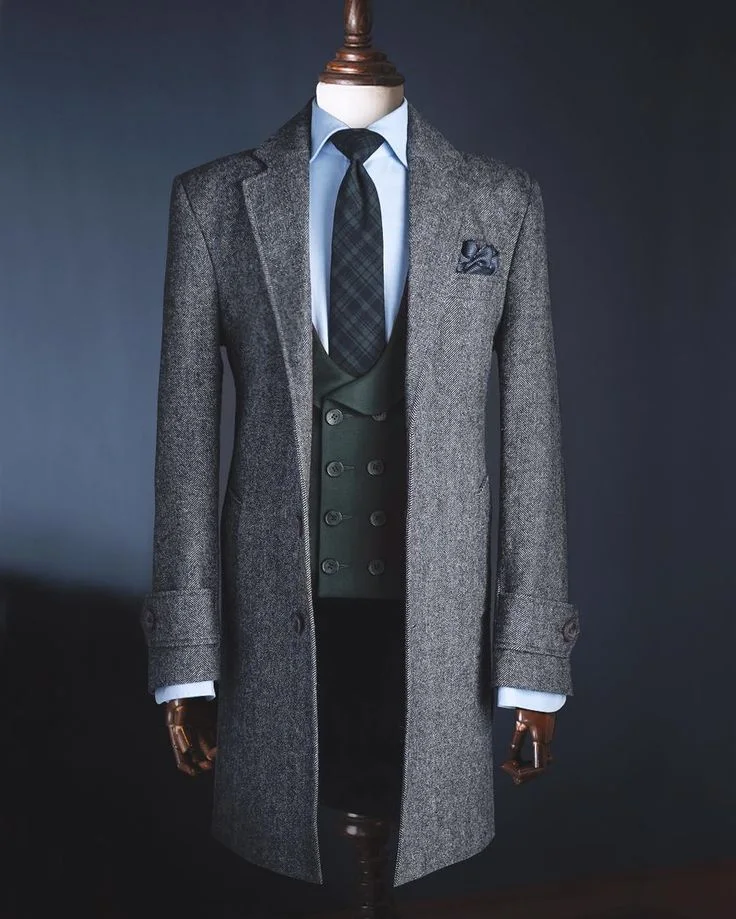
- Tweed (herringbone, houndstooth): patterned, warm and full of character; suited to a classic style.
- Cashmere blend: soft, light and warmer, but higher in price.
- Polyester or wool-look fabric: light but less warm and stuffy; use only for mild cold.
For a high-quality men's wool overcoat, check the following: the wool percentage clearly stated on the label, fabric that is thick yet drapes, a solid and smooth lining, even stitching and secure buttons. If you can, lift the coat and feel its weight: a good wool coat usually has a substantial heft in the hand.
Choosing the size and styling
- Try it with your suit underneath. The coat needs enough room in the shoulders and sleeves to be worn over a suit without feeling tight or wrinkling the suit's shoulders.
- Sleeves that cover the suit sleeves completely. The coat sleeve should be just long enough to cover the suit sleeve entirely, but not so long that it covers your hand.
- Buttons and lapels: if you wear it over a suit, choose a coat with medium lapels and buttons that balance with the suit.
- Color: black, charcoal and navy coats go with most suits; camel suits navy, grey and brown suits; tweed suits a relaxed style.
- Accessories: a wool scarf, leather gloves and matte leather shoes complete the look.
You can see more formulas in the article Styling a Men's Overcoat: 8 Elegant, Warm Ways to Wear It and in Styling Men's Suits for Winter.
Common mistakes when choosing an overcoat
- Buying the size that fits you without a suit, then being unable to wear it over a suit. Always try it with the layer you intend to wear underneath.
- Choosing a style that is too long when you are short. The coat “swallows” your height and makes the figure look cut short.
- Choosing polyester for a trip to deep cold. It looks like wool but does not hold warmth.
- Choosing a color that is too pale without thinking about keeping it clean. Beige and cream are beautiful but need careful care.
- Ignoring the lining. A thin lining leaves even a thick wool coat cold; a solid lining holds the heat.
- Not testing sitting down and raising your arms. A coat that looks good standing but feels tight when you sit in a car is the wrong choice.
Tips from Mon Amie's master tailors
Master tailors usually advise: when trying on an overcoat, wear the suit you will have underneath, fasten the suit jacket's button, and only then fasten the coat's. If you can fasten it comfortably, and raise your arms and sit down without catching, that is the right coat. And do not wait until the last week before a trip to look for an overcoat, because you need time to try it with the suit and adjust it to fit. You can preview styles on the product page, or book an appointment so a stylist can advise based on your trip itinerary.
If you want a suit that fits you well underneath before putting on an overcoat, the bespoke tailoring journey lets you choose the fabric and fit to your build, so that the inner and outer layers match.
Frequently asked questions
What is a men's măng tô?
A long coat worn over other clothes, usually reaching close to the knee, used in cold seasons or worn over a suit. The name is borrowed from the French “manteau.” The material is usually wool or khaki, with seams and a cut like tailored clothing.
How is a khaki overcoat different from a wool overcoat?
Khaki is a thick cotton twill: light, windproof and lightly rain-resistant, suited to between seasons. Wool is a thick, warm cloth that drapes and holds its shape, suited to cold climates. If you only need to block the wind, khaki is enough; if you need real warmth, choose wool.
Long or short men's overcoat, which suits me?
A long coat is more formal and warmer, suited to tall or well-proportioned men. A short coat is more compact, suited to shorter men and to relaxed occasions. Try it in front of a mirror and choose a length where the hem does not cut across the middle of the calf.
What should a high-quality men's wool overcoat have?
The wool percentage clearly stated, thick yet drapey fabric, a solid lining, even stitching, and secure buttons and buttonholes. A good coat usually has a substantial weight and holds its shape even when you sit or raise your arms.
Can an overcoat be worn in Saigon?
Yes, but on few occasions. In the rainy season, a khaki trench is a light, compact choice; a thick wool coat suits cold business trips or evenings with strong air conditioning. For most of the time in Saigon, you do not need to buy too many.
Closing thoughts
The types of men's overcoats are not hard to tell apart if you remember three factors: the material decides the warmth, the length decides the formality, and wearing it over a suit decides the size. Choosing the right coat for your upcoming cold trip keeps the suit underneath looking good, instead of letting the wind spoil the whole image. If you would like to try an overcoat with your own suit, visit the Mon Amie showroom.