

Two friends over coffee are having a lively argument: one says there are a dozen tie knots in the world, the other insists you only need one to get by. Both are partly right. In theory dozens of styles have been catalogued, but if you ask how many ways to tie a tie are really worth learning, the eight knots below are enough for almost every working morning.
The quick answer
There are dozens of ways to tie a tie, but you only need to know eight common knots: Oriental, Four-in-hand, Pratt, Half-Windsor, Windsor, Kelvin, Prince Albert and Trinity. Choose the knot by collar width and occasion: a narrow collar takes a small knot, a wide collar takes a large one, and for everyday work Four-in-hand or Half-Windsor is enough.
Eight common tie knots: a comparison table
| Knot | Size | Difficulty | Suits collar | Occasion |
|---|---|---|---|---|
| Oriental (simple knot) | Small, thin | Very easy | Regular collar, narrow collar | A rushed workday, a thick or long tie |
| Four-in-hand | Medium, slim, slightly asymmetric | Easy | Regular collar, button-down | Everyday office |
| Pratt (Shelby) | Medium, balanced, neat | Easy to moderate | Regular collar, medium spread | Office, meetings |
| Half-Windsor | Medium, symmetrical, triangular | Moderate | Regular collar, medium spread | Important meetings, interviews |
| Windsor | Large, symmetrical | Somewhat hard | Wide collar (spread, cutaway) | Ceremonies, formal parties |
| Kelvin | Medium to large, slightly asymmetric | Moderate | Regular collar, wide collar | When you want a fuller knot than Four-in-hand |
| Prince Albert | Compact, two wraps | Moderate | Regular collar, thin tie | Occasions that need a small accent |
| Trinity | Large, layered, interwoven | Hard | Wide collar | Evening party, photographs |
Choose the knot by the collar, not by preference
The collar decides which knot “fills” the space properly.
- Narrow collar, button-down collar: choose a small knot such as Four-in-hand or Oriental; a large knot will spill out of the collar.
- Wide collar (spread, cutaway): suits a symmetrical knot such as Half-Windsor or Windsor, so there is no gap left around the knot.
- Regular collar: almost any knot works, and Half-Windsor is the most comfortable choice.
Another formula to remember: the wider the collar, the larger and more symmetrical the knot. You can read more about how to tie the Windsor knot for a wide collar and the Half-Windsor knot for a regular collar.

How to tie a tie for beginners
If you learn only one knot, learn the Four-in-hand. It is quick and suits most ties and most collars. The steps are as follows:
- Drape the tie around your neck, with the wide end on the right hanging about a hand-span lower than the narrow end.
- Cross the wide end over the front of the narrow end.
- Wrap the wide end behind the narrow end, then bring it back out to the front.
- Pass the wide end up through the neck loop from underneath.
- Bring the wide end down through the loop of the knot at the front.
- Hold the narrow end and pull the wide end to tighten gently, then slide the knot up to the collar.
If the tie is too long or too thick, you can drop a wrap to make the knot neater; that is exactly the idea behind the Oriental knot.
Three details that make any knot look better
- The tie dimple: a small indentation just below the knot. Hold both sides with your index finger and thumb and slide the knot up as you tighten. A dimple gives the knot depth and is the mark of someone who ties carefully.
- Length: the wide end should stop at the top edge of the belt. Longer and it dangles; shorter and it looks like a bib.
- The narrow end hidden behind the wide end: use the keeper loop on the back or slip it through the label.
Tie width should also be balanced with the lapel. A classic suit jacket with a medium lapel suits a tie 7 to 8 cm wide. A narrower lapel calls for a slimmer tie so it doesn't overwhelm.
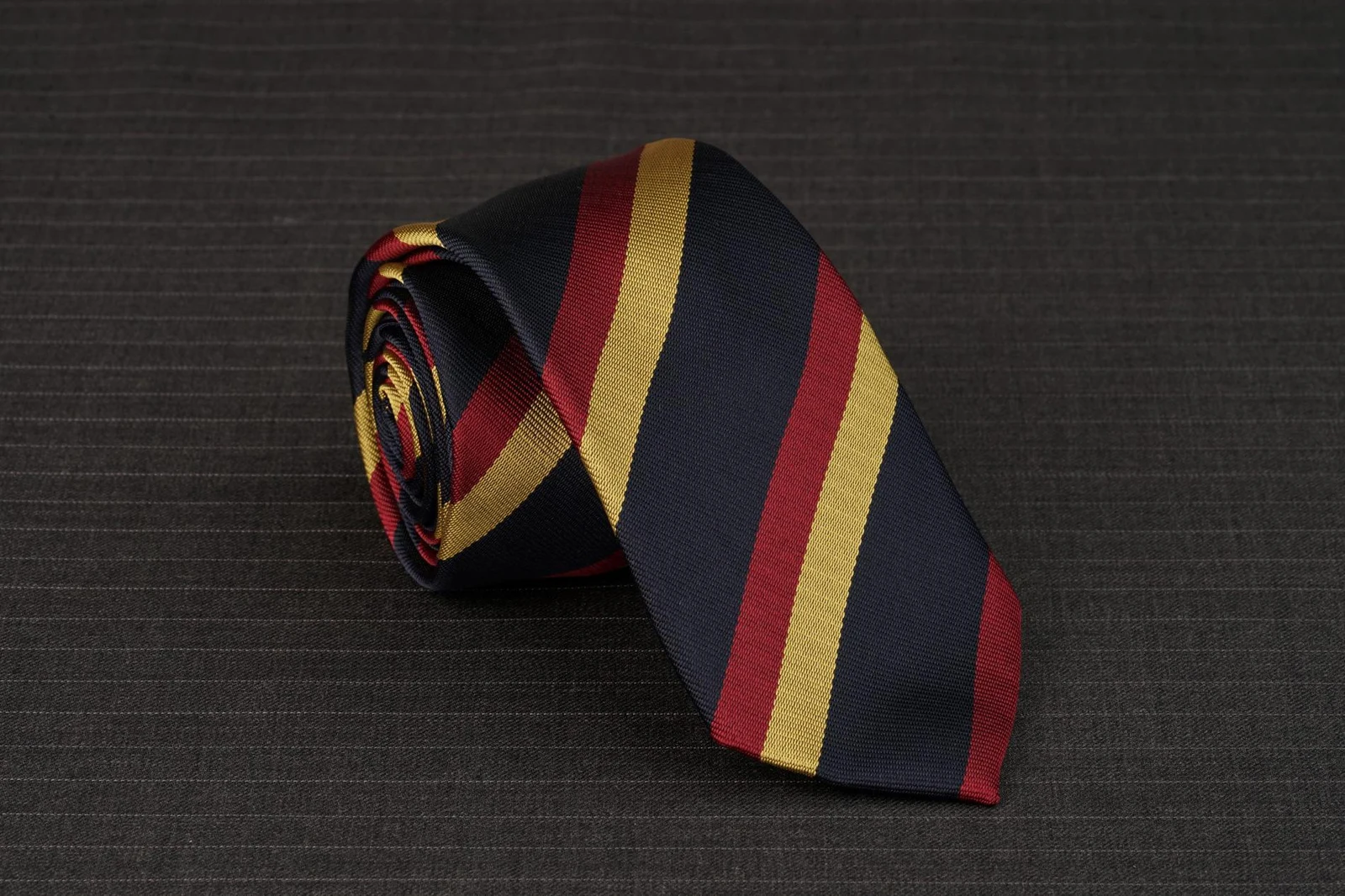
Tie-knot styles: neat, classic and artistic
- Neat style: Oriental, Four-in-hand, a small knot slightly off-centre by nature. Suits thin ties and people who like a natural look.
- Classic style: Half-Windsor, Pratt. Easy on the eye, balanced, never wrong for work.
- Artistic style: Windsor, Trinity, Prince Albert. Large or layered knots, for occasions that need a touch of interest.
How many ways to tie a tie are enough: a three-step path
Instead of learning them all, you can go step by step and move up to the next only when your hands are used to it:
- Step one, the everyday knot: Four-in-hand. Tied in a few dozen seconds, suited to almost every work shirt.
- Step two, the knot for important occasions: Half-Windsor. Use it for meetings, interviews and meeting partners, with a medium-spread collar.
- Step three, the knot for ceremonies: Windsor, with a wide collar and a long tie of medium width.
The rest, such as Kelvin, Prince Albert or Trinity, are the “seasoning”. Learn them later, when you want to vary how you present yourself rather than because you need to. This view makes the question of how many ways to tie a tie less daunting: remember few, but remember them well.
A tip from Mon Amie's master tailors
A “difficult” knot does not always give a good result. What decides it is the tie's material. A thick wool or silk tie tied in a Windsor becomes a big lump, while a narrow tie tied in a large knot has the knot swallowing the whole tie. So with a thick or narrow tie, choose a small knot such as Four-in-hand or Oriental; a tie of medium thickness and medium width suits Half-Windsor; and Windsor is for a tie that is long enough and of medium to wide width. A tie of moderate thickness with a soft hand is the most versatile kind. You can browse the accessories on the product page or ask a stylist for suggestions when you visit a showroom.
Common mistakes
- Choosing a large Windsor for a regular collar, so the knot “swallows” the collar.
- Forgetting to fasten the shirt's collar button before tying the tie, which leaves the knot loose and the collar gaping.
- A tie tip that hangs past the belt or stops short of the trouser waistband.
- A tie that curls because the knot was left tied overnight. Untie it after use and hang it straight.
Frequently asked questions
How many ways are there to tie a tie?
In theory there are dozens of styles, but in practice people use about eight common knots. Four-in-hand and Half-Windsor are the two you should master first.
Which tie knots look the nicest?
It depends on the collar and the material. Half-Windsor looks good with a regular collar, Windsor with a wide collar, and Four-in-hand with a thin tie and a narrow collar.
Which knot should I use for a job interview?
Half-Windsor is a safe choice: balanced, firm and not showy. Practise tying it a few times beforehand so your hands get used to it.
Do tie-knot styles affect how people perceive the wearer?
Yes. A large symmetrical knot gives a sense of care, while a small, slightly off-centre knot gives a sense of ease. Choose to suit the context.
Start with one knot, widen gradually
The answer to how many ways to tie a tie can be long, but the knots you really use need only be a few styles. You don't need to memorise all eight at once. Practise Four-in-hand and Half-Windsor until your hands do it on their own, then try Windsor for ceremonies. When you need advice on a tie to go with your suit, visit a Mon Amie showroom or make an appointment through the booking page.