
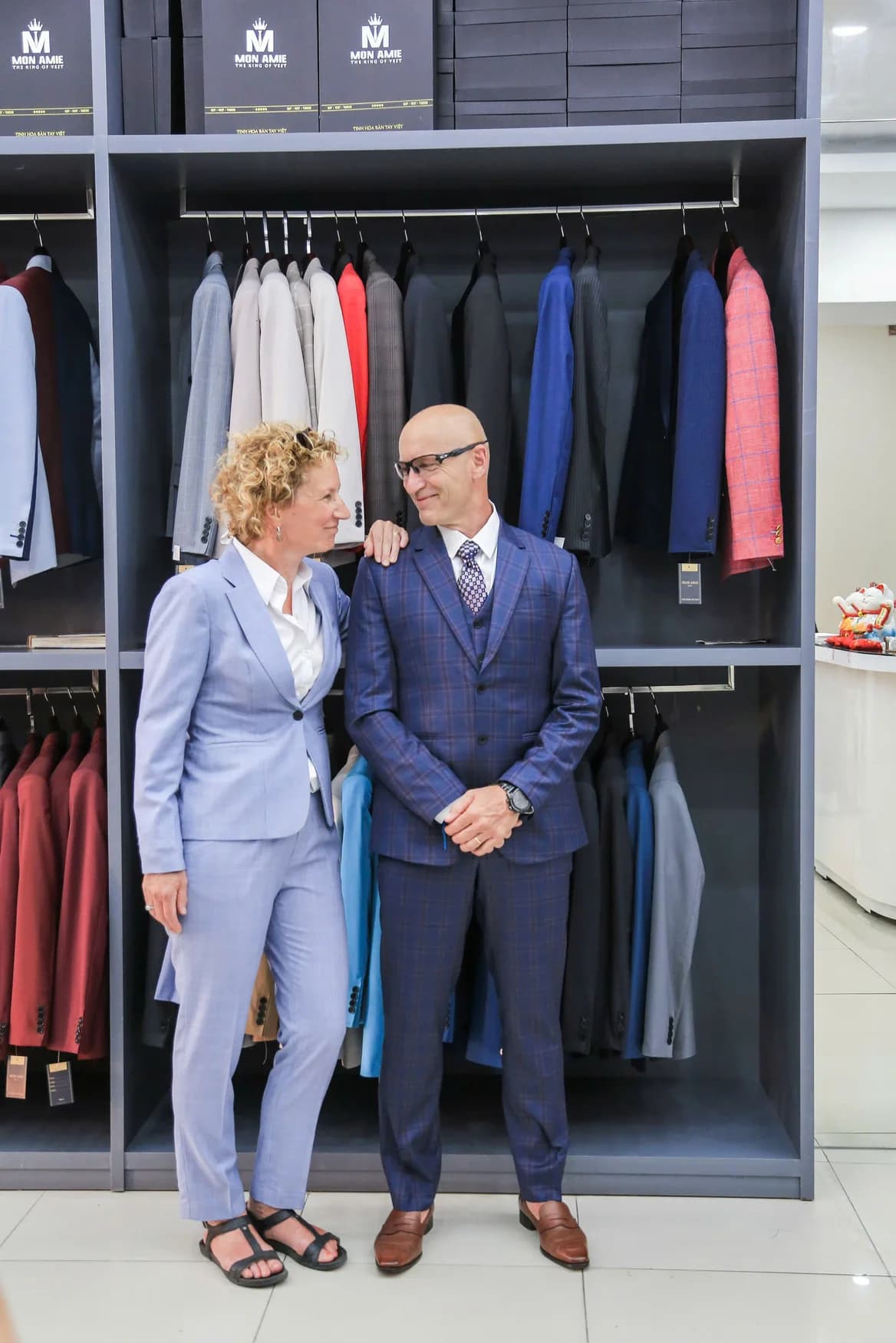
There is an opening line that stylists at Mon Amie's showrooms hear all the time: you pull out your phone, a photo of a model in a gray suit on the screen, and say “make me one exactly like this.” That sentence isn't wrong, but it is often the doorway to a few mistakes when getting your first suit made. A first suit teaches the wearer a great deal, unfortunately out of their own pocket. The seven mistakes below are common among people ordering a first made-to-measure suit in Saigon, each with a way to avoid it.
Quick answer
Seven common mistakes when getting your first suit made: choosing fabric by eye instead of by occasion, going to the fitting in the wrong clothes, preferring a cut that is too tight, skipping the baste fitting, choosing a color that is too loud, not describing your real wearing habits, and comparing only prices without asking what the price includes.
1. Choosing fabric by eye: beautiful on the table, heavy on the body
A fabric swatch on the table always looks good, because we only see the color and the weave. The wearer lives with it all day: sitting in a meeting in an air-conditioned room, stepping out into Saigon's midday sun, stuck in traffic and then at a dinner table. The right question isn't “which color is beautiful” but “where will this suit be worn, and how many times a week.” For a suit worn to work often, a wool blend or a 100s to 140s wool, of moderate weight and good at holding its shape, is the safe zone. The “s” number indicates the fineness of the wool fibre: the higher it is, the softer and smoother the fabric, but the more careful care it demands. Hold the fabric in your palm for a few seconds and then release it; if the creases flatten out on their own, the fabric holds its shape. If you want to look closely before coming to the showroom, you can open Mon Amie's fabric library to compare composition and fabric lines.
2. Going to the fitting in the wrong clothes: the measurer has to guess instead of measure
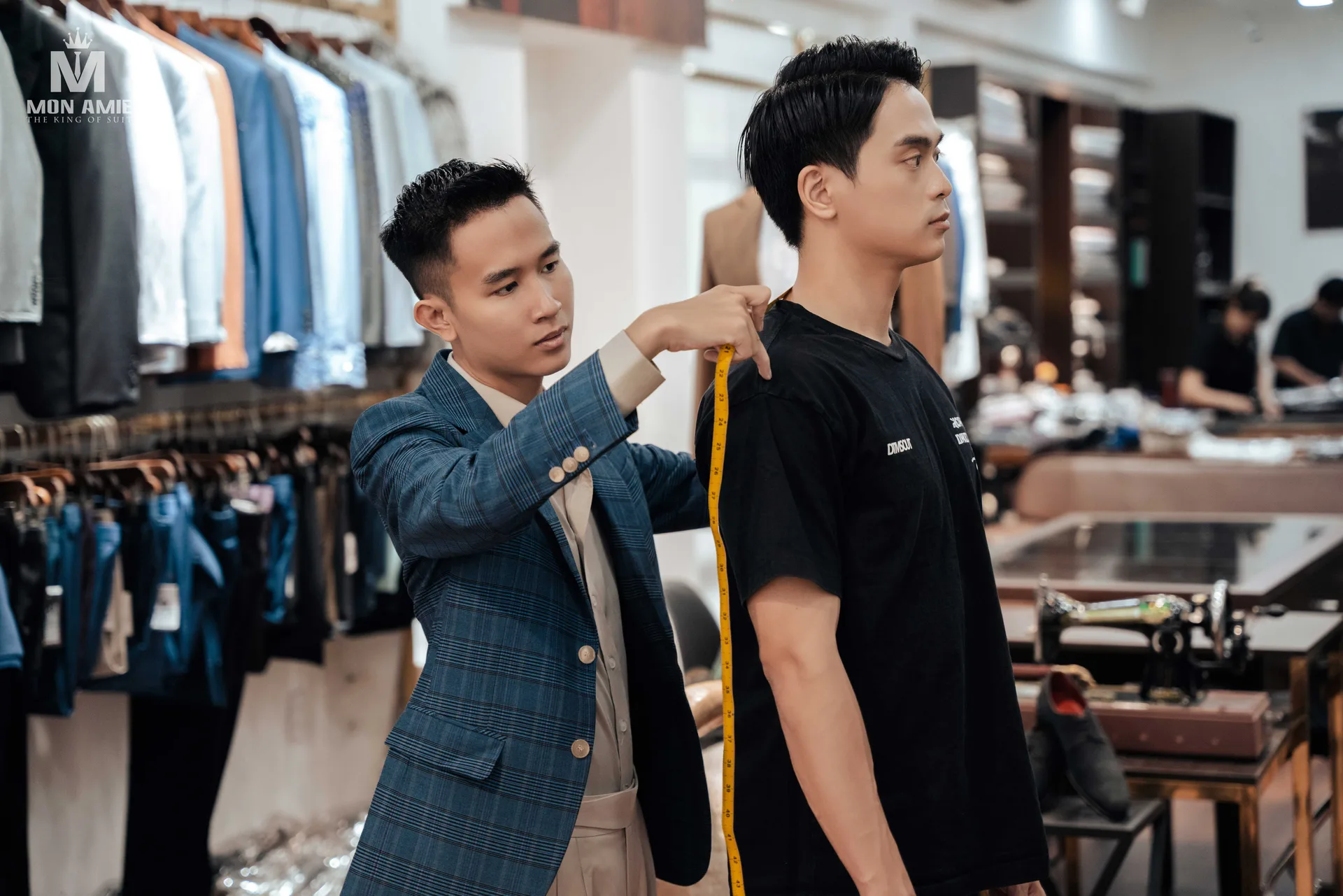
You come to the showroom in a thick T-shirt, jeans and sandals, with pockets full of a wallet and a phone. A jacket sleeve is calculated from the shirt cuff, trouser length from the shoes you plan to wear, the waist from where you actually fasten your belt; measure over the wrong layers and the whole suit is off. You should wear a well-fitting shirt and the dress shoes you plan to pair with the suit, empty your pockets, and stand naturally, without puffing out your chest to pose. The made-to-measure journey at Mon Amie begins with a tape measure around the shoulders, as in the photo, with more than 30 measurements kept on file for life. Get the measurements right the first time and the suits you order later benefit too.
3. Liking a skin-tight cut “to look neat” without testing movement
Slim cuts are in fashion, so many men ask for the tightest fit possible. The familiar result: button up and an X-shaped crease pulls out from the button, the shoulder seam spills beyond the shoulder bone, and lifting an arm lifts the whole body of the jacket with it. A good suit is a suit you can move in. The test is simple: button up, raise both arms to shoulder level, wrap your arms around as if hugging someone, then sit down. If the collar lifts away from the neck or the armholes tighten, the cut is tighter than it needs to be. The shoulder is very hard to fix later, so be demanding about the shoulder from the start. If you need more criteria to check for yourself, see 12 signs that show craftsmanship at a glance.
4. Skipping the baste fitting because of a busy schedule
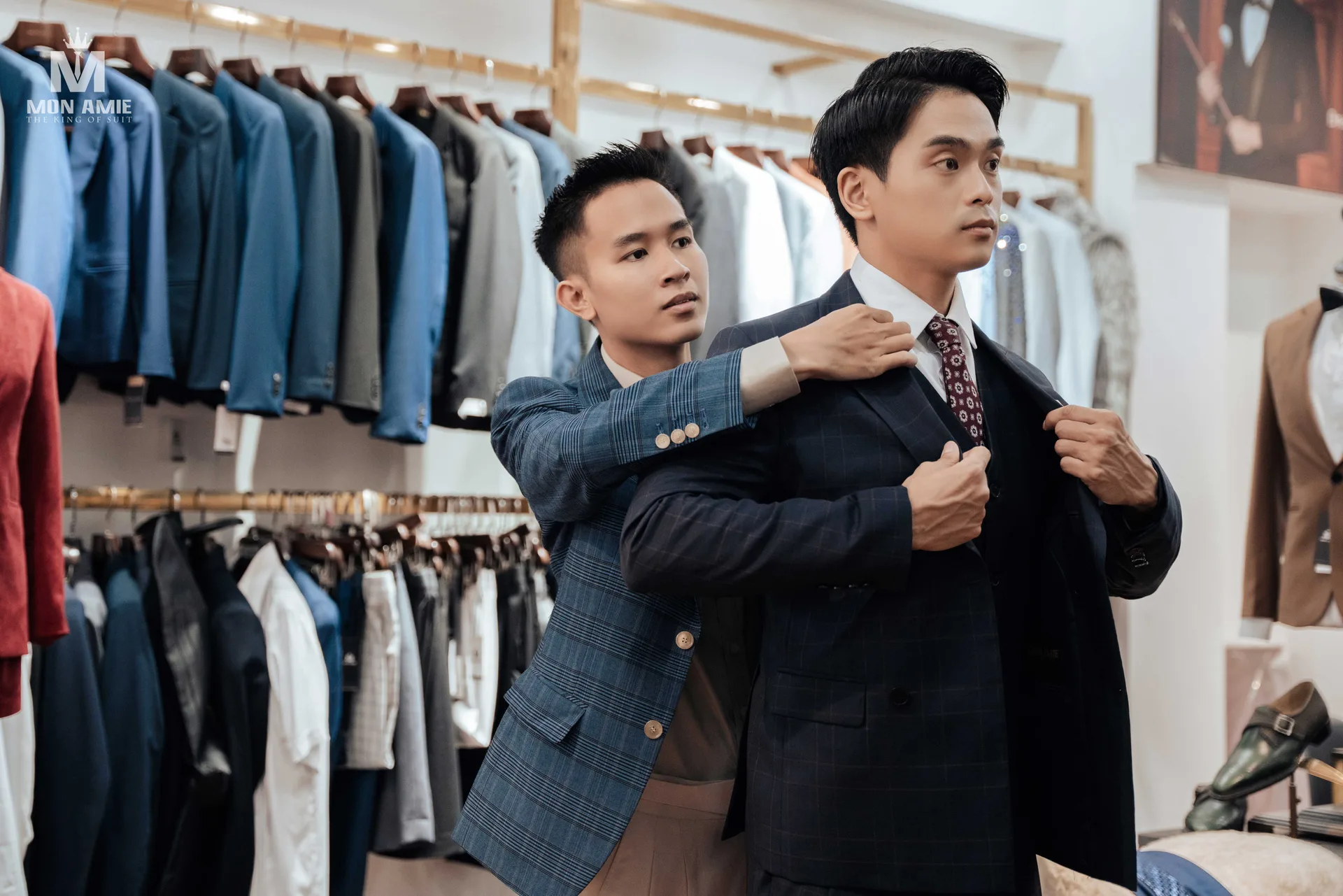
Some men think that once the measuring is done, all that's left is to wait for pick-up day. But measurements are only numbers; the baste fitting is when you see the suit built on a real body: whether the shoulder hugs, whether the lapel lies smooth, whether the body of the jacket twists when you stand sideways. It is also the time when alterations are still easy and inexpensive, because the fabric isn't finished yet. With Mon Amie's Bespoke tailoring, baste fittings and adjustments until it fits are part of the journey; the specific fitting schedule is given by the showroom at measurement. Right when you order, save the fitting date to your phone calendar. If you live far away or have a packed schedule, say so in advance so the stylist can propose another way, such as a video measurement or an artisan coming to you.
5. Choosing a “unique” color for the very first suit
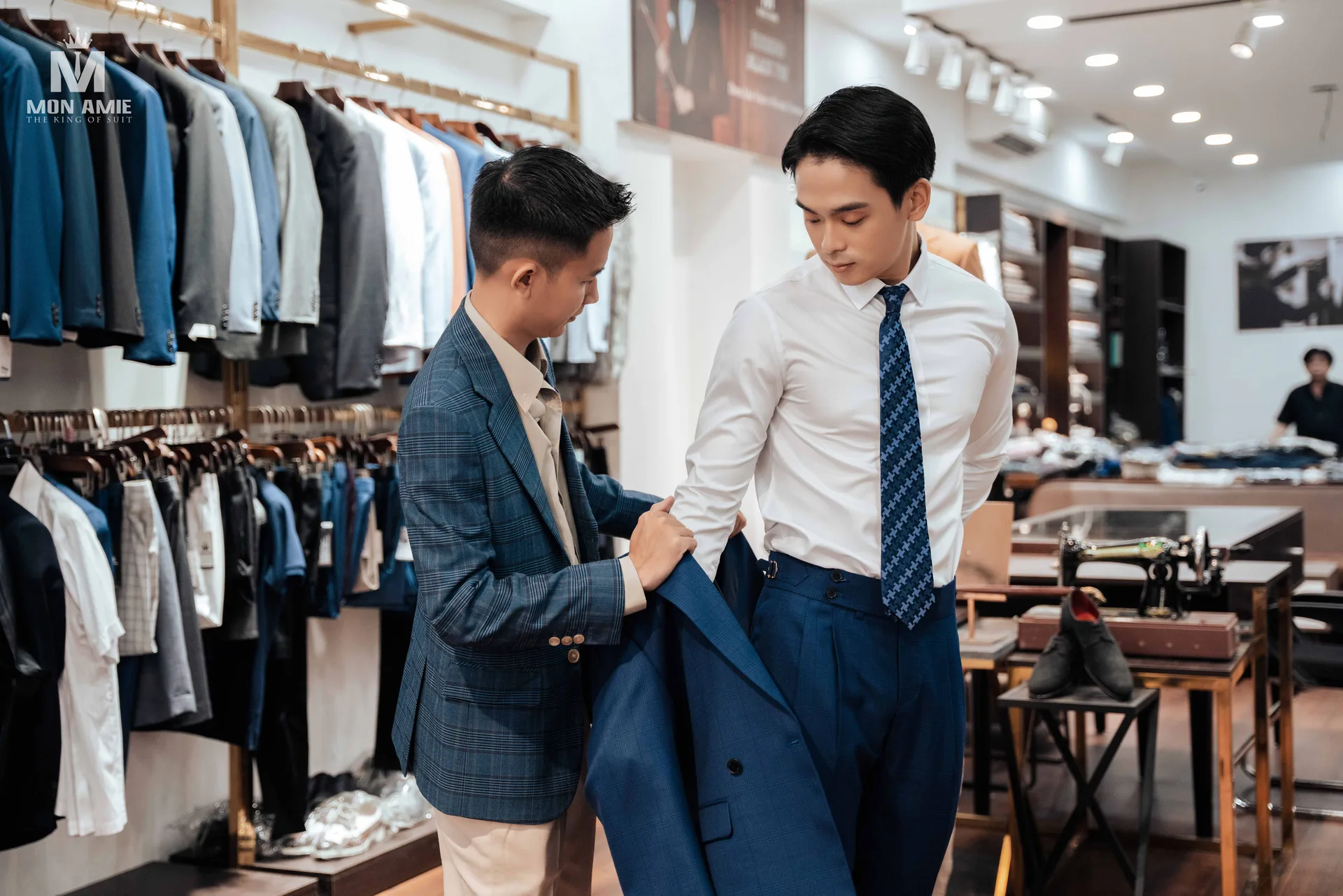
A large check, a bright moss green or a deep purple looks captivating in photos. But a first suit has to carry many jobs: meetings, client visits, a close friend's wedding, sometimes even an interview. Muted colors such as navy, charcoal gray, or an almost-solid tonal pinstripe pair with all kinds of shirts and ties, so even if you wear it over and over, nobody remembers. Bright or heavily patterned suits should come later, as a second suit once you know what you like to pair. The navy double-breasted suit with a check of pale red stripes in the photo is a style that most people find suits a second or third suit better. The color of fabric in real life also differs from a screen, so look at it in person.

6. Not telling the stylist your real wearing habits
Two people with the same measurements still need two different suits, if one sits in meetings for six hours and the other stands at a counter and walks around all day. Do you drive a lot, keep your phone in your jacket pocket, wear a large-face watch, carry a briefcase in your right hand, or are you working out so that your weight changes month to month? That is information a tape measure cannot capture. If you sit a lot, the trousers need extra room at the seat and thighs; if you carry things in your pockets, say so, so that the jacket doesn't bulge; if your weight is fluctuating, tell the stylist in advance so they leave seam allowance. If you're reluctant to describe it, you can choose made-to-measure service at home or at the office, so the artisan sees for themselves how you work.
7. Comparing only prices, forgetting to ask what the price includes
Two quotes that both say “suit” are not necessarily the same thing. You need to ask: does the price include the trousers, which fabric line is it, how much of the fabric is wool, is VAT included or not, and is alteration after you receive it charged extra. At Mon Amie, the price list is per full set of jacket plus trousers: Essential from VND 4.8 to 10 million, Signature from VND 10 to 20 million, Heritage above VND 20 million. The price from VND 4.8 million is for a full two-piece set excluding VAT; the stylist confirms the exact figure at measurement. A cheap suit that has to be altered two or three times and still doesn't fit is a suit that costs more than you think.
Quick summary table
| Mistake | Common when | Remember |
|---|---|---|
| 1. Choosing fabric by eye | Looking at swatches on a table | Ask about the wool content, feel the fabric and crease-test it |
| 2. Wrong clothes for the fitting | Coming to the showroom straight from home | A well-fitting shirt, dress shoes, empty pockets |
| 3. Too tight a cut | Wanting to look “neat” | Raise your arms, wrap them round, sit down; the shoulder is very hard to fix later |
| 4. Skipping the baste fitting | A busy schedule or living far away | Save the fitting date when you order; if you live far away, say so in advance |
| 5. A color that is too loud | Being drawn in by model photos | Navy, charcoal gray for the first suit; unusual colors for later |
| 6. Not describing your habits | Thinking measurements are enough | Say clearly whether you sit or walk, what you carry, your weight |
| 7. Comparing only prices | Receiving several quotes | Ask what the price includes, VAT, alterations after pick-up |
Tips from Mon Amie's master tailors
- Bring (or wear) the shirt and the shoes you often use with a suit; don't make the measurer imagine.
- If you have a suit that fits you now, bring it for comparison; if not, bring a reference photo and say which details you like, the lapel or the jacket length.
- A first suit should have only one highlight. Patch pockets, a floral lining and unusual buttons all at once can quickly make a suit “go out of style.”
- Look in the mirror from the side and the back, too. The wearer usually only looks at the front, while the camera and colleagues see from every side.
- Ask about care in advance: hanging, steaming, how often to dry-clean. A good suit lasts through how it is worn more than through its price.
Frequently asked questions
What color should a first suit be?
Plain navy or charcoal gray, or a very fine tonal pinstripe. These two colors work for meetings, client visits and weddings, and are easy to pair with shirts and ties. Save the more distinctive shades for a second suit.
What should I prepare for a suit fitting?
A well-fitting shirt, the dress shoes you plan to wear with the suit, and empty trouser and jacket pockets. If you have a suit that fits you well, bring it along. You should also think in advance about which occasion this suit will be worn for, so the stylist can choose the right fabric and cut.
Which price line should I choose for my first suit?
It depends on how often you wear it. Essential (VND 4.8 – 10 million) is the standard starting point of Mon Amie's cut, with Kevinlli fabric of 40–70% wool. Signature (VND 10 – 20 million) is the line many customers choose if you wear a suit to work often and want a smoother fabric. The exact price is confirmed at measurement.
Should I get my first suit at a showroom or online?
For the first time you should be measured in person, at a showroom or through at-home made-to-measure service, so that you can have a baste fitting and see the fabric by hand. Online made-to-measure via video call suits when you live far away or already have measurements saved at Mon Amie.
In closing
A first suit doesn't have to be perfect, but it should fit you and deserve to be worn many times. If you are still hesitating over any of the seven points above, you can book a measurement appointment so a stylist can talk it through directly on the fabric and on your own figure. If you want to go deeper before deciding, read 9 things to know before ordering your first suit.