

Take the jacket you wear most, settle its collar against your shirt collar and look in the mirror. If there is a gap between the two layers, or the jacket collar slides away from your neck every time you bend, that is the first sign of a suit that is not well made. Outsiders may not be able to name the flaw, but their eyes sense it. This article helps you name the 12 signs of a well-made suit, so that you can tell the craftsmanship in a suit at a glance.
Quick answer
A well-made suit has a collar that hugs the neck, flat shoulders without ripples, a lapel that rolls naturally, a clean chest without creases, stripes or checks that match at the seams, crisp buttonholes and sleeves that hang correctly. Check these 12 points during a 5-minute fitting and you will know whether a suit was made with craftsmanship or simply sewn to get it done.
12 signs of a well-made suit
The collar and shoulders
1. The collar hugs the neck. The jacket collar must sit against the shirt collar, with no gap and no bulging at the back. This is the hardest detail in the trade, because with an error of just a few millimetres the collar slides.
2. Flat shoulders, no ripples. The shoulder line ends exactly at the tip of the shoulder bone, lying flat, with no dents or diagonal creases. The shoulder is the one point that cannot be altered, so the master tailor always settles the shoulder first.
3. A natural lapel roll. The lapel should curve gently from the collar down to the first button, rolling as a curve, not pressed flat like something under an iron. A beautiful lapel roll is a sign of carefully made canvas.
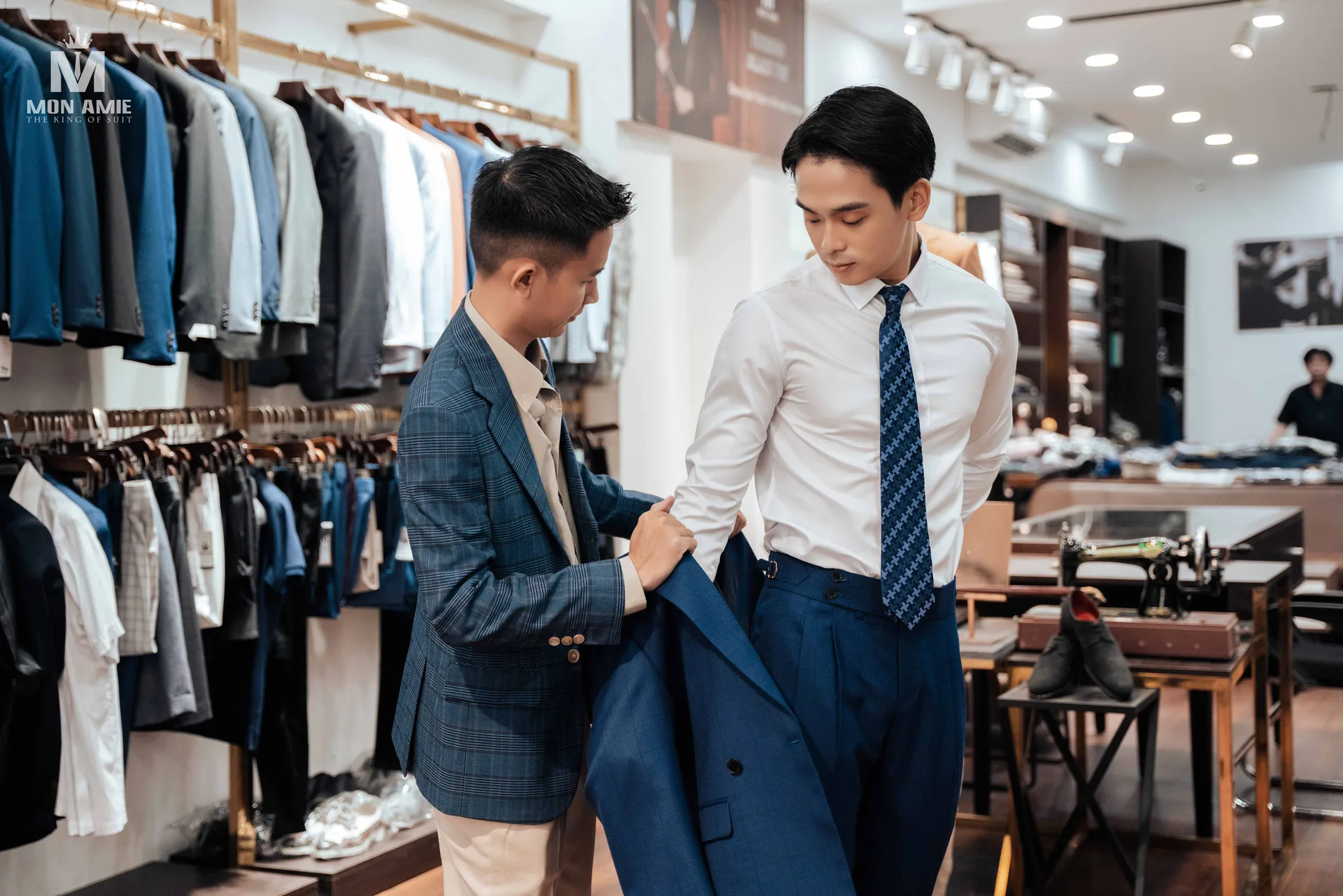
The chest and body
4. A clean chest. When buttoned, the chest lies flat, with no X-shaped creases around the button and no wrinkles at the underarm. X-shaped creases are a sign the jacket is too tight; puffing in the chest means it is too loose.
5. Front panels lying flat. The two front panels sit close to the body and do not flare out. Flaring fronts mean the jacket is too short or the cut is off.
6. A flat back. The back of the jacket has no horizontal creases and no radiating creases running down from the shoulders. A good back shows that the tailor has adjusted correctly for the curve of the customer's back.
The details
7. Matched stripes and checks. If the cloth is striped or checked, the lines must run continuously at the pocket, the shoulder, the centre back and the lapel. Matching takes extra cloth and extra cutting labour, and only a careful artisan is willing to do it.
8. Crisp buttonholes. Hand-sewn buttonholes have thick, even stitching that does not come loose. Machine buttonholes also need to be clean and straight, with no loose threads.
9. Sleeves that hang correctly. With your arms relaxed, the sleeve should hang straight along the arm, without twisting to the front or inward. A twisted sleeve is a sign the sleeve was set at the wrong angle.
10. The right sleeve length. A jacket sleeve should cover only as far as the end of the wrist, showing about 1 to 1.5 cm of shirt cuff.
The trousers and the inside
11. Trousers that fall straight. The crease runs straight from the waistband to the hem, without twisting or being pulled diagonally. The trousers fit snugly at the seat, with no horizontal creases at the crotch.
12. A clean interior. Open the jacket and the lining should be tidy, the edge binding clean and the inside pockets balanced, with no loose threads and no creases. This is the part customers rarely look at, but a master tailor always makes it as beautiful as the outside.
Does a well-made suit start with the cloth or the measurements?
The answer is both, but in a clear order. Accurate measurements are the necessary condition: without correct measurements, however expensive the cloth, the suit comes out crooked. Good cloth is the sufficient condition: with the same measurements, good wool drapes softly and holds its crease, while poor cloth goes limp after a few wearings. Between the two lies craftsmanship: the person who turns the measurements into a pattern and builds the cut, places the canvas and judges the roll of the lapel.
So if you must choose where to put your budget first, put it on a place that takes measurements carefully (bespoke takes more than 30 measurements), and only then on cloth. A suit in Signature cloth made to the right measurements is usually more beautiful than a Heritage-cloth suit made in a rush. When you have both, that is a suit for a lifetime.
The opposite signs: what does a suit that is not well made look like?
Learning to recognise beauty is sometimes easier if you know what the opposite looks like:
- A collar that bulges at the back, leaving a gap between the jacket collar and the shirt collar.
- Lapels that puff up or flare, not lying against the chest.
- X-shaped creases around the button when fastened, a sign the jacket is tight across the waist.
- Pocket openings that gape, or pockets that are out of line with the stripes in the cloth.
- Rippled shoulders or a dent beneath the shoulder tip.
- Trousers with horizontal creases at the crotch, or twisted trouser legs.
Seeing just two of these six signs gives you reason to ask for alterations before you take the suit.
A 5-minute self-check when you collect the suit
When you come in for a fitting or to collect the jacket, stand in front of the mirror and go through these steps in order:
- Button the jacket, stand straight, and look at the collar and shoulders.
- Raise both arms to shoulder height and lower them: the jacket should fall back into place by itself, not catch at the underarm.
- Sit down on a chair, buttoned or unbuttoned: the trousers should not strain and the jacket should not pull.
- Turn your body to the left and to the right: the back of the jacket should not crease horizontally.
- Check your back with a small mirror: the back is flat and the collar does not gap.
Mon Amie always includes a baste fitting and adjustments before finishing, exactly as in the process described in bespoke tailoring. You can see each step on the tailoring process page.
Tips from a Mon Amie master tailor
Do not rush to score the first fitting. The first baste always has creases, because that is when the tailor sees the real body. A good tailor does not hide the creases: they point them out to you and explain how they will fix them. If at the final fitting the shoulder is still rippled and the collar still gaps, ask for adjustments. That is reasonable, and Mon Amie's long-term alteration warranty exists for exactly this.
Mistakes when choosing a tailor for a well-made suit
- Looking only at price. An unusually low price usually comes with thin canvas and few fittings.
- Looking only at photos. A beautiful photo may be thanks to a suit shot on a model. Look at a real suit, and look inside it as well.
- Not asking how many fittings there are. A good suit always needs at least one baste fitting.
- Not asking about the warranty. Bodies change, and suits need adjusting too. Ask about the warranty before paying a deposit.
For choosing where to have it made, the article criteria for choosing a good men's suit tailor in Ho Chi Minh City has a detailed comparison table.
Frequently asked questions
What does a well-made suit look like?
A suit with a collar that hugs the neck, flat shoulders, a natural lapel roll, a clean chest, matched stripes, crisp buttonholes and comfortable movement. A beautiful suit does not only look good; it is also comfortable to wear.
What should a good suit tailor have?
An experienced master tailor, a cloth library with a clear origin, a baste fitting and alteration step, and a warranty policy after delivery. A place that lets you handle a real suit with your own hands is one worth trusting.
Where should I go for a well-made suit in Ho Chi Minh City?
Choose a place near where you live or work so that you can come for several fittings. Mon Amie has five showrooms in Ho Chi Minh City, of which the Caravelle Hotel is the main showroom.
How do I know if a suit jacket fits?
Check the shoulders (no dents, no overhang), the collar (no gap), the chest (no X-shaped creases) and the sleeves (covering the whole wrist, showing the shirt cuff). If all four points pass, the jacket almost certainly fits.
Conclusion
A beautiful suit is the sum of dozens of small things done right, not one detail made spectacular. If you want to check with your own eyes, visit one of Mon Amie's five showrooms; the artisans will show you both the right side and the inside of the suits being made.