
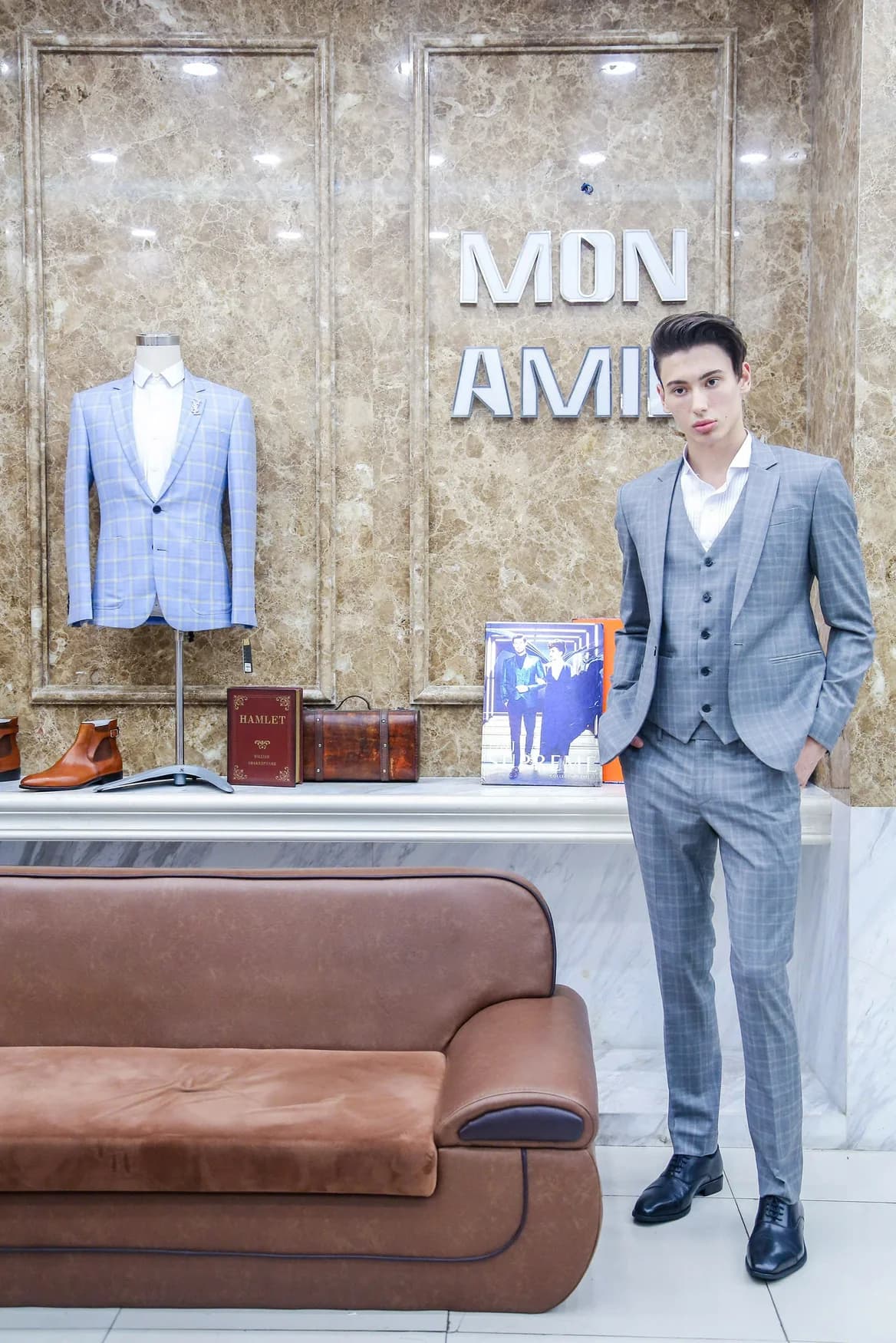
You stand 1.85 m tall, and in a ready-to-wear suit the sleeves come up a knuckle short, the trouser hems show your ankles when you sit, and the jacket skirt is short as if borrowed from someone else. Tall, large-framed men rarely lack presence; what they lack is a suit cut to their own proportions. The five suit styles for tall men below use height and shoulder width as an advantage rather than trying to shrink them.
The short answer
Tall, large-framed men should consider five styles: the double-breasted suit, the three-button single-breasted suit, the three-piece suit with waistcoat, the large-check suit and the wide peak lapel suit. The general rule is to use height and shoulder width as the advantage: a jacket long enough, a lapel wide enough, a pattern large enough, trouser legs long enough.
1. Double-breasted suit: adding width to a tall frame
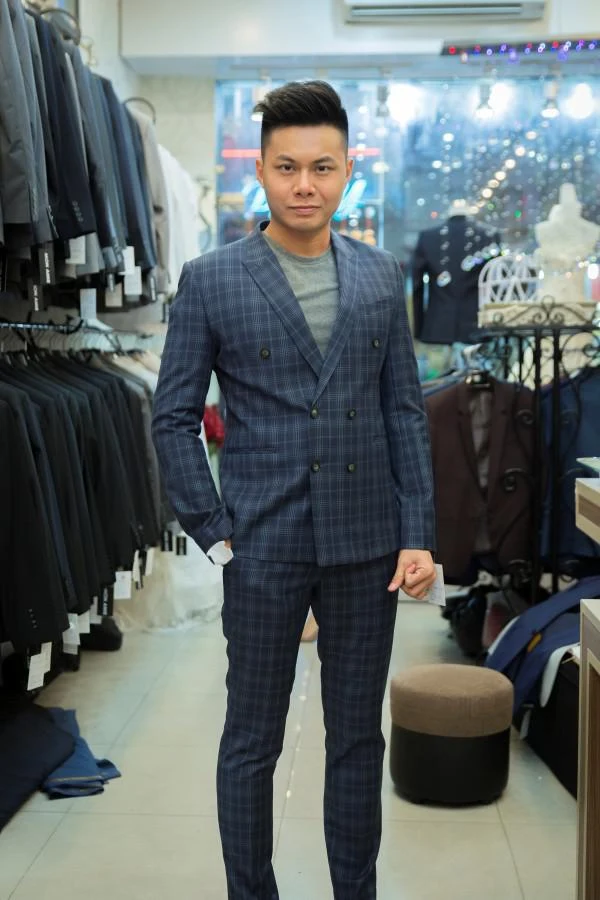
The double-breasted jacket has two parallel rows of buttons and fronts that overlap across the chest; the common structure is six buttons with two to close, abbreviated 6x2. The overlap adds width to the upper body, so this style balances a tall man with broad shoulders and a deep chest. On a small-framed man it easily becomes a heavy block.
How to wear it: a jacket long enough to cover the seat, straight-leg trousers, and a trouser turn-up (cuff) of about 4 cm to add weight at the bottom. Always button up when standing, because a double-breasted jacket left open loses its shape. A common mistake is to cut the body loose for fear of a tight chest, which leaves the overlap wrinkled and puffed. The navy check double-breasted suit in the collection is an easy example to picture: large navy checks on a double-breasted ground.
2. Three-button single-breasted suit: pacing a long jacket body
The two-button single-breasted jacket is the familiar style; the three-button version lengthens the lapel line and adds a vertical break across the chest. For a man with a long torso, that extra beat divides the chest and stomach area into three small segments instead of two large ones, so the whole jacket body looks balanced and tighter. The comparison article two buttons or three for tall men goes deeper into each point.
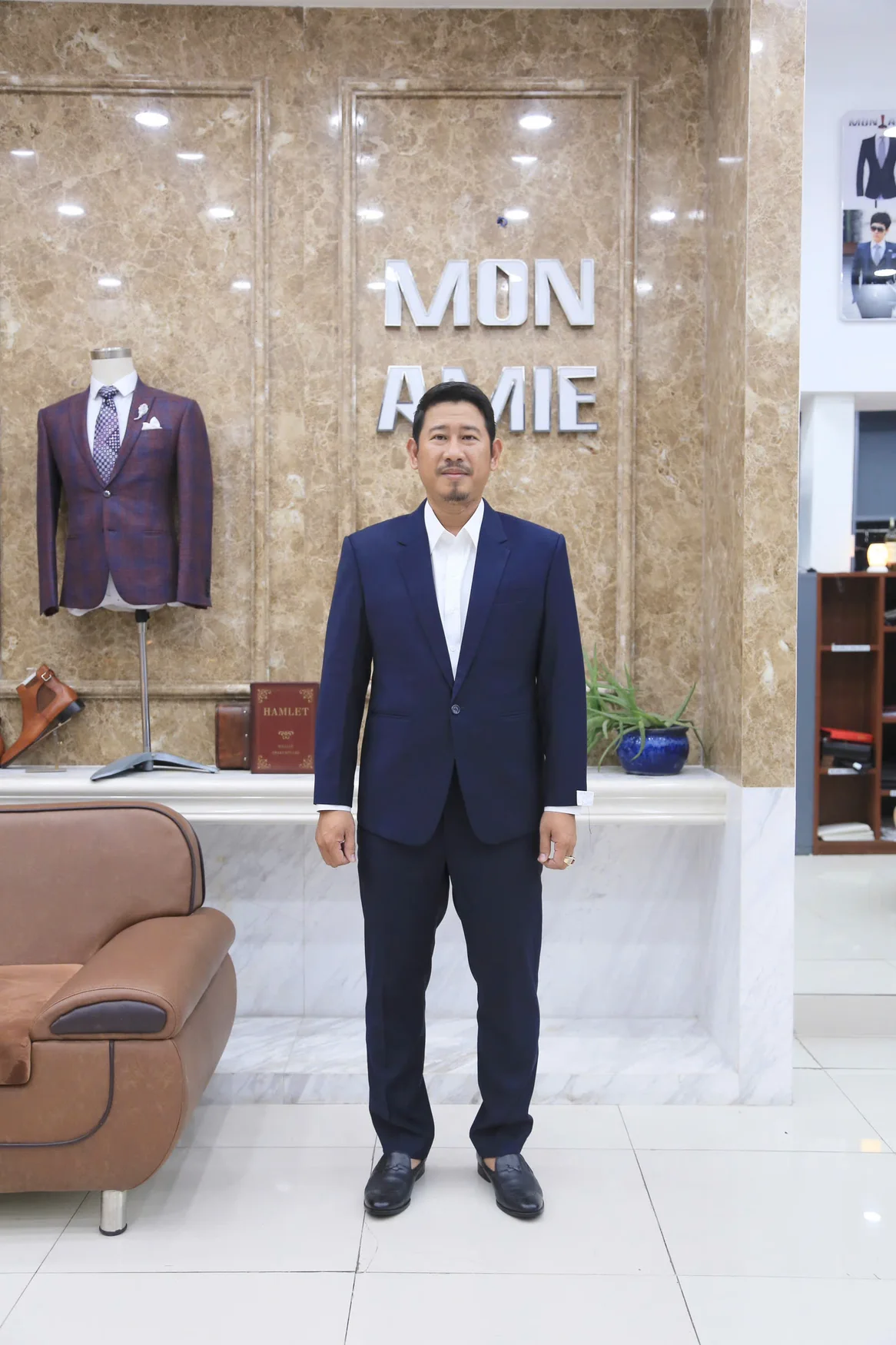
Buttoning rule: the middle button is always fastened, the top button is fastened or left to roll under the lapel depending on the jacket, and the bottom button is always left open. Two notes: the middle button should sit near the natural waistline, not lower; and a loosely cut three-button jacket easily becomes “old-fashioned”, so choose a neat cut with evenly spaced buttons. If you need a suit for everyday wear, this is the low-risk style for a tall, upright build.
3. Three-piece suit with waistcoat: filling a long torso
The waistcoat is a short layer that hugs the torso, worn between the shirt and the jacket. On a long torso, it creates a continuous block of colour from collar to waistband, keeping the shirt from billowing and making the upper body look full and deliberate. This style suits tall, slim men because it adds a layer of cloth to the frame; big-framed men can still wear it, as long as the waistcoat fits and does not bind.
The waistcoat must cover the waistband; shorter and the shirt shows, looking as though a stretch is missing. The last waistcoat button is always left open. When it is hot, take off the outer jacket and you still have waistcoat and shirt, tidy enough to stand for photos or to greet tables. Choose the waistcoat in the same cloth as the suit so the surface is one block, not split into two colours.
4. Large-check suit: pattern at the right scale for the frame
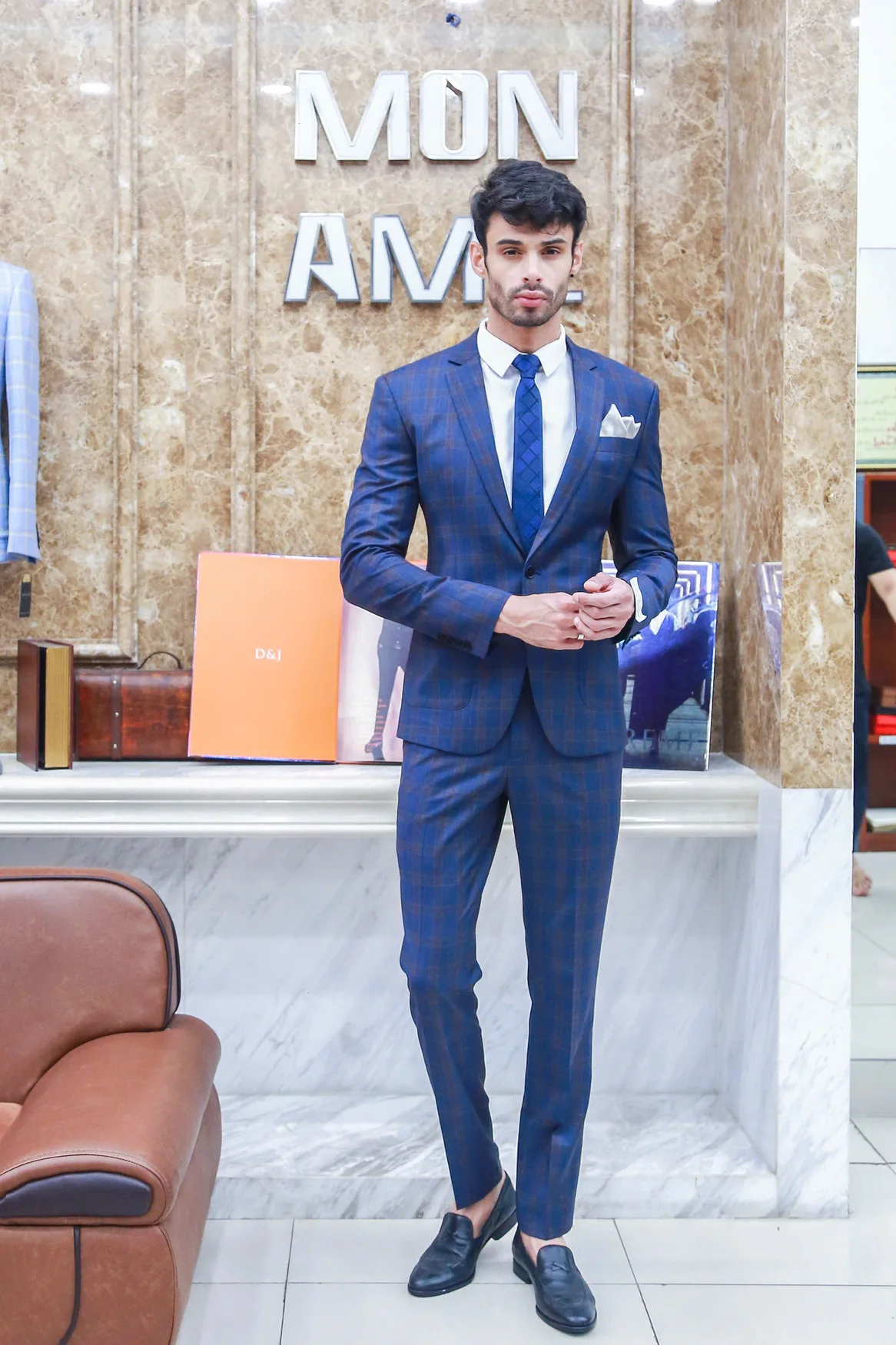
Pattern has a simple rule: the check must follow the size of the man. Tiny checks on a tall, large-framed man look lost, while large checks feel balanced, like the double-breasted example in section 1. You can choose checks in deep tones such as grey, navy or brown for the office, and lighter checks for daytime parties.
Details to inspect closely: the pattern must be matched at the shoulders, pockets and centre back, otherwise the lines break at the seams; ask the tailor to check this at the baste fitting. Pair it with a plain shirt and a plain or small-dot tie so the patterns do not fight. A common mistake is choosing checks that are too loud and then adding a striped tie as well; the result is that the viewer's eye is chopped into pieces.
5. Wide peak lapel suit: balancing shoulders and height
The peak lapel has its point directed up toward the shoulder instead of being cut with a notch like the notch lapel, the classic lapel with a small notch. On a tall, large-framed man, a wide lapel of about 9–10 cm balances the shoulder width; the narrow 6–7 cm lapel of a slim cut would look like a thread running across a broad chest.
Pair the peak lapel with a single-breasted jacket of a length that just covers the seat, and straight-leg trousers. The tie width should be roughly the lapel width, about 8–9 cm; a big lapel with a small tie is out of step. For a tall man, the jacket body usually needs extra length over the standard measurement, so tell the tailor at the measuring rather than waiting until the fitting.
Quick summary table
| Style | Suits | Remember |
|---|---|---|
| 1. Double-breasted | Tall, broad shoulders, deep chest | Always button up when standing; do not cut the front loose |
| 2. Three-button single-breasted | Long torso, wanting an everyday suit | Bottom button open, neat cut |
| 3. Three-piece with waistcoat | Tall and slim, or tall of medium build | Waistcoat covers the waistband, fits without binding |
| 4. Large check | Large frame | Match the check at shoulders and pockets, keep the rest plain |
| 5. Wide peak lapel | Broad shoulders, formal look | Lapel 9–10 cm, tie 8–9 cm |
Tips from Mon Amie's master tailors
- Settle the sleeve and body length first. These are the two spots where tall men come up short in ready-to-wear. At Mon Amie, measurements are taken at 30 points and stored for life, so the next suit does not have to be measured from scratch.
- Sit down when you try it on. A tall man's trousers ride up noticeably when he sits; the hem should rest on the instep of the shoe when standing and still cover the top of the shoe when seated.
- Do not choose a close fit just because you think close is smart. A large frame needs a fit that suits the body, enough to raise your arms without the jacket pulling up toward your neck.
- Look closely at the shoulder at the baste fitting. Broad shoulders need tight seams; a tight shoulder wrinkles diagonally across the chest.
- Choose shoes with a full toe. Shoes that are too pointed make large feet look out of step with straight-leg trousers.
Frequently asked questions
What colour suit should a tall, large-framed man choose?
Navy, charcoal grey and black give a neat, solid feel. Tall, slim men who want to add volume can choose mid-grey, beige or large-check cloth; light colours and large patterns make the body look fuller.
Should a tall, large-framed man wear a fitted suit or a loose one?
One that fits. Too tight will crease horizontally at the button and restrict movement, while too loose makes a large frame look as if it is wearing borrowed clothes. A snug shoulder, a body that fits and straight-leg trousers are the safe formula.
What should be considered in a suit for an older man?
Older age is a different need from being tall and large: comfort comes before shape. Choose soft, light cloth, a shoulder that is not too stiff, an armhole wide enough, a slightly higher trouser rise and deep colours. The article men's suits for older gentlemen covers each detail.
What if I am tall and big with a belly?
Choose a two-piece single-breasted or a three-piece, in deep tones, cloth that holds its shape, and a waistcoat that fits. The detailed approaches are in wearing a suit when you are heavyset: 9 tips.
A suit for tall men looks good when every detail is cut to the proportions of the wearer, not to a common mould. You can explore the Bespoke tailoring journey with more than 30 measurements, or book a measuring appointment so a stylist can try the styles above on a real body.