
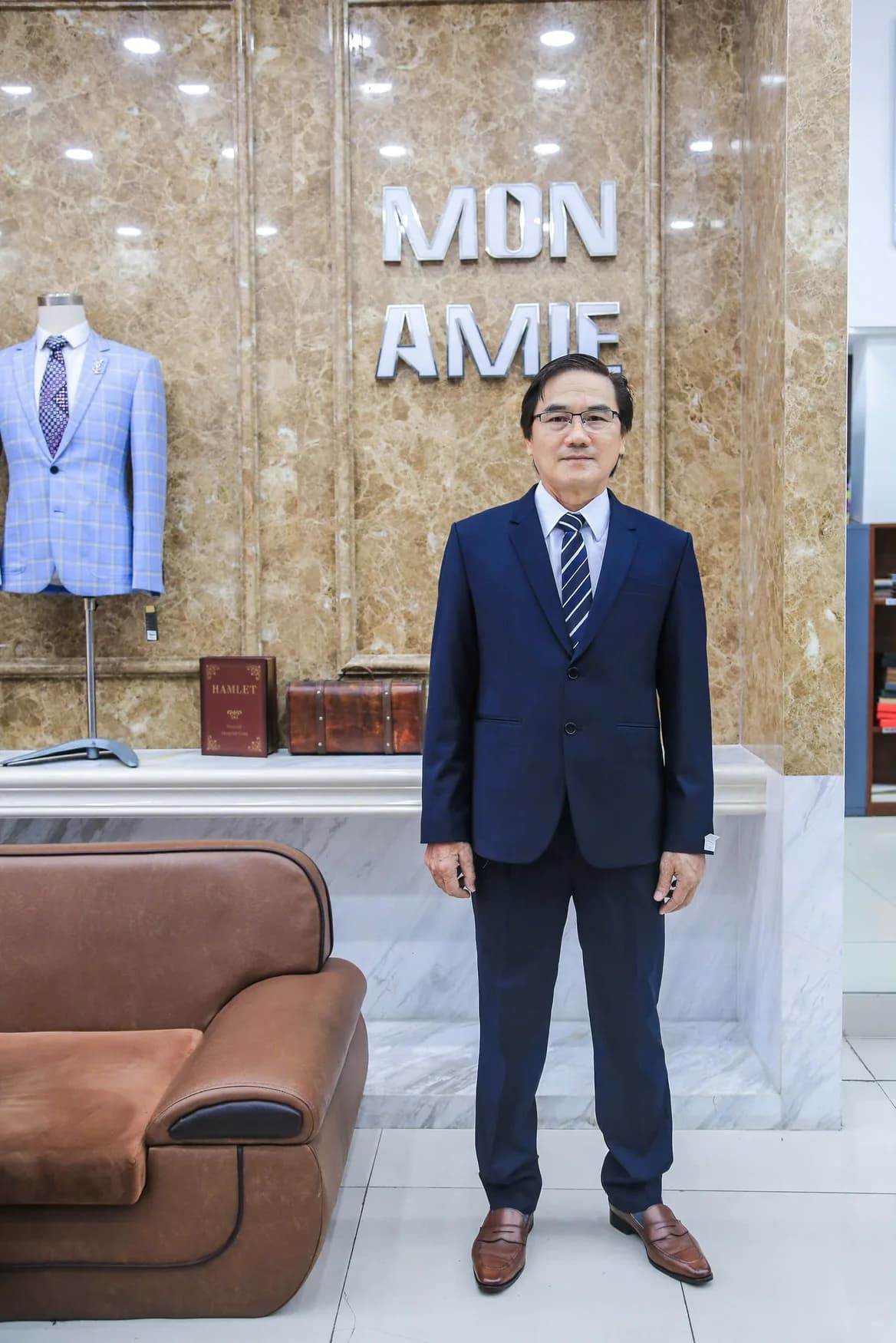
“Will a suit make me look bigger?” That question comes up at the showroom almost every week, and the honest answer always has two halves. The first half is about the suit itself: whether the shoulders, armholes, jacket length and trouser waist suit the body. The second half is mentioned by far fewer people: how you wear it. This article is about the second half, for anyone who already has a well-fitting suit and wants to know how to wear a suit when overweight so that it looks trimmer and more composed.
Quick answer
To look trimmer in a suit when overweight, do three things: fasten just one jacket button, keep the trouser waist at a moderately high position with braces or side adjusters instead of a tight belt, and let the tip of the tie reach the waistband. Choose a single dark colour, fine vertical stripes and a shirt that fits; do not choose loose clothes to feel “less tight”.
Tip 1: fasten just one button, in the right place
Two-button jacket: fasten only the top button, and always leave the bottom one open. Three-button jacket: fasten the middle button (the top one fastened or open, depending on the style). Done correctly, the two fronts form a Y, drawing the eye down the length of the body. Fasten the bottom button too and the fronts are pulled into a tight X across the stomach, which looks even bigger. When you sit, unbutton at once; when you stand up, fasten again. Three small things, but they change the line completely. The detailed rules for each style are in the article how to button a suit jacket: the rules.
Tip 2: a shirt collar that fits the neck, with a moderate spread
A tight shirt collar pushes the flesh of the neck upward and makes the face look rounder. Check by sliding one finger between the collar and the neck once it is buttoned: one finger is right. Choose a semi-spread collar (a moderate opening) or an Italian collar in proportion to the lapel. A collar that is too small and too pointed makes a round face look shorter; a collar that is too wide is out of proportion with the lapel.
Tip 3: a shirt that fits, neither loose nor tight
The classic mistake is buying a loose shirt to hide the stomach. The excess cloth balloons out under the jacket, and that is exactly what makes the stomach look bigger. A well-chosen shirt fits moderately close, with no horizontal pulling lines across the stomach, and with a tail long enough to tuck neatly into the trousers. A made-to-measure shirt lets you adjust the stomach separately from the chest, something that off-the-rack sizes find very hard to meet.
Tip 4: a trouser waist at a moderate height
A waistband that sinks below the stomach makes the stomach look “pushed out”, and the trousers keep wanting to slip down. For a fuller stomach, the waistband should sit at about the navel or just above it, wrapping over the roundest part of the stomach rather than sitting under it. A moderately high waist makes the legs look longer and lets the jacket cover more cleanly. If trousers are your particular concern, see men's trousers for a bigger stomach.
Tip 5: braces or side adjusters instead of a tight belt
A belt cuts across the stomach and divides the body in two, which emphasises the stomach. Braces (suspenders) or side adjusters (adjustable tabs at the hips) hold the trousers from the shoulders or from both sides, so the trouser line falls straight, does not drag down, and does not squeeze the stomach when you sit. The braces should match the trousers or be close to their colour; do not use contrasting braces that cut across the body.
Tip 6: a tie at the right length, with a neat knot
The tip of the tie should reach the trouser waistband, not the belt buckle. Shorter, and it reveals the stomach area; longer, and the tie hangs over the stomach like an arrow pointing exactly where you do not want people to look. Choose a moderate tie width in proportion to the lapel, and tie a four-in-hand or a half-Windsor. A large Windsor knot makes the neck look shorter. A fine diagonal-stripe or plain tie is also better than a large pattern.
Tip 7: a single dark colour, fine vertical stripes
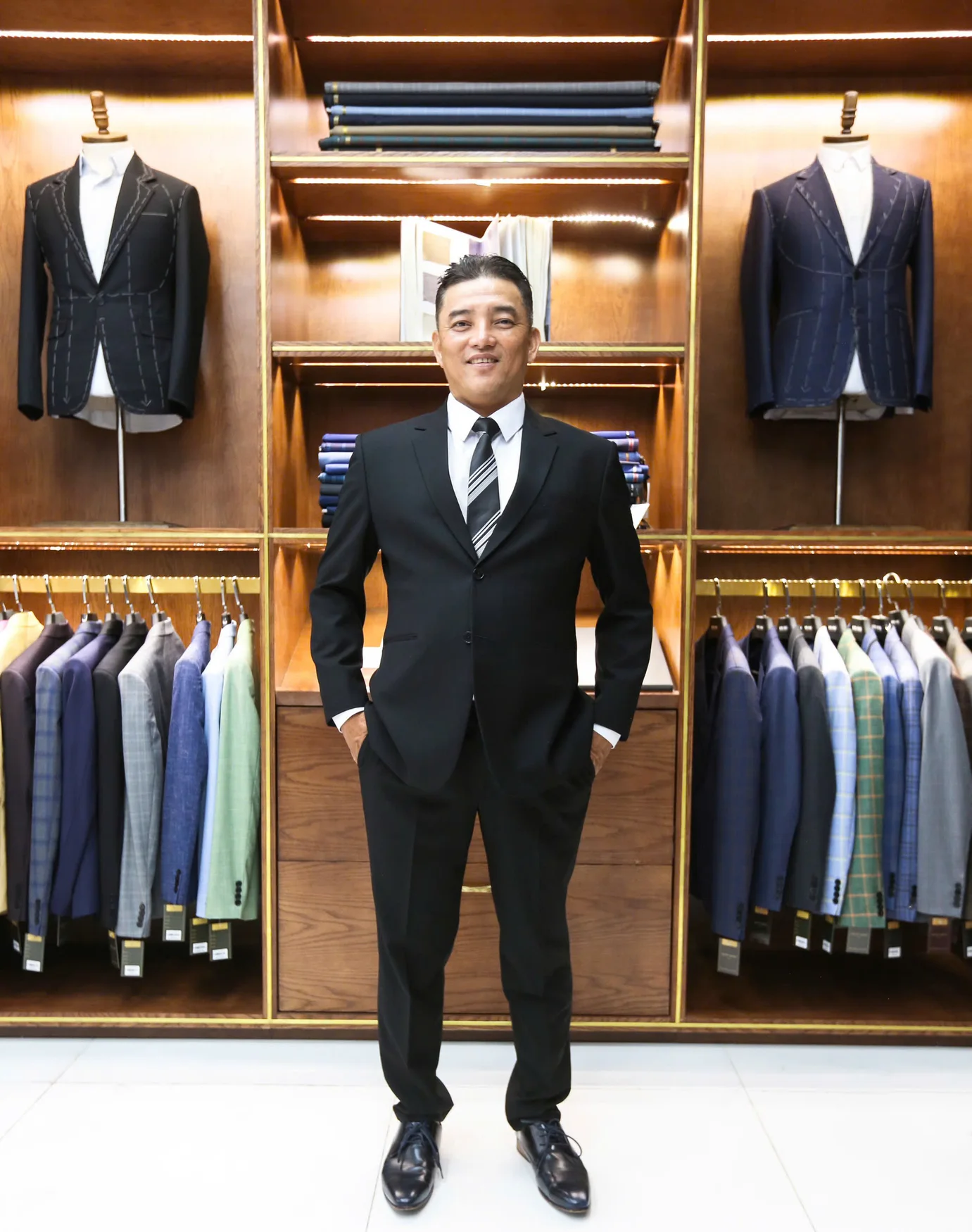
Dark colours such as navy, midnight blue, charcoal and blue-black absorb light, and the lines draw in. Matching jacket and trousers in the same colour (a full suit) forms a single unbroken vertical line, which is far more effective than a one-colour jacket with differently coloured trousers. Fine vertical stripes (pinstripe) pull the eye vertically. Avoid large checks, large-scale patterns and glossy cloth, because they exaggerate surface area.
Tip 8: tidy pockets, accents near the face
Jacket and trouser pockets stuffed with a wallet, phone and keys puff out the hips and thighs and ruin the seam line. Leave these things in a bag or in the inside pocket. Conversely, put the accent near the face: a flat-folded pocket square, a clear lapel line, a tie slightly lighter in colour. The eye is drawn upward, away from the stomach.
Tip 9: posture and how to sit
Shoulders open, chin slightly tucked and stomach gently drawn in: three things that make a big difference in photos. Stand turned about 45 degrees instead of facing the camera squarely, with the line of the shoulders slightly angled, and the front of the torso reads narrower. Do not push your hands deep into your trouser pockets, since that makes the jacket flip up. When seated, unbutton the jacket, sit straight, and lightly tug the trouser leg at the knee. These cost nothing, and work better than many people think.
Suit styles for larger men: which cut to choose
Styling tips only work when the cut is right. Here is a summary table for anyone looking for suit styles for larger men:
| Detail | Choose | Avoid |
|---|---|---|
| Jacket style | Single-breasted, two buttons | Double-breasted, fronts that overlap too far |
| Lapel | Notch lapel of moderate width | Lapel that is too small or too large |
| Cloth | Wool that holds its shape, matt surface | Shiny cloth, cloth that is too thin and clings |
| Back vent | Double vent (one at each side) | No vent, which pulls tight across the hips when seated |
| Colour | Navy, midnight blue, charcoal | Bright shiny colours, large patterns |
If you want to go deeper into the overall cut, the article suits for larger men: 8 principles for choosing the cut sets out the principles from shoulders and chest to jacket length.
Common mistakes
- Choosing a larger size to be comfortable. A jacket that is loose at the shoulder sags and loses its line; a fuller man needs a jacket that fits at the shoulder first, with the stomach adjusted afterwards.
- Fastening the bottom button, or fastening it while seated.
- Wearing a T-shirt or a thick undershirt underneath, which stretches the cloth further.
- An oversized belt or a big buckle sitting right where the stomach protrudes.
- Forcing in low-rise trousers hugging below the stomach, which leads to sagging trousers and a flat seat.
Tips from the master tailors at Mon Amie
The shoulders of a jacket cannot be altered much, so choose the jacket by the shoulders first and adjust the chest, waist and stomach afterwards. For a fuller figure, a made-to-measure suit differs from a ready-to-wear one precisely here: the master tailor leaves extra cloth in the body and eases the stomach while keeping the shoulders and armholes standing correctly, creating a natural curve rather than a strained line.
Frequently asked questions
What style of suit should an overweight man wear?
Choose a single-breasted, two-button suit with a moderate notch lapel, in matt dark wool, with double vents. The jacket should be long enough to cover the seat, or fall just past it, to cover the hips. Avoid short jackets, double-breasted jackets and shiny cloth. When possible, go made-to-measure so that the stomach measurement is taken separately.
Which suit colour works for a larger man?
Navy, midnight blue, charcoal and blue-black are the four safest colours, because they slim the line and are easy to pair with shirts. If you prefer something lighter, choose mid grey or dark brown, and avoid white, cream and glossy colours.
Should a larger man wear a three-piece suit?
It can work, if the waistcoat fits properly and matches the colour of the suit. A well-fitting waistcoat creates a vertical line, but a tight waistcoat makes the stomach more prominent. If you carry a fuller stomach, try the waistcoat on before deciding, and skip it if the buttons pull.
Should you wear a tight suit to look slimmer?
No. An over-tight suit stretches the cloth and shows every fold at the stomach and armholes. A well-fitting suit has just enough ease for the cloth to drape straight, and that is the suit that actually flatters the figure.
In closing
A well-fitting suit is the necessary condition; how you wear it is the sufficient one. Knowing how to wear a suit when overweight is not about hiding, but about choosing the lines that let the body stand straight and neat. The nine tips above cost nothing extra; you only need to do them right before you leave the door. If you want a suit with every circumference measured separately, you are welcome to visit a Mon Amie showroom to experience bespoke tailoring or to book a measuring appointment first.