
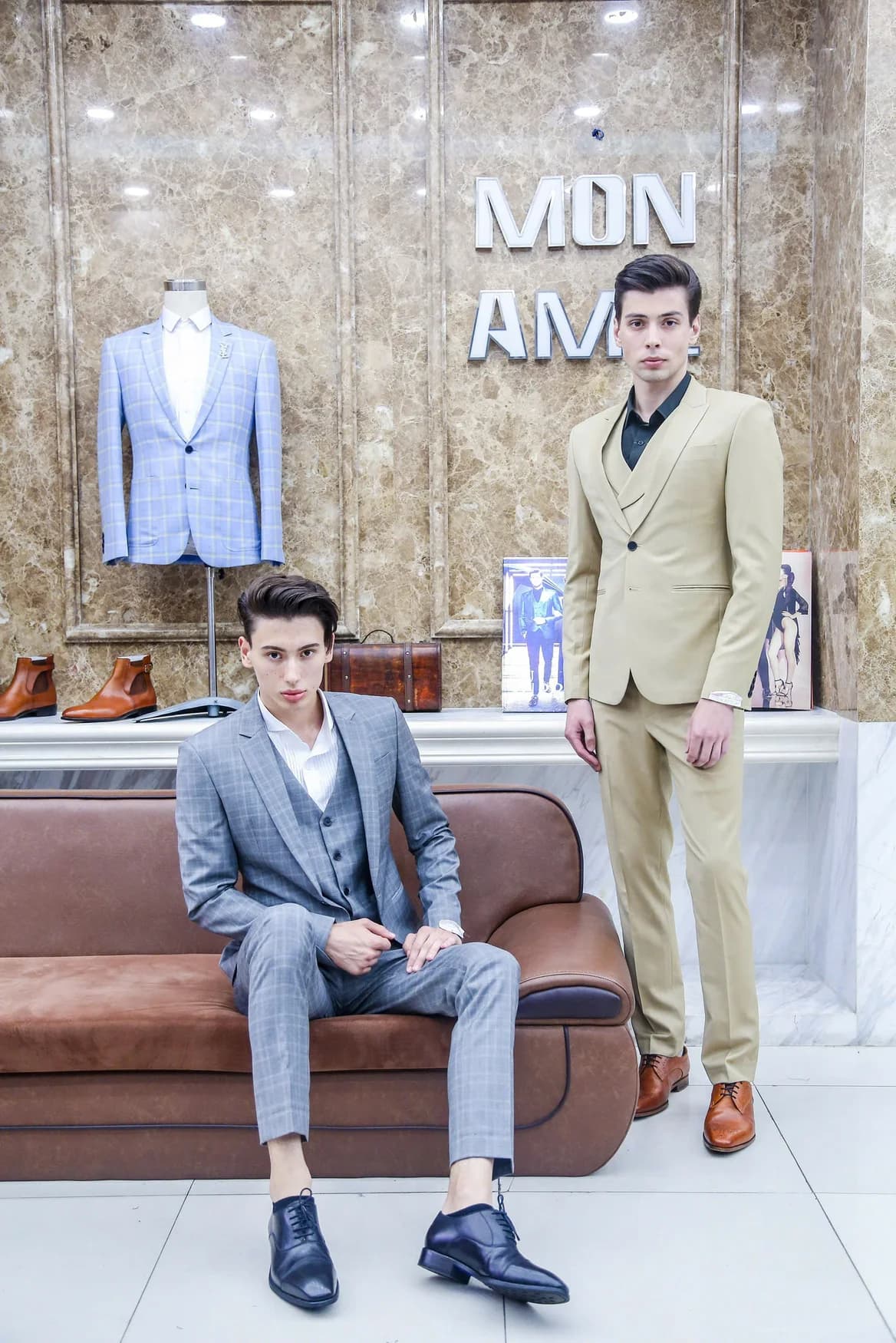
Clients with broad shoulders and a full chest tell much the same story: they try a ready-to-wear suit, and when the shoulders fit, the chest strains; when the chest fits, the body hangs loose; and the moment they lift an arm, the whole hem rides up. The build is not at fault: a V-shaped frame is exactly what a suit was made to flatter. It is just that ready-to-wear is cut to average proportions, and this man is not average. Choosing a suit for broad shoulders means choosing the right five details below.
The short answer
A suit for a man with broad shoulders and a full chest should have five features: a soft shoulder with little padding, a lapel of medium to wide width, a moderately suppressed body with a slightly low button stance, deep tones with a subtle tonal vertical stripe, and a high armhole with side vents. The aim is not to hide the shoulders but to let the jacket follow the V-shape.
1. Soft shoulder, light padding: let the shoulder line follow the real shoulder bone
A thick padded shoulder is a way of making shoulders wider; a man whose shoulders are already broad does not need it. A soft shoulder, with thin or almost no padding, lets the shoulder line follow the true shoulder bone, so the shoulder head does not stand up as a “block”. The edge of the shoulder should end exactly at the point of the shoulder, neither poking beyond it nor dropping onto the upper arm. A shortfall of 1 cm already reads as hollow, an excess of 1 cm already reads as sagging, so men with broad shoulders have to be more demanding about the shoulder than about any other spot.
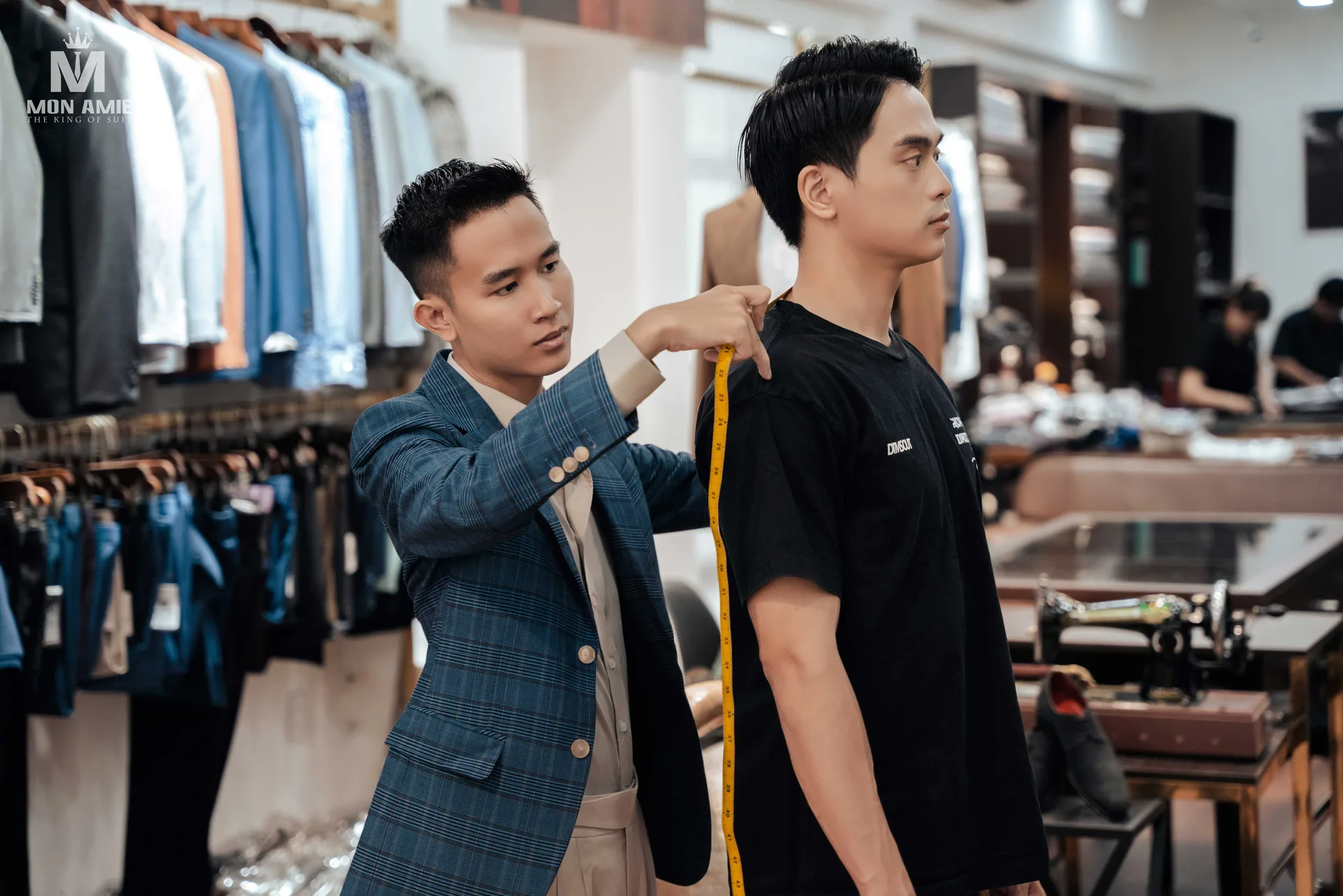
The shoulder is one of the hardest parts of a suit to alter, since it is the hanging point of the whole jacket. That is why at Mon Amie the first step is measuring the shoulder directly with a tape measure, as in the photo, among the more than 30 measurements stored for life. Read more in how to measure a suit shoulder correctly to see how measuring on the body differs from measuring on a jacket.
2. Lapel of medium to wide width: balance the chest panel
A narrow lapel on a broad chest is like a small frame hung on a large painting: out of proportion, and it makes the chest look bigger. A medium to wide lapel, around 8–10 cm at the widest part, divides the chest panel more sensibly. A notch lapel on a single-breasted jacket is the safe choice. A peak lapel draws the eye out toward the shoulder, so for a man whose shoulders are already broad, consider it carefully and try it in front of the mirror.
Conversely, a lapel that is too large can make the chest look fuller than necessary. The secret is proportion: a lapel wide enough to match the width of the chest, yet still leaving a gap of plain cloth between the lapel edge and the point of the shoulder. Read should men with broad shoulders choose wide or narrow lapels if you want to go deeper.
3. Moderately suppressed body, slightly low button stance: keep the V-shape
Men with broad shoulders and a full chest usually have a trim waist, meaning the difference between chest and waist is greater than average. Ready-to-wear is graded by a fixed difference, so this man tends to be tight at the chest or loose at the waist. A made-to-measure jacket for him suppresses moderately at the side seam, hugging the waist without binding, so the skirt drops straight from the chest. Too deep a suppression strains the buttons and creates X-shaped creases running from the button to both sides.
The button stance set slightly low, about level with the natural waist, lets the V open longer and deeper, making the upper body look slimmer. A two-button jacket is the standard choice; a stance set too high makes the V narrow and the torso look shorter. When trying on, fasten the button and raise your arms to shoulder level: the skirt must neither ride up nor gape at the button.
4. Deep tones and a tonal vertical stripe: gather the mass, lengthen the torso
Navy, charcoal grey and midnight blue are colours that gather mass: the shoulders and chest look neater than in a light colour or a large pattern. A tonal vertical stripe in the same shade as the ground, visible only up close, lengthens the torso without announcing itself. Avoid large squares or wide checks running across the chest, since the horizontal lines will emphasise the width you are trying to keep neat.
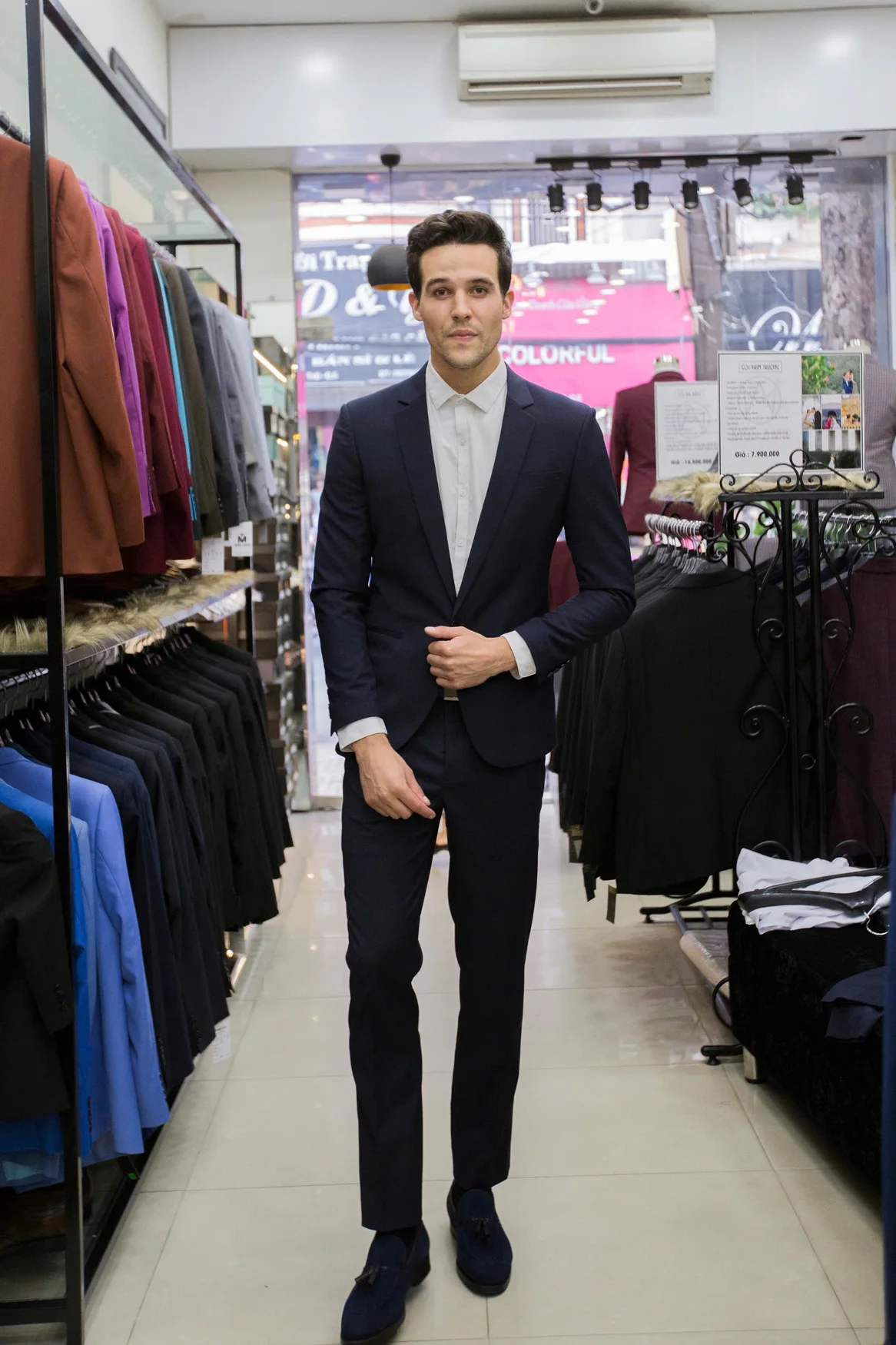
Navy with a white shirt, as in the photo, is an easy foundation. As for cloth, choose a tightly woven wool with some body and a surface that is not harshly glossy; cloth that is too soft will cling to every muscle, and cloth that is too glossy makes the chest patch with light. You can look at the cloth library to compare composition and cloth lines before choosing.
5. High armhole, roomy sleeve, side vents: room for the muscle to move
Men with broad shoulders and a full chest usually have large upper arms and a broad back, so they need room to move. A moderately high armhole lets you raise your arm without the body of the jacket following; the sleeve is wide enough at the bicep and then tapers toward the wrist; at the cuff, 1–1.5 cm of shirt should show. The back should have side vents (double vent) rather than a centre vent, so the skirt does not gape when you put a hand in a trouser pocket and falls smoothly when you sit.
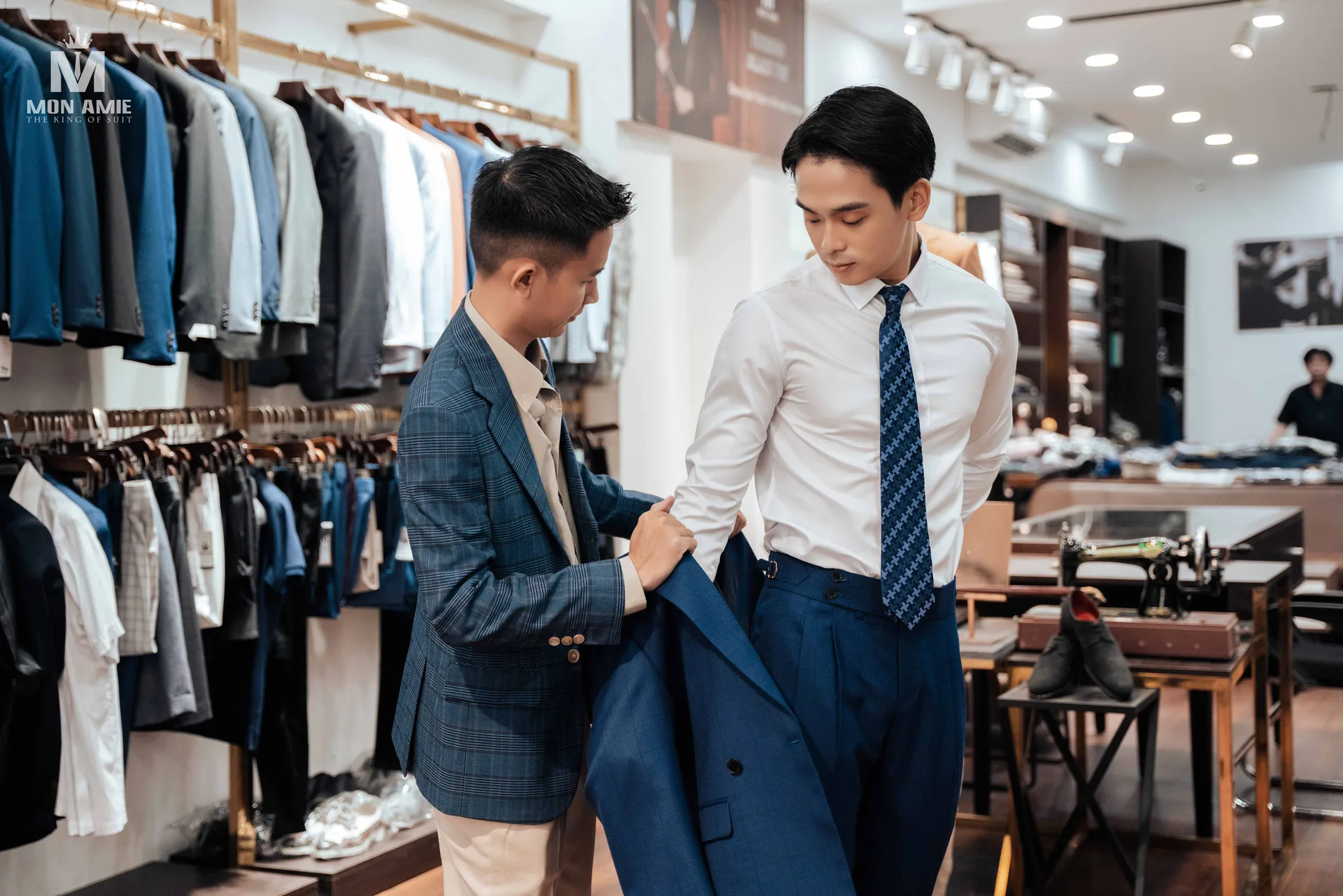
The baste fitting is the decisive moment, as in the photo where the tailor is adjusting the fit around the shoulder and sleeve. Raise your arms, wrap your arms around, then sit down to check all three. Wherever it still pulls, tell the tailor right then, because the garment is not finished and adjusting is still easy.
Quick summary table
| Style | Suits | Remember |
|---|---|---|
| 1. Soft shoulder, light padding | Broad, square shoulders | Edge ends at the point of the shoulder; be pickier about the shoulder than anywhere else |
| 2. Notch lapel of medium to wide width | Full chest, fuller upper body | Lapel about 8–10 cm; consider a peak lapel with care |
| 3. Moderate suppression, low stance | Full chest, trim waist | Not tight; no X-shaped creases at the button |
| 4. Deep tones, tonal vertical stripe | Men who want a neater line | Avoid large checks at the chest |
| 5. High armhole, side vents | Large biceps, broad back | Raise arms, wrap arms, sit at the baste fitting |
Tips from Mon Amie's master tailors
- Bring a shirt that fits you when you come to be measured, since a full chest often makes ready-to-wear shirts strain at the buttons, and measurements taken over a wrong-fitting shirt will drift accordingly.
- Tell the tailor if you train at the gym: chest and bicep measurements can change month to month, so the jacket needs enough seam allowance to be let out.
- Check your side profile and your back as well: a horizontal crease across the back of the jacket is a sign that the shoulder or armhole does not yet fit.
- Avoid suit sleeves that are too short: with a large bicep, a short sleeve makes the wrist look small and the body look bigger.
- A good suit for broad shoulders is not tight, but it is not loose either: you should be able to move without noticing you are wearing a suit.
Frequently asked questions
Should a man with broad shoulders wear a slim fit or a regular fit suit?
There is no general answer, since ready-to-wear “slim” and “regular” are both cut to an average difference. What is needed is a fit across the shoulders and chest first, then neatness at the waist. A ready-to-wear slim-fit suit tends to be tight at the chest for this man; if you like a neat silhouette, made-to-measure with a trimmer waist is the safer route. The article Japanese-Style Men's Suit also shows who a neat-shoulder cut suits.
Can a ready-to-wear suit that is tight at the shoulders be altered?
The body, sleeves and length can be altered within limits; the shoulder is very difficult, since it is the hanging point of the whole jacket. If the shoulder is tight from the start, it usually makes more sense to make a new suit to your actual measurements. A made-to-measure suit at Mon Amie starts from your own shoulder measurement.
What if I have broad shoulders but a slim build?
You still keep the principles of a soft shoulder and a moderate lapel, but you need room to build fullness at the chest. The article suits for slim men: choosing a cut for fuller shoulders and a stronger frame explains in more detail.
Which cloth suits broad shoulders and a full chest?
Tightly woven wool of medium weight, with body, a surface that is not glossy, in deep colours. For people who work in an office, 100s–120s wool is the comfortable zone in Saigon; the showroom will advise a specific cloth line when you come to the cloth library.
Conclusion
Choosing a suit for broad shoulders and a full chest is a matter of proportion: broad shoulders and a full chest are the natural capital of a suit's silhouette; with a moderate lapel, a soft shoulder, a correctly suppressed body and deep tones, the suit follows your build instead of fighting it. You can book a measuring appointment to have your shoulder measured in person, or read Office suits: choosing cloth, lining and style to wear all week if this is your everyday work suit.