

In early December you pull your wool suit jacket out of its garment bag and notice two things at once: a faintly damp, closed-up smell from the wardrobe, and tiny balls of fibre clinging at the elbows and under the arms. The question comes straight away: how do you wash it now? How to wash a wool suit jacket is nothing like washing a shirt or a pair of trousers, because felted wool is a cloth that “remembers” every mistake: one hot-water soak or one ordinary machine cycle and the jacket thickens, shrinks and never returns to what it was.
Quick answer
A wool suit jacket should not be machine-washed or soaked in water regularly. Pure-wool cloth and jackets with interfacing should be dry cleaned about once a season; day to day, simply brush off the dust, hang the jacket somewhere airy and steam it lightly. Only a wool-blend jacket whose label allows it may be hand-washed in cold water, never wrung or twisted, and laid flat to dry.
What is felted wool cloth, and why does it shrink so easily?
Felted wool cloth is woven wool that then goes through a “felting” step: the cloth is dampened, pressed and worked so that the wool fibres tangle into one another, giving a thick, warm surface with a soft nap. Wool fibre is naturally covered in microscopic scales, much like fish scales. When three conditions meet, heat, water and friction, the scales lock tightly together and the cloth shrinks. The process cannot be reversed.
That is why every piece of advice on washing a wool suit jacket comes down to avoiding one of those three conditions. Hot water, a hard machine spin or scrubbing by hand all felt the cloth one more time.

Telling pure wool from wool blends
To know how your wool jacket can be washed, the first thing is to know which group the cloth belongs to. There are three ways, from easiest to hardest:
- Read the composition label on the inside side seam. “100% wool” means pure wool. “Wool 50%, polyester 50%” or similar means a wool-blend cloth.
- Use your hands. Pure wool feels warm, soft and slightly “alive”; squeeze it into a fist and let go, and the cloth springs open slowly. Blends with a lot of synthetic fibre are usually slicker, crease less and feel a little cool to the touch.
- Try a thread when there is no label. Pull one thread from the edge of the cloth in an inside allowance (never from the outer face) and hold it near a small flame in a safe place. Wool burns slowly, curls away, smells like burning hair and leaves a crumbly ash that is easy to crush. Polyester melts and forms hard beads.
| Feature | Pure wool | Wool blend |
|---|---|---|
| Feel when worn | Warm, soft, breathable | Slightly slick, stuffier in the heat |
| Creasing | Creases fall out after hanging | Few creases, holds a crease well |
| Pilling | Little, but longer fibres do pill | Pills more readily at friction points |
| Shrinkage in water | Pronounced | Yes, but milder |
| Recommended washing | Dry cleaning | Dry cleaning, or hand washing if the label allows |
When is dry cleaning a must?
Dry cleaning uses a solvent instead of water, so it does not felt the wool any further. We recommend taking the jacket to a cleaner in these cases:
- The jacket has chest interfacing, padded shoulders or a lining: water makes these layers shrink unevenly and the jacket twists out of shape.
- Grease, red wine or ink stains: these need a specialist solvent.
- At the end of the season, before you put the jacket into its garment bag: leftover dust and fine traces of sweat attract insects.
- The label shows a circle (dry clean) or a crossed-out washtub.
Two small points when you hand it in. First, tell the staff clearly that this is a wool jacket with interfacing so they choose the right steam-press setting. Second, when you get the jacket back, take off the plastic bag at once and hang it somewhere airy so the smell of solvent can disperse. Left in the bag, the jacket easily turns damp. If you want to understand what happens at the cleaner's, the article what dry cleaning a suit jacket is describes each step.
How to wash a wool-blend suit jacket at home: 6 steps
Only apply this when the label does not forbid washing in water and the jacket is a wool blend without stiff interfacing. For a made-to-measure jacket with half-canvas interfacing, we still prefer dry cleaning.
- Test the colour first. Put one drop of water on a hidden inner edge of the cloth and press a white cloth over it; if the cloth picks up colour, stop.
- Mix cold water (no warmer than 30 °C) with a neutral detergent or one made specifically for wool. Avoid alkaline soaps and bleach.
- Soak for 10–15 minutes, pressing gently only so the water soaks in. Do not scrub the collar or underarms with a stiff brush.
- Rinse twice in cold water, lifting the jacket with both hands so the shoulders are not stretched.
- Press the water out; do not wring. Lay the jacket on a large bath towel, roll it up and press gently so the towel absorbs the water.
- Dry it flat on a dry towel or a mesh rack. Only when it is nearly dry, move it to a wide shoulder hanger, somewhere with a breeze and out of direct sun.
A wet wool jacket is very heavy. Hang it on a hanger while it is still soaked and its weight will drag the shoulders down and leave marks that cannot be repaired.
Brushing, steaming and dealing with fluff at home
Most of the time, a wool jacket does not need water; it needs dry care. These are the three things to do after every few wearings:
- Brush off the dust with a soft-bristle brush, in the direction of the nap, from the shoulders down to the skirt. Brush lightly, because pressing hard flattens the nap.
- Steam it with a steam iron: hold the iron 3–5 cm from the cloth, never pressing directly, so the steam loosens creases and opens up the fibres. If you must iron, lay a damp cotton cloth over it and iron on the wrong side with the setting at wool.
- Remove fluff with a handheld fabric shaver. Lay the jacket flat on a firm surface and glide lightly in one direction. Never pull the fuzz off by hand, because the base fibres get tugged out and the pilled patch only grows.
Pilling appears where friction repeats, such as the elbows, the underarms and the side where a shoulder-bag strap rubs, because short fibres are rubbed into tangles and form little balls. Brush early and regularly and the jacket will pill less. If the jacket is already badly pilled, see also wool fabric pilling: causes and how to fix it.
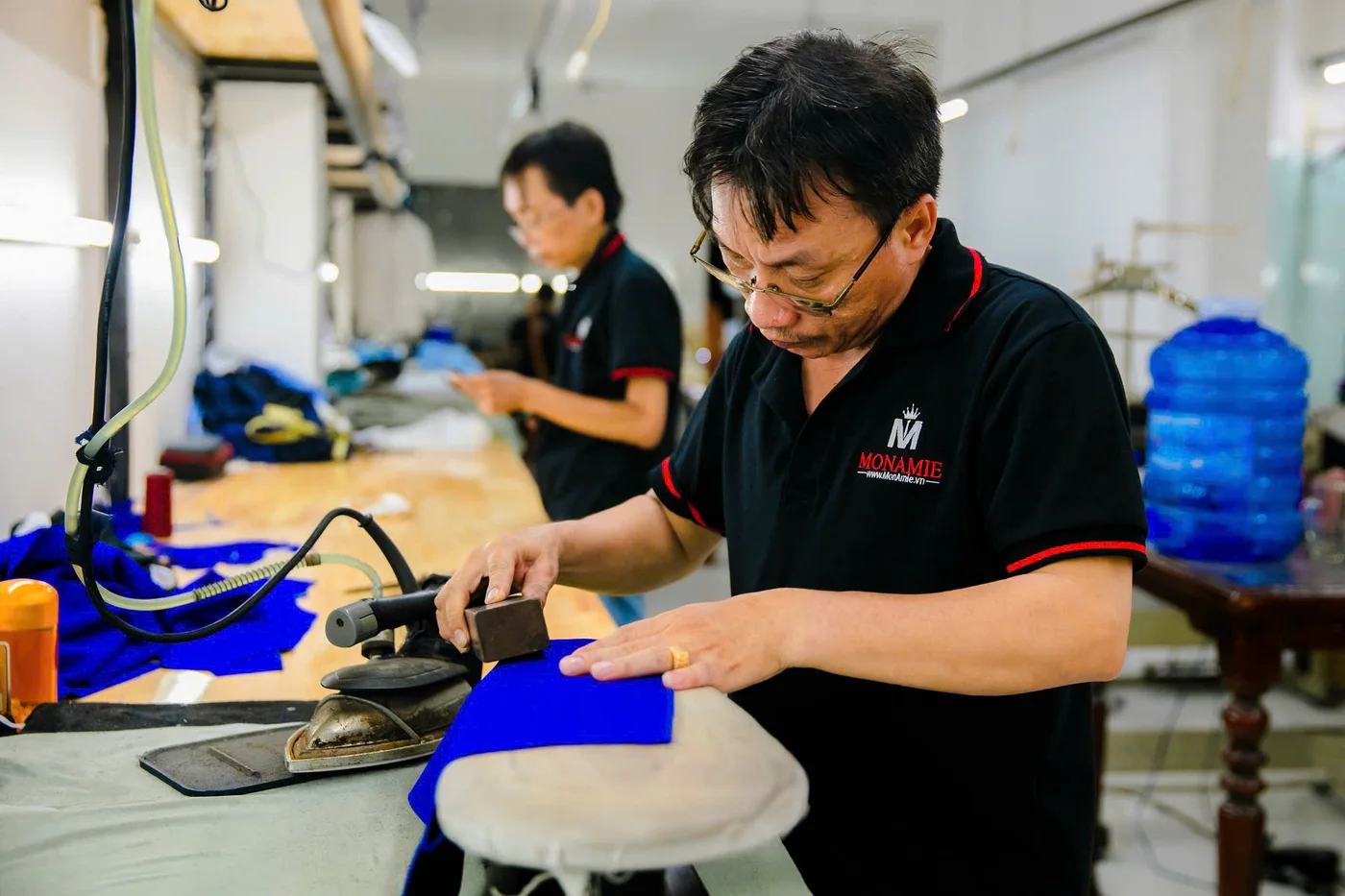
Tips from Mon Amie's master tailors
- Let the jacket rest. Rotate two or three jackets, and let each one rest at least a day on a wide shoulder hanger after wearing. Wool fibres recover on their own when given time.
- Don't stuff the pockets. A wallet, phone and keys drag the skirt down and wear the cloth at the pocket openings faster.
- With a made-to-measure jacket, favour steam over water. The interfacing inside a made-to-measure jacket reacts differently to water, and the shoulders cannot be re-made once they have been knocked out of shape.
- Choose the cloth from the start. When you order a new jacket, ask for the exact wool composition in the fabric library so you know which cloth suits the climate and is easy to look after with your habits.
Common mistakes when washing a wool suit jacket
- Putting it in the washing machine on a normal cycle with warm water.
- Putting it in the dryer, even just to “fluff up the cloth”.
- Drying it in harsh sun on a line, which both marks the shoulders and fades the colour.
- Hanging it for long on a wire hanger or the thin hanger from the cleaner's.
- Spraying perfume or deodoriser directly onto the cloth.
The article how to wash a suit at home lists more cloth types so you can compare.
Frequently asked questions
Can a wool suit jacket be machine-washed?
Usually not. Pure wool shrinks noticeably when it meets water and the machine's spin, and a jacket with interfacing easily twists out of shape. The rare exception is a wool blend whose label permits a machine wash on a wool cycle, in cold water, inside a mesh bag; even then we still advise hand washing or dry cleaning.
How does pure wool cloth differ from a wool blend?
Pure wool cloth is warmer and more breathable and creases less, but it is more sensitive to water. A wool blend has added synthetic fibres such as polyester or acrylic, holds a crease better but pills more easily and feels stuffier in the heat. The composition label is the surest way to tell them apart.
Can a pilled wool suit jacket be saved?
Yes, if it is handled properly. Glide a fabric shaver over it lightly, then brush off the dust and steam it so the nap lies down again. Do not pull the fuzz off by hand. Light pilling can be dealt with completely, while cloth that has already worn thin can only be improved somewhat.
How often should a wool suit jacket be dry cleaned?
For a jacket worn regularly through the cool season, one dry clean at the end of the season is reasonable, plus extra when there is a stain. Dry cleaning too often leaves the cloth dry and takes away its softness, so between cleans use brushing and steaming.
Conclusion
A wool suit jacket is more durable than many people think, as long as you avoid the combination of heat, water and friction. If you are unsure which wool to choose for your next cool-season suit, come to a showroom or book an appointment and let a stylist put each cloth in your hand so you can feel it for yourself.