

Look at a suit jacket hanging in your wardrobe from behind. Do you see two sharp peaks sticking up above the shoulders? That is the sign of a hanger that is too small or too thin, and it is pulling the shoulders into a shape they never had. The shoulder is the one part of a suit jacket that can hardly be repaired, yet it is also the part most often ruined by a cheap suit hanger in the wardrobe.
Quick answer
The right suit hangers are wide wooden shoulder hangers, curved to follow the shoulder and as wide as the jacket's shoulders. Hang trousers on a hanger with a clip bar, and waistcoats on compact hangers. Avoid wire hangers, thin plastic hangers and undersized hangers, because they dent and distort the shoulders.
Why the hanger decides the shape of the shoulder
The shoulder of a suit jacket is built in several layers: the shoulder pad, the chest canvas and the inner lining. That structure keeps the jacket in shape even when no one is wearing it. But when it hangs, the entire weight of the jacket bears down on two points of the shoulder. If the hanger doesn't follow the curve of the shoulder, the jacket will:
- Dent in the middle of the shoulder: a hanger that is too thin leaves a sunken line.
- Grow two horns: a hanger that is too small pulls the fabric up into two peaks.
- Droop at the shoulder: a hanger that is too wide pushes the shoulder outward and distorts the canvas.
- Wrinkle at the chest: a hanger that doesn't support enough weight lets the chest of the jacket sag.
This damage accumulates over time. Every week of hanging it wrongly is another week in which the shoulder remembers the wrong shape.
Choosing a shoulder hanger: the right size and the right shape
Measuring the hanger size against the jacket's shoulder
Measure the width of the jacket's shoulder, the distance from the shoulder seam on one side to the shoulder seam on the other. The hanger should touch exactly those two points, neither sticking out nor falling short. A typical men's suit hanger runs from about 43 to 46 cm, but measure each jacket rather than choosing at random.
| Hanger condition | Consequence | Fix |
|---|---|---|
| Hanger smaller than the shoulder | Shoulders collapse, horns at both ends | Change to a wider hanger |
| Correctly sized hanger | Shoulders keep a natural shape | Keep it |
| Hanger wider than the shoulder | Shoulders pushed out, seams strained | Change to a smaller hanger |
| Straight, thin hanger | Dent in the middle of the shoulder | Use a thick, curved shoulder hanger |
Hanger shape
- Thick, curved wooden shoulder hanger: the right choice. The curve follows the shoulder and the thickness carries the weight.
- Hanger with shoulder padding: suits thin jackets and wool overcoats, and distributes the load evenly.
- Hanger with a crossbar (bar): lets trousers hang with the jacket and saves space.
- Hanger with non-slip grooves: stops the jacket slipping off when you open the wardrobe.

Suit hangers for trousers, waistcoats and other pieces
A suit has several pieces, and each needs its own way of hanging.
- Trousers: use a hanger with a clip bar or a felt-covered crossbar. Fold the trousers along the crease and drape them over the bar, or clip them at the hem to hang upside down. With thin wool trousers, avoid strong clips, which leave dents.
- Waistcoat: a compact waistcoat hanger in wood or covered metal. A waistcoat is shorter than a suit jacket, so the hanger is smaller. It is a light item, so the hanger doesn't need to be very thick.
- Shirts: thin wooden hangers or flat plastic ones. Don't use the wire hangers from the laundry, which pull the collar out of line.
- Ties: a dedicated tie hanger, or roll them up neatly in a box.
- Overcoats and thick coats: thicker, wider shoulder hangers, because the garment is much heavier.
Hangers to avoid
- Wire hangers from the laundry: thin and sharp, they leave a mark on the shoulder within a few days.
- Thin, brittle plastic hangers: they snap, bend and dent the shoulder.
- Hangers that are too small, like children's hangers: as mentioned above, they easily create horns.
- Metal hangers with sharp edges: they scratch the lining.
- Hanging by the collar or the loop: this distorts the collar and dents the shoulder.
Two meanings of “suit accessories”: accessories to wear and accessories to care
When people search for “suit accessories” or “suit jacket accessories”, many mean two different groups.
Accessories worn with the suit include ties, bow ties, pocket squares, cufflinks, lapel pins, belts and braces. This is the part that gives a suit its personality. Mon Amie has a Groom Styling service with ties, bow ties, pocket squares and cufflinks coordinated to the concept of the wedding.
Care accessories include shoulder hangers, breathable garment bags, wool brushes, shoe trees and moisture absorber packs. Nobody sees this group, but it determines how long the suit lasts.
If you are building a care kit for your suit wardrobe, start with three things: a wide wooden shoulder hanger for every jacket, a breathable garment bag for long-term storage and a soft-bristle wool brush. The detailed arrangement is covered in the article the suit accessory wardrobe and how to organize it.
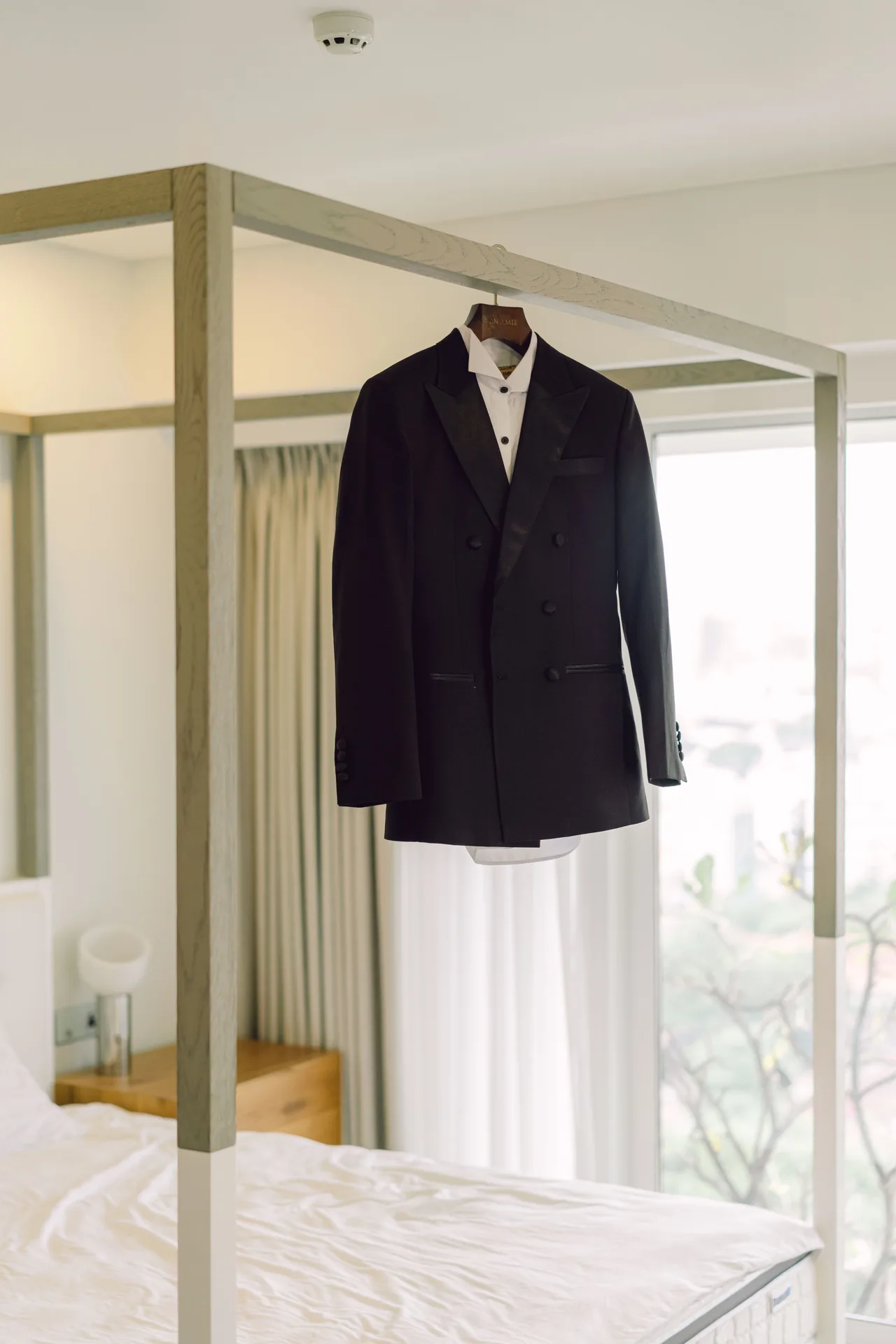
How to hang a suit jacket correctly
- Fasten the top button (on a two-button jacket) so the body keeps its shape.
- Place the hanger right in the center of the collar, with the shoulders sitting snug against the hanger.
- Hang it with room to breathe, at least a few centimeters from the next garment so air can circulate.
- Let the jacket rest for at least a day after wearing, before it goes into a garment bag.
- Don't stuff heavy items into the pockets, such as a phone, wallet or keys, which makes the pockets sag.
Common mistakes
- Using one type of hanger for everything. Suit jackets, shirts and trousers need different hangers.
- Hanging a wet or damp jacket. The weight of the water stretches the shoulders and adds the risk of mold.
- Hanging a thick coat on a thin hanger. An overcoat needs a thicker hanger than a suit jacket.
- Cramming the wardrobe too full. Garments crowded together distort the shoulders and the lapels.
- Leaving the jacket tilted or lopsided on the hanger. One shoulder bears more load than the other.
Tip from Mon Amie's master tailor
The shoulder is the part the master tailor watches most closely at the baste fitting, and also the hardest to adjust once the garment is finished. So protect it with something very cheap: a correctly sized hanger. When you receive your new suit, bring a hanger with you or ask the master tailor which hanger suits your shoulders. If the shoulders show signs of distortion or dents after a time hanging, you can bring the jacket to the showroom for the master tailor to look at and advise. The bespoke tailoring service comes with a long-term alteration warranty after you receive the garment.
Frequently asked questions
Which waistcoat hanger should men choose?
Choose a small wooden hanger or a padded one, as wide as the shoulders of the waistcoat, usually smaller than a suit jacket hanger. Don't use wire hangers or thin plastic ones, because the shoulders of a light waistcoat distort easily.
What counts as suit accessories?
There are two groups: accessories worn with the suit (ties, bow ties, pocket squares, cufflinks, lapel pins) and care accessories (shoulder hangers, garment bags, wool brushes, shoe trees). Both groups are needed for a suit to look good and last.
Which suit accessory should I buy first?
A correctly sized wide wooden shoulder hanger should come first, because it protects the part that is hardest to repair. Next come a garment bag and a wool brush. You can also read about moisture-proof suit garment bags.
How can I fix a suit shoulder that has been dented by the wrong hanger?
If the dent is slight, hanging the jacket on a correctly sized hanger in a room with a little steam, then letting it dry naturally, may help. If the dent is deep or has already distorted the canvas, ask a tailor to look at it. The master tailor can assess whether the chest canvas is still usable.
Closing thoughts
Choosing the right suit hangers is a small task, but it protects the most important part of the garment. You only need to measure the jacket's shoulders, choose a curved wooden hanger of the right size and let the jacket rest before putting it away. When you need a new suit cut for your own shoulders, you can book a fitting at Mon Amie.