
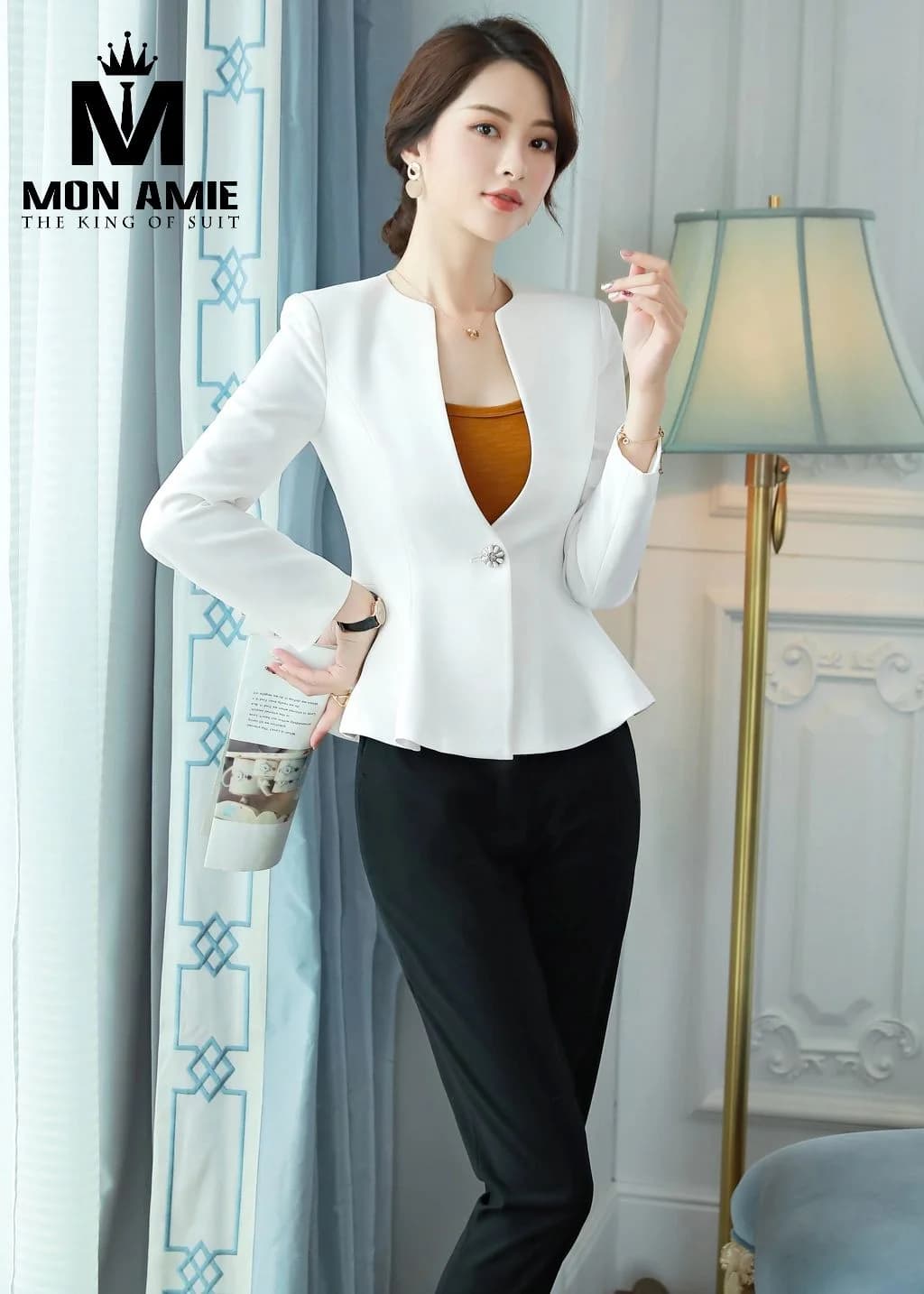
Come up twenty centimetres short on cloth, and a whole women’s suit may have to change its design. This holds true even when you have found a fabric you love, settled on the colour, and are only waiting for the cutter’s turn. That is why the question of how much fabric a women’s suit needs should be answered before you buy, not after the cloth is already in your bag.
Quick answer
A two-piece women’s suit (jacket and trousers) usually needs about 2.6 to 3.2 metres of 1.5 m-wide fabric; a jacket and skirt set needs about 2.2 to 2.8 metres. Long jackets, peplums, wide-leg trousers, checked cloth or larger sizes need more. The exact figure can only be settled after measuring and choosing the style.
Why “metres” are not enough: you need the fabric width
Two pieces of fabric of the same 3 metres can give completely different results if their widths differ. Fabric width is the width of the bolt, measured from one edge to the other.
- 1.4–1.5 m width: common for woollen cloth and wool blends. This is the benchmark most of the figures below use.
- 1.1–1.2 m width: often seen in some silks, crepe or narrow imported cloth. You need to buy about 20 to 30% more.
- Wider than 1.5 m: some special fabrics; you may need fewer metres.
When you shop for fabric or ask a tailor, ask for both figures: how many metres, and what width.
How much fabric a women’s suit needs: allowance by piece
The table below is a reference point for 1.5 m-wide fabric in an average size. Tailors may calculate slightly differently depending on the pattern and style:
| Piece | Style | Allowance (metres) |
|---|---|---|
| Jacket | Short (about 55–62 cm long) | 1.2 – 1.5 |
| Jacket | Mid-length, past the hip | 1.5 – 1.8 |
| Jacket | Long (past the seat, longline blazer) | 1.8 – 2.2 |
| Extra for peplum | Peplum skirt, asymmetric hem | + 0.25 – 0.4 |
| Trousers | Straight or tapered legs | 1.1 – 1.3 |
| Trousers | Wide-leg, palazzo | 1.4 – 1.7 |
| Skirt | Pencil, fitted | 0.6 – 0.9 |
| Skirt | A-line, pleated | 1.0 – 1.5 |
| Jacket lining | Full lining | 1.2 – 1.5 (lining fabric) |
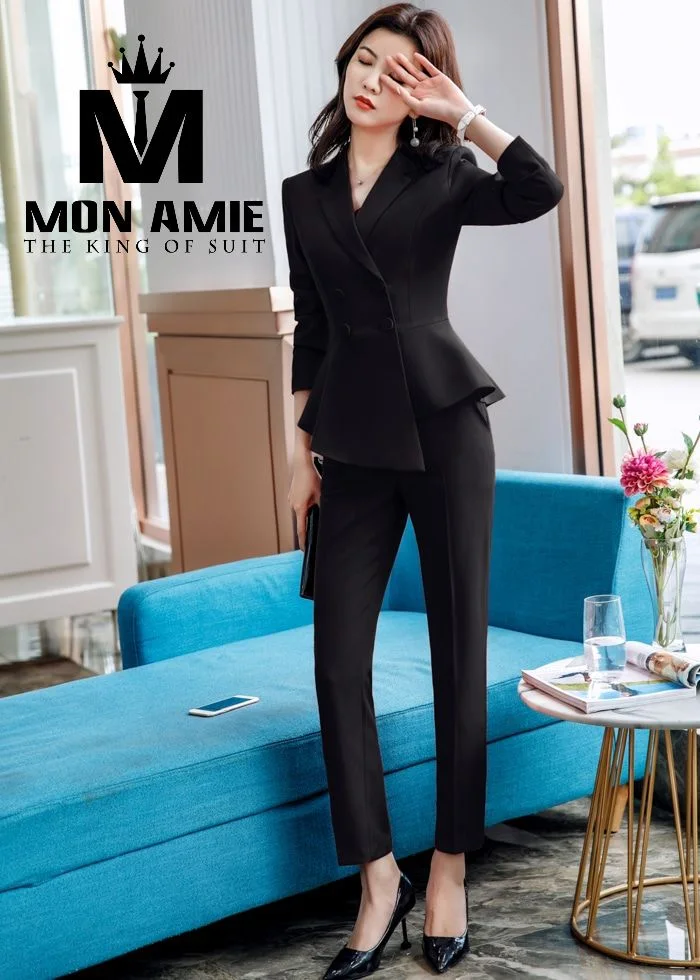
How much fabric does a complete women’s suit need?
Adding the pieces together gives you a quick view for each set:
| Set | Estimated total (1.5 m width) |
|---|---|
| Mid-length jacket + straight-leg trousers | 2.6 – 3.1 m |
| Mid-length jacket + pencil skirt | 2.1 – 2.7 m |
| Peplum jacket + straight-leg trousers | 2.9 – 3.5 m |
| Long jacket + wide-leg trousers | 3.2 – 3.9 m |
| Three-piece set (jacket + trousers + skirt) | 3.3 – 4.2 m |
These are average figures. They may be lower if you are petite, or higher if you are tall and the design has many details.
When do you need more fabric?
Some factors raise the allowance that not everyone remembers:
- Striped or checked cloth. The tailor has to match the pattern at the shoulders, pockets and front seams, so you need roughly 10 to 20% extra depending on the size of the check.
- Directional cloth. Velvet, fabrics with a sheen and patterns with a direction must be cut one way, so there is more waste.
- Larger sizes or tall wearers. Longer jacket bodies and trouser legs add about 10 to 25 cm per piece.
- Detailed styles. Peplums, yokes, flap pockets, large collars and double-breasted jackets all use extra fabric.
- Contrast-fabric sleeves. If the sleeves or collar use a different coloured fabric, they need a separate allowance.
Trims and notions count too
The main fabric is only part of it. To make the suit hold its shape, you also need:
- Lining (cupro or viscose for breathability; avoid stuffy polyester).
- Interfacing at the chest, collar and shoulders.
- Buttons, thread and zips matched in colour and quality.
- Shoulder pads for a structured shoulder.
Trims are normally part of the tailor’s advice, so you do not have to buy them yourself. You can also read the article the cost of a made-to-measure women’s suit to see how the price is calculated.
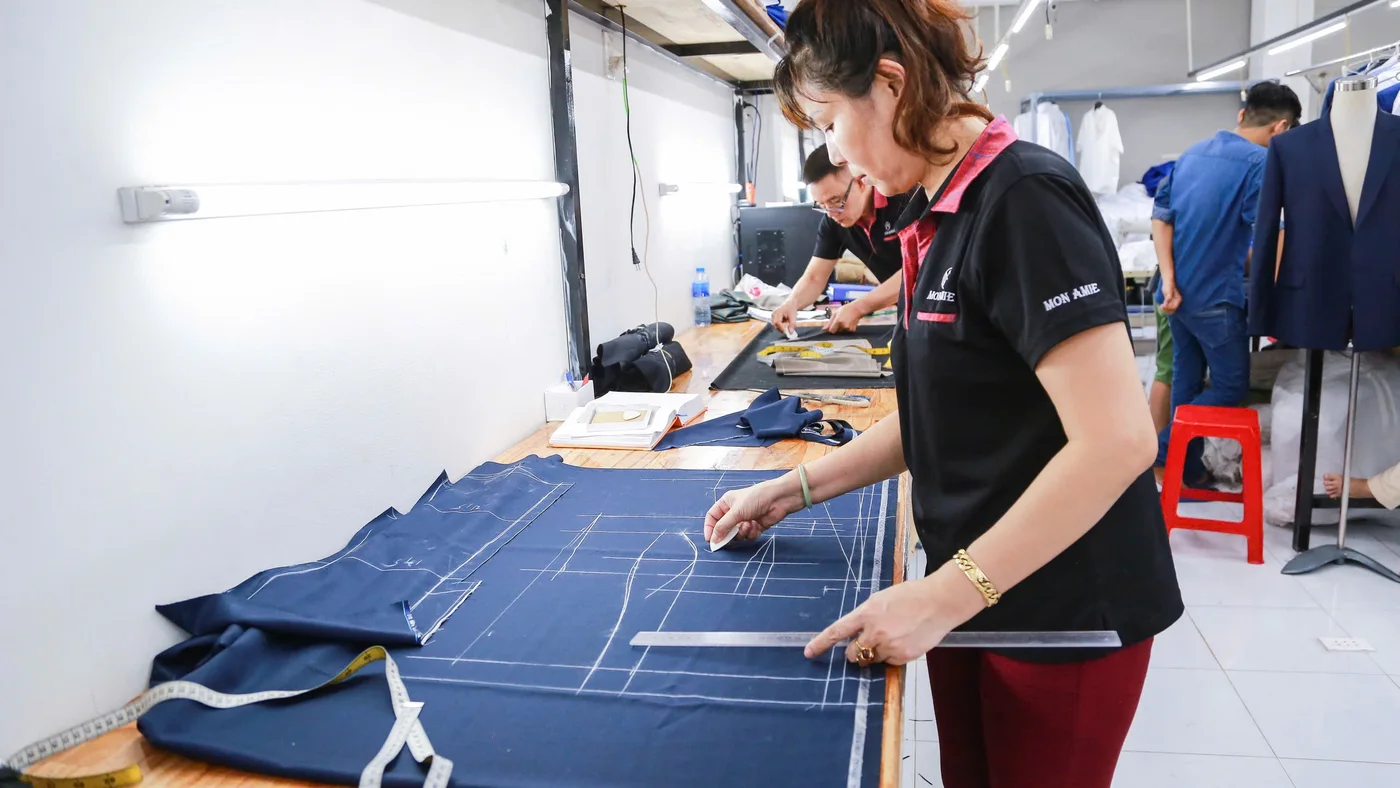
Do not buy fabric before settling the style and measurements
The right order to avoid getting the allowance wrong:
- Settle the style: long or short jacket, trousers or skirt, with or without a peplum.
- Take your measurements: height, bust, waist, hip, jacket length, trouser length.
- Choose the fabric and its width.
- The tailor calculates the allowance from your real measurements and that fabric width.
- Only then buy (or choose from the fabric library).
If you choose the fabric at the tailor’s, steps 4 and 5 happen at the same time. For those still unsure whether to buy fabric themselves or choose at the tailor’s, the equivalent article for men, how many metres of fabric a men’s suit needs, explains the same principle further.
How to sanity-check the allowance a tailor quotes
If a tailor quotes a figure much lower or higher than the table above, do not hesitate to ask why. An experienced master tailor will be able to explain: because the fabric is narrow, because it is directional, because the pattern has to be matched, or because the style has many details. You can also ask whether the leftover cloth after cutting will be kept for you, for later alterations or for making a scarf or accessories in the same material.
Common mistakes and tips from Mon Amie’s master tailors
- Buying by a figure found online. A generic number does not account for fabric width or body shape.
- Buying just enough. Always have a little to spare for alterations, letting down a hem or changing the style later.
- Forgetting about checked cloth. Pattern matching demands extra fabric, especially for women’s suits with many seams.
- Overlooking the lining. A good lining makes a jacket far more comfortable than a thin, cheap one.
- Choosing the fabric first and thinking of the style later. Some light fabrics do not suit a structured shoulder, and some thick ones do not suit a full peplum.
Trade tip: when being measured, wear a thin shirt or a fitted top, not a thick garment, so that the bust and shoulder measurements are accurate. Mon Amie’s showrooms calculate the allowance from your real measurements.
Frequently asked questions
How many metres of fabric does one women’s suit need?
A two-piece suit (jacket and trousers) usually takes about 2.6 to 3.2 metres of 1.5 m-wide fabric. A jacket and skirt set takes about 2.2 to 2.8 metres. The exact figure depends on the style, size, height and type of fabric.
How much fabric does a women’s jacket need?
A women’s jacket usually needs 1.2 to 2.2 metres of 1.5 m-wide fabric, depending on whether it is short, mid-length or long. A peplum style needs about 0.25 to 0.4 metres more. Checked cloth needs extra for pattern matching.
Which fabric should I choose for a made-to-measure women’s suit?
Wool or wool blends drape well and hold their shape. For the climate of Ho Chi Minh City, a lightweight weave, linen blend or breathable crepe suits the hot season. You should see the cloth in person in the fabric library and take advice based on the style you want to make. The article what fabric is used for women’s suits also analyses each material.
Do narrow fabrics need more to be bought?
Yes. Fabric 1.1 to 1.2 m wide usually needs about 20 to 30% more than 1.5 m. Always ask the tailor for the exact number of metres based on the real fabric width.
Final thoughts
Knowing how much fabric a women’s suit needs is not hard, but a small mistake costs a lot. The safest way is to let a master tailor measure and calculate for you. You can book a measuring appointment at a Mon Amie showroom, or learn more about Bespoke tailoring to see the process step by step.