
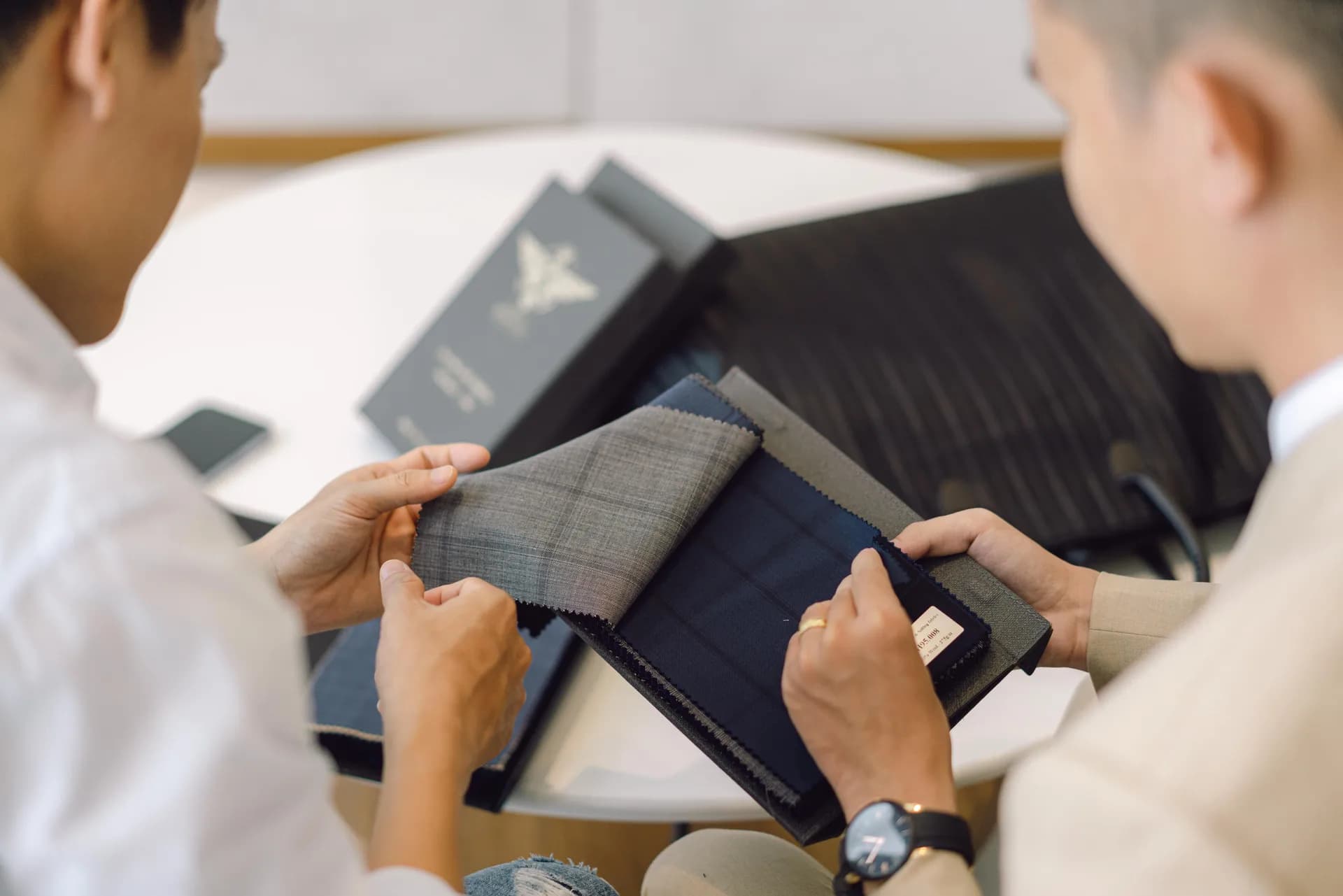
Three and a half metres. That is usually the first number people hear when they ask how much cloth a suit needs. But three and a half metres is right for only one person, one cloth width and one jacket style. Change the height, change the cloth width or choose a checked cloth, and the number changes too. This article helps you work out the range you need when you ask how many metres of fabric for a men's suit you will need, and why the master tailor always says “let me cut the pattern first, then I will confirm”.
Quick answer
A men's two-piece suit (jacket and trousers) usually needs about 3.2–3.7 metres of 150 cm-wide fabric; add 0.6–0.8 metre for a waistcoat. A tall, large man, a narrower 140 cm cloth, a double-breasted style or a checked cloth needs more. These are industry reference figures; the master tailor confirms the final number when cutting the pattern to your real measurements.
Fabric allowance for each piece
A suit is made of several pieces, each needing its own amount of fabric. The table below is for 150 cm-wide cloth and an average build.
| Piece | Reference amount | Notes |
|---|---|---|
| Jacket | 1.9 – 2.3 m | Body, sleeves, lapels, pockets |
| Trousers | 1.2 – 1.5 m | More for a high waist, wide legs, pleats |
| Waistcoat | 0.6 – 0.8 m | Added when making a three-piece |
| Jacket lining | 1.3 – 1.6 m | Counted separately, usually a different cloth |
Altogether, a two-piece suit comes to about 3.1–3.8 m and a three-piece to about 3.7–4.6 m. These figures match the chart by build below, where height and weight have the greatest effect.
How many metres of fabric for a men's suit, by height and weight?
| Build | Height | Weight | Two-piece | Three-piece |
|---|---|---|---|---|
| Small, compact | 1.55 – 1.65 m | 50 – 60 kg | 3.0 – 3.2 m | 3.6 – 3.9 m |
| Average | 1.65 – 1.72 m | 60 – 70 kg | 3.2 – 3.5 m | 3.8 – 4.2 m |
| Fairly tall | 1.72 – 1.80 m | 65 – 78 kg | 3.4 – 3.7 m | 4.0 – 4.4 m |
| Tall and large | 1.78 – 1.85 m | 78 – 90 kg | 3.7 – 4.0 m | 4.3 – 4.7 m |
| Very large, very tall | Over 1.80 m | Over 90 kg | 4.0 – 4.5 m | 4.7 – 5.2 m |
Height determines the length of the jacket, the sleeves and the trouser legs. Weight determines width, which means larger pattern pieces, so fewer pieces can be fitted tightly together across the cloth width. Two men of the same height but weighing 60 kg and 85 kg can differ by almost half a metre.
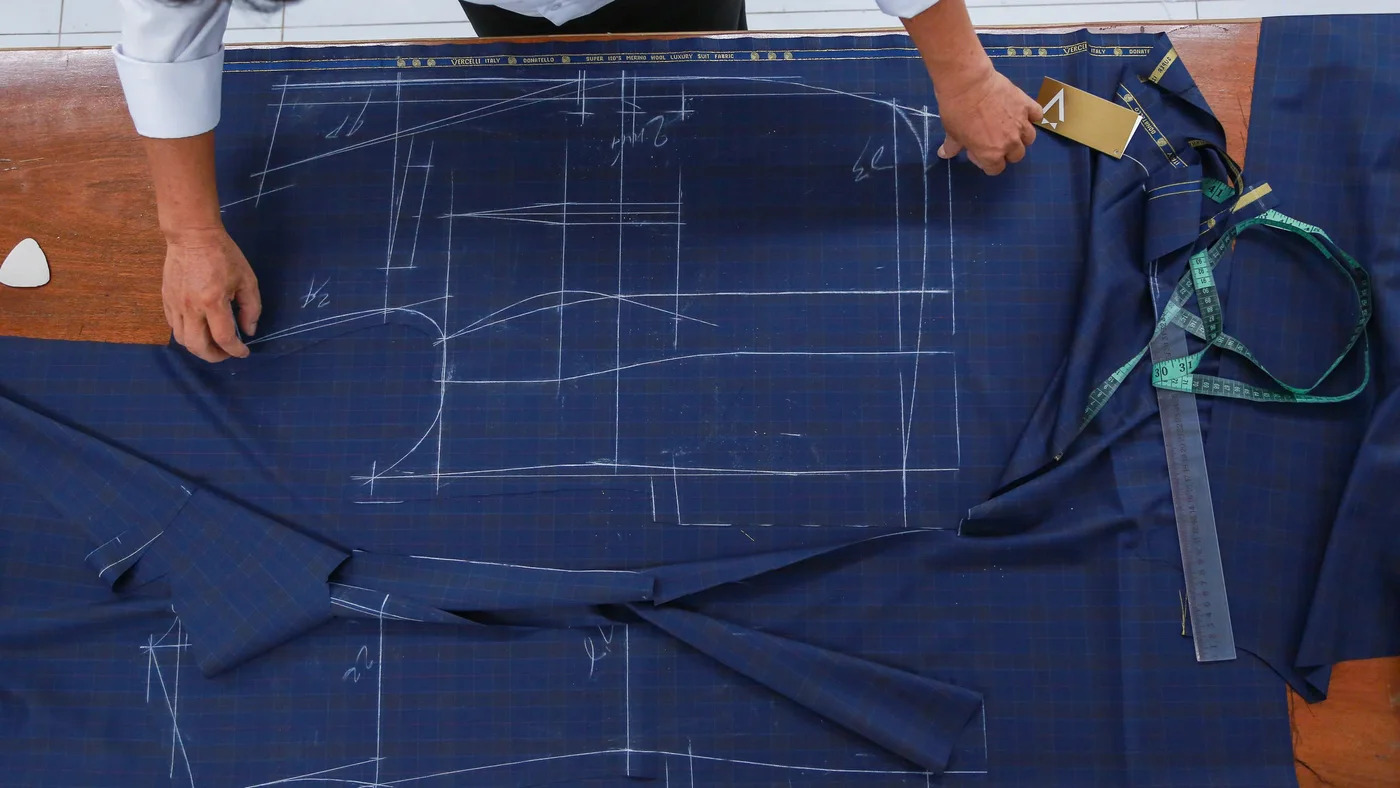
How does cloth width matter?
Cloth width is the width across the bolt. The wider the cloth, the easier the pattern pieces are to lay out, and the more economical it is.
- 150 cm width: the reference point for all the tables above.
- 140 cm width: add about 0.15–0.25 m for the whole suit because the pattern pieces lay out less efficiently.
- 160 cm width or more: you can reduce by about 0.1–0.2 m.
Many premium wool cloths come in widths of around 140–150 cm, so when buying cloth elsewhere, ask for the width before working out the metres. For the same suit, cloth widths can make a difference of almost a whole metre.
How much extra for striped, checked and plaid cloth?
This is why many people calculate too little. Plain cloth lets you cut any piece next to any other. Checks, large stripes or repeating patterns must match at the centre back, on both sides of the lapel, at the pockets and at the sleeves. To match them, the tailor must cut each piece according to the position of the pattern, and more of the remainder is discarded.
| Cloth | Add | Reason |
|---|---|---|
| Plain | None needed | Cut freely |
| Small stripe, subtle weave | 0.1 – 0.2 m | Only the direction of the stripe has to be right |
| Check, large stripe, plaid | 0.3 – 0.6 m (about 10–20%) | The pattern must be matched at the back, lapel and pockets |
| Directional cloth (velvet, some tweeds) | 0.1 – 0.3 m | All pieces must run in the same direction |
A small tip: the larger the check, the more cloth it costs. A fine chalk stripe or a small check adds almost nothing, while a large plaid can cost nearly half a metre more.
Style changes the allowance
| Style | Effect |
|---|---|
| Double-breasted jacket | Add 0.2 – 0.3 m (the fronts overlap) |
| Trousers with pleats, wide legs, high waist | Add 0.1 – 0.2 m |
| Jacket longer than usual | Add 0.1 – 0.2 m |
| Fitted two-piece jacket, tapered trousers | Add 0, or a slight saving |
| Double-breasted waistcoat | Add 0.1 – 0.2 m compared with a single-breasted one |
| Patch pockets, extra sleeve detail | Add 0.05 – 0.1 m |
These figures are general industry knowledge and may vary from one pattern cutter to another.
A quick estimate in 5 steps
- Decide the number of pieces: two-piece (jacket and trousers) or three-piece (add a waistcoat).
- Look up the chart by build above for a starting point.
- Adjust for cloth width: add for 140 cm, subtract for 160 cm.
- Add for pattern if the cloth is a check or a large stripe.
- Add about 0.1–0.2 m as a reserve for alterations or small changes.
Example: a man 1.74 m tall, weighing 70 kg, having a three-piece suit made in navy small-stripe cloth, 150 cm wide. The chart gives 4.0–4.2 m. A small stripe adds about 0.15 m. Add a 0.1 m reserve. The total is about 4.3–4.5 m.
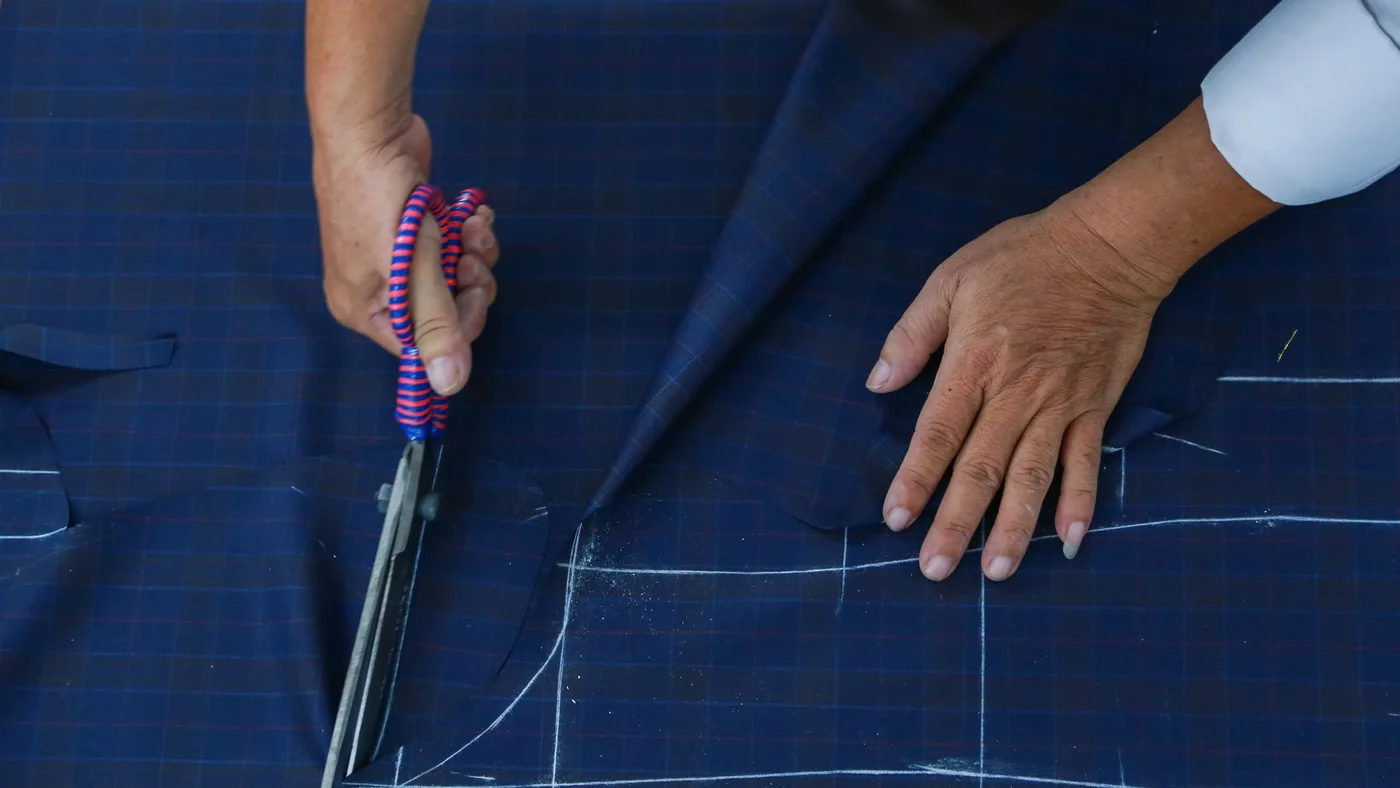
Buy the cloth separately, or have the whole suit made?
If you buy cloth elsewhere yourself, ask the tailor for the allowance before you buy and choose about 10% extra rather than buying exactly. Being 10 cm short is often more painful than having half a metre spare, because wool from the same dye lot is hard to find again.
When you have a suit made to measure at Mon Amie, you do not have to work out the metres yourself. The price is set by the fabric line, for the complete jacket and trousers: Essential VND 4.8 – 10 million, Signature VND 10 – 20 million, Heritage over VND 20 million. You can choose your cloth from the cloth library and see the price list. If you wonder why cloth prices vary so widely, the article suit fabric prices: why they differ so much explains it in detail.
Common mistakes
- Using one number for everyone. “Three and a half metres for all” is right for only one group of builds.
- Forgetting to ask the cloth width. 140 and 150 cm give quite different results.
- Not allowing for checked cloth. Buying enough for plain cloth, then running short when the tailor matches the stripes.
- Buying down to the last centimetre. No spare cloth for repairs or patches when needed.
- Confusing lining with outer cloth. Lining is a different cloth, counted separately.
- Forgetting the waistcoat. Going from two pieces to three adds almost a whole metre.
Tips from Mon Amie's master tailors
Keep the leftover cloth after the suit is made. A small piece from the same dye lot is very useful for patches or pocket repairs later, and almost impossible to find again after a few years.
Ask about the direction of the cloth before buying. For cloth with a direction or a large pattern, ask the tailor how the pattern pieces will be laid out before settling the metres. The number from the actual pattern cutter is the one that counts.
For women's suits the allowance is different. A women's jacket and skirt or trousers usually take less cloth than a man's suit, but the cuts vary more. The article how much fabric a women's suit needs analyses it separately.
Frequently asked questions
How many metres of fabric for a men's suit if the man is 1.75 m tall and weighs 70 kg?
A two-piece takes about 3.4–3.7 m of 150 cm cloth; a three-piece about 4.0–4.4 m. If the cloth is checked or 140 cm wide, add according to the tables above.
How much cloth does a jacket alone need?
A jacket on its own usually needs about 1.9–2.3 m of 150 cm cloth for an average build. For a large check, add 0.2–0.4 m to match the pattern.
How much fabric is needed if I add a spare pair of trousers?
A second pair of trousers needs another 1.2–1.5 m or so. Many men have two pairs of trousers made with one jacket, because trousers wear out faster than jackets.
How much does it cost to have a suit made?
It depends on the fabric line. Mon Amie has three price lines for the complete jacket and trousers: Essential VND 4.8 – 10 million, Signature VND 10 – 20 million, Heritage over VND 20 million. The final price depends on the cloth you choose and the style.
Conclusion
A metre of cloth is a dry number, but it decides whether the suit has enough material to be finished exactly as intended. If you would rather not work it out yourself, leave it to the artisans: book a measuring appointment and bring a photo of the suit you want, and the master tailor will calculate precisely from your measurements and the cloth you choose. Learn more about cloth in the article types of suit fabric.