

Before stepping into a tailor's shop, many men have already asked themselves a familiar question: should I buy the fabric first and bring it in, or let the tailor take care of everything? It sounds minor, but it is a decision that affects the price, the fit and even the life of the suit. Where to buy suit fabric, and who is responsible if the cloth turns out to be wrong, are two halves of one question that have to be answered together.
The short answer
You have two routes: buy the fabric yourself and bring it to the tailor, or choose cloth from the tailor's own stock. Buying it yourself looks cheaper, but you may run short, pick cloth that is wrong for a suit, and have no one to hold responsible if the garment goes wrong. Choosing at the tailor gives you a proper yardage allowance, advice, and alterations after you collect the suit.
Two ways to buy fabric, side by side
| Criterion | Buy the fabric yourself and bring it to the tailor | Choose from the tailor's stock |
|---|---|---|
| Visible price | Low fabric price, labour charged separately | An all-in price for the full suit, fabric and labour included |
| Risk of too little or too much fabric | High, depends on your own estimate | Low, the tailor calculates the yardage from your measurements |
| Suitability for a suit | Easy to buy thin fashion fabric that loses its shape quickly | Cloth selected specifically to hold a suit's structure |
| Advice on colour and pattern | Usually by feel alone | Based on your build, complexion and occupation |
| Warranty | The tailor usually takes no responsibility for the cloth | Alterations under the tailor's policy |
| Effort | Visiting many places, comparing many times | One place, one decision |
That does not mean buying the fabric yourself is always wrong. It suits you when you already understand cloth, have a special length of cloth in hand, or enjoy the hunt. But for most men making a suit for the first time, choosing at the tailor is the lower-risk path.
Where to buy suit fabric if you still want to buy it yourself?
There are four common sources:
- Fabric markets, wholesale-and-retail fabric districts. Plenty of choice and good prices, but it is hard to verify the true composition and easy to run into cloth that is “pretty to the eye, poor in use”.
- Specialist suit-fabric shops. Specifications and labels are provided, but prices tend to be higher and you still have to calculate the yardage yourself.
- Buying fabric online. Convenient, but the colour on screen differs from the real thing, and you cannot feel the cloth.
- Imported cloth or a gift. Usually a special length of cloth, so ask a tailor whether there are enough metres and whether it suits a suit before cutting.
Whichever source you choose, check these five things before you pay:
- Composition: a suit needs at least a significant proportion of wool to hold its shape. 100% polyester cloth is usually hot and shiny.
- Width: a width of 1.4 to 1.5 m is common for wool cloth. Narrower cloth needs more metres.
- Weight: for a hot-weather suit choose lighter cloth, and for a suit worn in cold air-conditioned rooms choose something more substantial.
- Squeeze test: hold the cloth for a few seconds, then let go. Good wool recovers almost immediately.
- Look at it in daylight: colour under shop lighting often differs from colour outdoors.
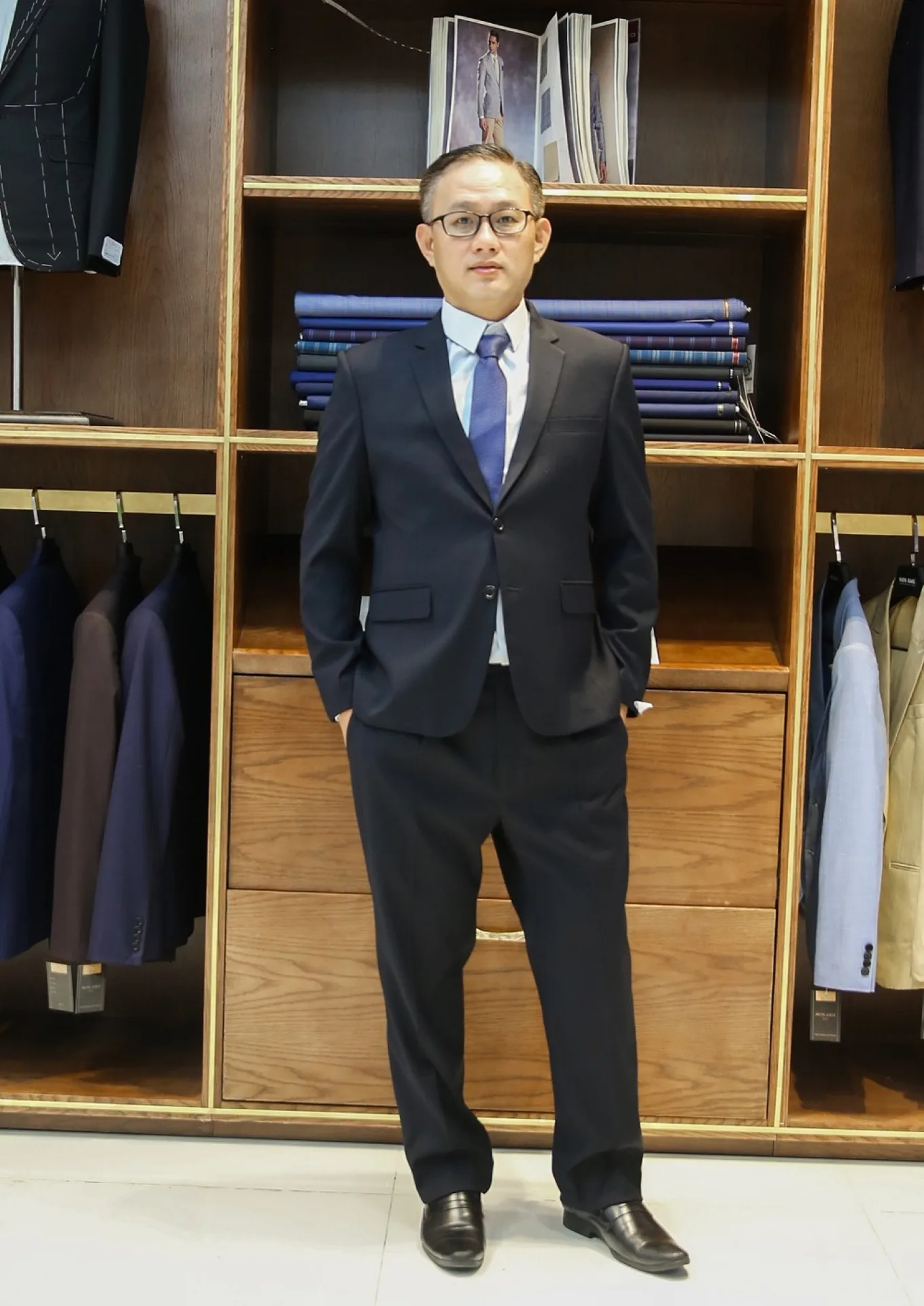
The biggest risk of buying your own: running short
A men's two-piece suit usually needs about 3 to 3.5 metres of cloth 1.4 to 1.5 m wide. This figure goes up for tall or large men, trousers with many pleats, three-piece suits, or checked cloth that needs the pattern matched. Buying 20 cm too little is enough to force the tailor to drop a detail or piece the cloth together against your wishes. Buying a little extra costs only a little more for the fabric, and the surplus can be made into a pocket square or kept for later alterations.
The article how many metres of fabric to make a men's suit gives a yardage table by jacket style and body type. The rule: do not buy fabric before the style and measurements are settled.
Choosing fabric at the tailor: what do you get?
At a tailor's, you see cloth already selected by people in the trade, with the yardage calculated from your real measurements, and you hear advice on which colours suit your work, your skin tone and the season. At Mon Amie, the cloth sits right in our own stock: the Essential line uses Kevinlli 40–70% wool (100s–140s), the Signature line uses Kevinlli 80–100% wool, Dolce & Taylor, Luciano, Salford and Vercelli, and the Heritage line uses Canonico, Holland Sherry, Dormeuil and Scabal cloth. The all-in price of the jacket and trousers is calculated by fabric line, and you can see it in the made-to-measure price list.
If you live far away or are busy, you still do not need to run around:
- Online made-to-measure: consultation by video call, choosing cloth through a photo library that details each material, and delivery to your door.
- At-home made-to-measure: an artisan brings a curated set of cloth samples to your home, office or hotel within Ho Chi Minh City, as in the at-home tailoring service.
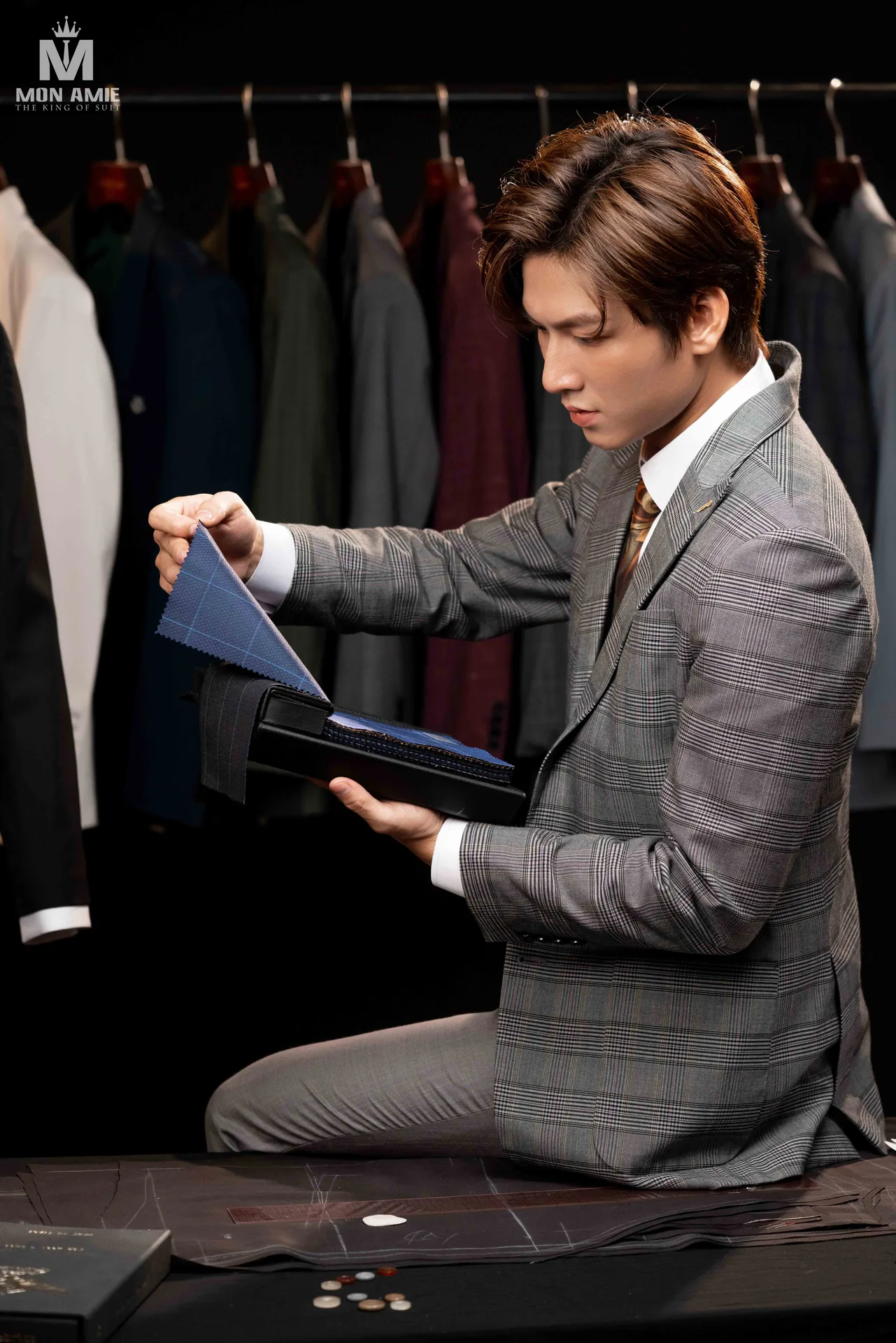
Common mistakes and tips from Mon Amie's master tailors
- Buying by price per metre and ignoring the total cost. The cloth is cheap, but you pay labour separately, plus trims, plus the surplus you buy. Added up, it is not necessarily cheaper.
- Buying cloth from photos online. A navy on screen may turn out to be blue-black or a pale blue in real life.
- Forgetting the trims. A suit needs lining, interfacing, buttons and thread. Good trims decide the shape of the jacket after a few months of wear. You can learn more in the article why suit fabric prices vary.
- Choosing cloth by taste, not by occasion. A check cloth is lovely but hard to wear to an interview. Plain dark cloth is the easiest to wear.
- Rushing. Give yourself time to feel the cloth with your hands, and let the real cloth tell you.
A tailor's tip: when you come to look at cloth, stand by a window or step outdoors to see the true colour, and lay the swatch book over the very shirt you plan to wear with the suit. The colour of a suit sits next to your skin tone, the shirt underneath and the light where you work, so a small swatch on a table does not tell the whole story. If you are still torn between two swatches, photograph both in the same light and compare them after a night's sleep.
Frequently asked questions
Where to buy men's suit fabric in Ho Chi Minh City?
You can choose a fabric market, a specialist fabric shop, or a tailor's fabric stock. If you are not familiar with cloth, choosing at a tailor with someone to advise you is the lowest-risk way. Mon Amie has 5 showrooms in Ho Chi Minh City, of which the Caravelle Hotel showroom is the main one.
Where to buy women's suit fabric?
The principle is the same as for men's suits: prefer wool, wool blends, crepe and fine-grain textured suiting, with good drape and shape retention. Women's suit jackets come in many styles, such as peplum and long cuts, so the yardage differs. Settling the style and measurements first and only then buying the cloth is the safest way.
What is premium suit fabric?
Usually wool cloth from Italian and English mills, with fine yarns and a firm weave, such as Canonico, Holland Sherry, Dormeuil and Scabal. A premium suit also needs trims, interfacing and workmanship to match, not just the cloth.
Is buying fabric yourself cheaper?
On paper it can be, because you pay only the fabric price. But once you add the separate labour charge, the risk of buying too little or the wrong cloth, and no warranty on the cloth, the total cost often does not differ much. Ask the tailor's labour price before you buy.
Final thoughts
You can buy suit fabric almost anywhere, as long as you know what you are trading for: a cheap price you can see, or peace of mind for the whole suit. If you want to feel real cloth and hear advice, you can preview the fabric library or book a fitting at the nearest showroom.