

Put two pieces of navy cloth side by side on a table. Under the showroom lights the naked eye can barely tell them apart. One metre costs a few hundred thousand dong, the other a few million. Every customer who hears this for the first time asks exactly one question: with a tenfold difference, where does it actually differ? Suit fabric prices do not differ by chance; they are the sum of six factors, and understanding them helps you pay in the right place.
Quick answer
Suit fabric price depends mainly on fibre composition (wool or a polyester blend), the Super number (the fineness of the fibre), the mill, the weave and finish, and rarity. A common polyester-blend cloth costs only a few hundred thousand dong a metre; fine wool from Italian and English mills can reach a few million a metre, because the fibre is precious and is woven more slowly and more consistently.
Six factors that make suit fabric prices differ
1. Fibre composition
A suit cloth can be 100% wool, wool blended with polyester, or blended with silk, cashmere, mohair or linen. Natural wool costs more than polyester, and the higher the share of wool, the more breathable, drapey and comfortable the cloth. Polyester blends hold their crease well, are durable and cheap, but are hotter and “breathe” less.
2. Super number
“Super 100s” and “Super 150s” are ways of measuring the fineness of a wool fibre: the higher the number, the finer the fibre.
| Super number | Fibre diameter (approx.) | Characteristics |
|---|---|---|
| 100s | about 18.5 microns | Durable, substantial, suits everyday wear |
| 120s | about 17.5 microns | A balance between soft and durable |
| 140s | about 16.5 microns | Soft, smooth, clearly lighter |
| 150s | about 16 microns | Very fine, needs to be worn in rotation and cared for carefully |
A high Super number does not mean “better in every respect”. The finer the fibre, the softer and more beautiful, but also the more fragile. For someone who works every day, 100s to 130s cloth is usually more durable; 140s and above suits you when you have a few suits to rotate.
3. Mill and origin
With the same composition and the same Super number, cloth from a long-established mill still costs more: thanks to control of raw material, weaving technique, finishing and consistency between rolls. Many Italian mills in the Biella region, and English mills, are renowned among tailors for that reason. What you pay extra for is consistency: the colour does not drift between lots, and the drape does not change.
4. Weave and finish
With the same yarn, twill, herringbone and hopsack weaves give different feels. Finishing treatments (bleaching, steaming, pressing, anti-crease) also decide whether the cloth is soft or stiff, lustrous or matt. Thicker, heavier cloth usually consumes more material, so the price edges up.
5. Rarity and exclusivity
Cloth produced in small quantities, in rare colours, or in limited collections costs more than mass-market lines. This is the part where you “pay for being distinct”.
6. Metres and the cumulative difference
A two-piece suit needs about 3 to 3.5 metres of cloth. If one metre differs by VND 1 million, the whole suit differs by about VND 3 to 3.5 million, before tailoring labour. That is why choosing the cloth is the biggest financial decision when making a suit.
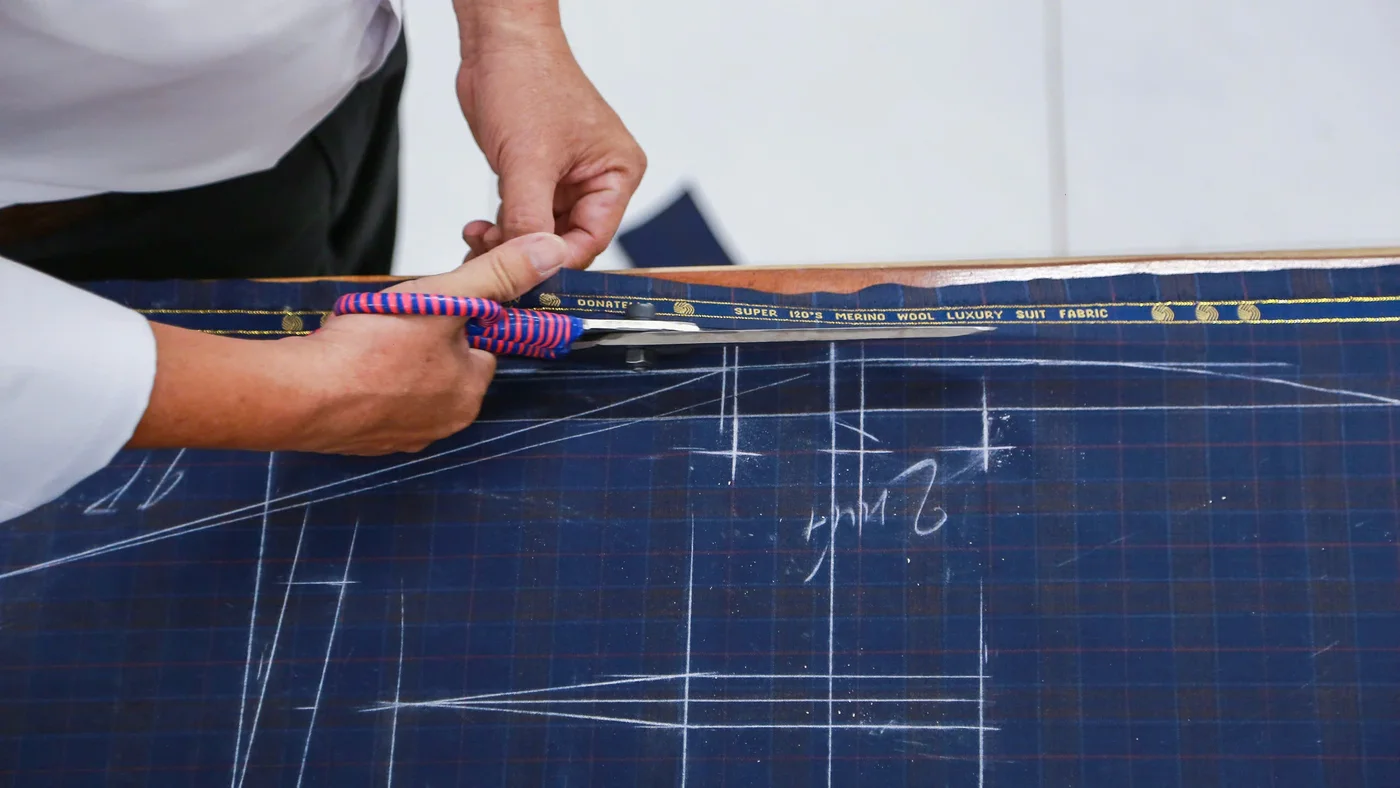
Comparing Mon Amie's three made-to-measure fabric lines
Mon Amie divides its fabrics into three lines, with prices for a complete suit including jacket and trousers:
| Line | Price for a complete suit | Fabric | Who it suits |
|---|---|---|---|
| Essential | VND 4.8 – 10 million | Kevinlli 40–70% wool (100s–140s) | Beginners who need the standard Mon Amie cut |
| Signature | VND 10 – 20 million | Kevinlli 80–100% wool 140s–150s, Dolce & Taylor, Luciano, Salford, Vercelli | The most chosen line; for frequent wear, for those who want beautiful cloth |
| Heritage | Over VND 20 million, up to VND 60 million per suit | Canonico, Holland Sherry, Dormeuil, Scabal | The pinnacle of Italian and English mills |
A quick way to read it: Essential is blended wool, good enough for everyday wear; Signature raises the share of wool and the fineness; Heritage is the classic mills. For the details of each price level, you should see them in person at the price list and the fabric library.
Three people, three ways of choosing fabric
To see how much suit fabric price is worth spending, look at the three people below (these are illustrative situations, not specific customers).
- An office worker who wears a suit three days a week. Needs durability and crease retention. Wool 100s to 130s, with a sensible blend ratio, is enough for many years; two suits in rotation are better than one ultra-fine suit.
- A manager who meets partners often. Needs beautiful cloth that drapes well and creases little. Wool 140s to 150s in a higher line is the balance point: worn many times a month, but in rotation.
- Someone who wears a suit a few times a year for major events. Can invest in a suit of genuinely good cloth, since little wear makes it very durable; the cost per wear is still reasonable if the suit lasts many years.
None of these three people needs “the most expensive cloth”. Each needs the cloth that fits how they wear it.
How to avoid paying in the wrong place
- Ask for the composition in percentages. “Wool cloth” is a generic name; ask exactly what percentage is wool.
- Ask for both the Super number and the weight (grams per metre). A high number in thin cloth is hard to wear in an office with strong air-conditioning.
- Ask about the mill. Cloth with a named mill usually comes with documentation; unnamed “imported” cloth is hard to verify.
- Do not choose on price alone. A suit worn for years works out cheaper per wear than a cheap suit that loses its shape fast.
- Touch it, crumple it and look at it under real light before deciding. The six tests in the article how to recognise premium suit fabric are very useful.
If you want to learn more about the kinds of cloth, the article types of suit fabric arranges them by property.

Frequently asked questions
How much does premium men's suit fabric cost per metre?
The market level ranges from a few hundred thousand dong for a metre of common polyester-blend cloth to a few million dong, even higher, for fine wool from Italian and English mills. For complete made-to-measure suits, you should refer to the suit prices in the price list, which makes comparison easier.
How much does wool cloth cost, and is it worth more than a blend?
Wool costs more because the fibre is natural, breathable and drapes well. In a hot, humid climate, light wool or wool with little polyester is worth the investment more than cloth with a lot of polyester. Blends still have their place for those who need a durable suit that holds its crease at a gentle price.
What price of wool cloth should I buy for an office suit?
For everyday wear, medium-weight wool 100s–130s is the group that balances durability and price. Prioritise a clearly stated wool composition and a named mill rather than looking only at the price.
Is the cost of the fabric included in the made-to-measure price?
With Mon Amie's complete-suit price list, the price includes jacket and trousers in the fabric line you choose. The fabric line sets the price bracket; each detail should be confirmed when you choose the fabric at the consultation.
Choose fabric by how you use it, not by how luxurious it feels
Expensive fabric is not always right for you; fabric that suits how you wear, the climate and your budget is what is worth the money. If you want to feel the lines at the three price levels side by side, bespoke tailoring at the showroom lets you choose from the Italian and English fabric library together with an artisan, before you decide.