
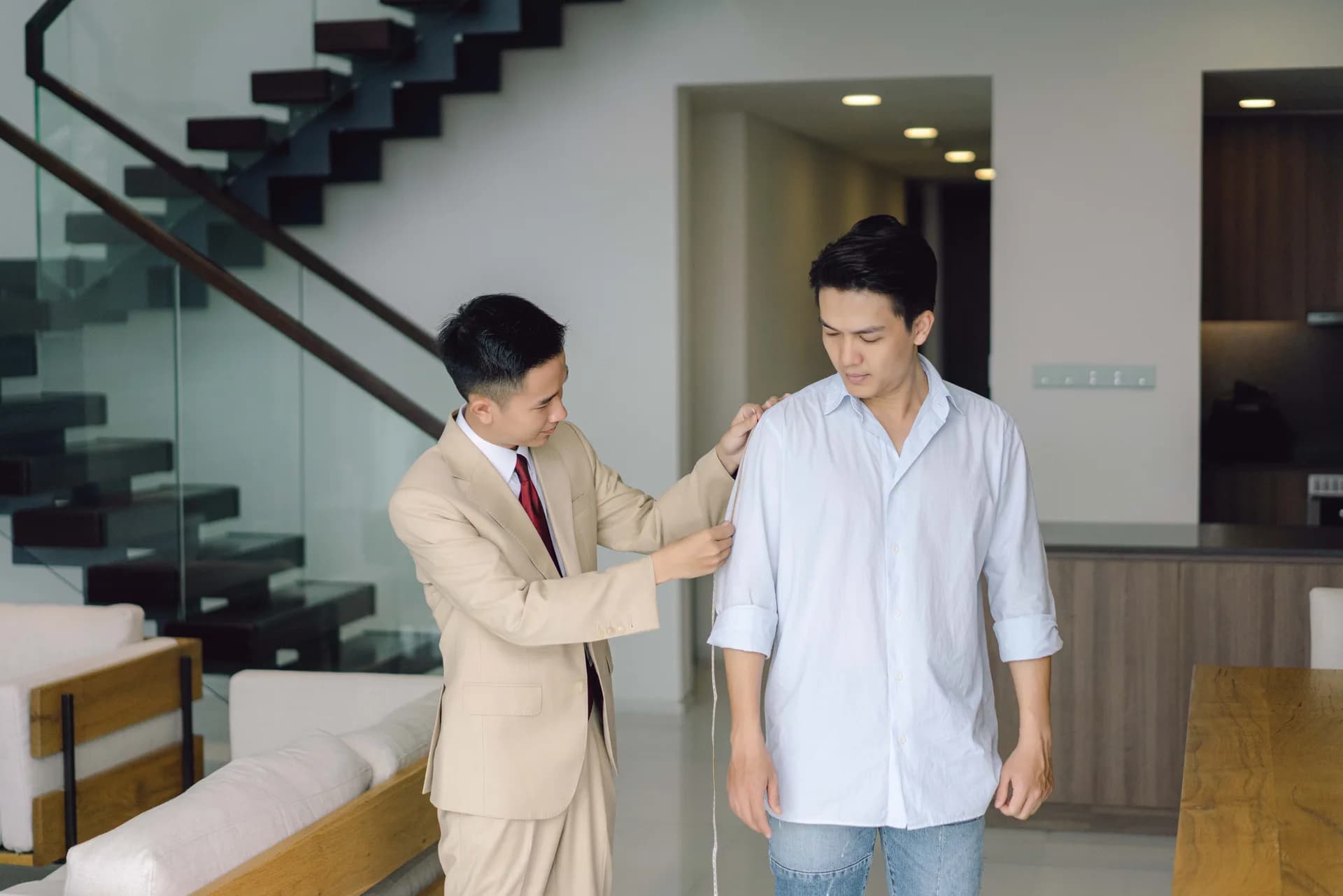
A ready-to-wear shirt needs just one number: the size. A made-to-measure suit needs more than thirty. That gap is not tailoring's pointless fussiness; it is the direct result of the fact that no human body has two identical halves. Your suit measurements are the private map of your body, and a well-fitting suit can only be drawn from that map.
Quick answer
A made-to-measure suit needs more than 30 measurements because every body is asymmetrical and does not follow ready-made sizes. The measurements fall into three groups: the jacket body (shoulders, chest, waist, seat, jacket length), the sleeves (sleeve length, upper arm, wrist) and the trousers (waist, seat, thigh, crotch, trouser length), plus notes on posture such as uneven shoulders, belly and back. Mon Amie stores your measurements for life so the next order does not mean being measured from scratch again.
Why do suit measurements run to more than 30?
A ready-to-wear suit is based on just a few numbers: chest circumference, height, sometimes the waist. Manufacturers choose these numbers because they are common, then scale every detail up or down evenly. The problem is that your body does not scale evenly.
- The two shoulders are often unequal. One shoulder sloping a couple of centimetres more than the other is perfectly normal, especially for people who favour one hand or always carry a bag on the same side.
- The two arms are not the same length. A difference of half a centimetre may not matter on a shirt, but on a suit a mismatched sleeve shows right away at the wrist.
- Posture differs. Someone with a stooped back needs a longer back panel; someone who carries the chest high needs a shorter front.
- Belly, chest and hips do not follow anyone's proportions. Everyone has their own curve between chest, waist and seat.
More than 30 measurements is how those differences are separated into specific numbers. The more numbers there are, the less the pattern-cutter has to "guess". At the Bespoke tailoring service, the artisan takes more than 30 measurements and keeps them for life, for exactly this reason.
Jacket body measurements
This is the most important group, because the body of a jacket is the hardest part to alter once it has been made.
| Measurement | Where it is taken | Why it matters |
|---|---|---|
| Neck | Around the base of the neck | The suit collar sits snugly against the shirt collar without gaping |
| Shoulder width | From the left shoulder point to the right | The shoulder is the one thing that cannot be altered |
| Shoulder slope | The angle of each shoulder | Sloping or square, the left can differ from the right |
| Chest | The fullest point of the chest | Sets the base "size" |
| Front chest width, back width | Across the chest, across the shoulder blades | So that raising your arm does not strain the jacket |
| Belly and waist | At the navel and at the natural waist | Whether the body of the jacket is fitted or straight |
| Seat | The fullest part of the seat | So the front of the jacket does not flare open |
| Jacket length | From the nape down to below the seat | The proportion of the whole suit |
| Back length | From the nape to the waist | The waist position of the jacket |
Sleeve measurements
A suit sleeve looks simple but is demanding, because it must hang straight when relaxed and still be comfortable when bent.
- Sleeve length, taken on each side from the shoulder point to the wrist, with the arm hanging straight. The two sides can differ.
- Upper arm, so that the muscle is neither squeezed nor lost in spare cloth.
- Elbow, because this bend decides whether the sleeve creases.
- Wrist and cuff, so that the jacket cuff falls at the wrist bone and leaves room for the shirt cuff to show.
- Armhole, so that raising your arm does not drag the whole jacket with it.
Trouser measurements
Trousers usually have fewer numbers than the jacket, but mistakes here show as soon as you sit down or walk.
- Waist and lower belly, which is where the waistband sits.
- Seat and thigh, so the trousers do not strain when you sit.
- Front rise and back rise (the curve between the legs), a number few people know about but which decides whether the trousers "sit still".
- Knee and leg opening, which create a slim or straight silhouette.
- Trouser length, taken to the shoes you normally wear, because different heel heights give different lengths.
Counting left and right measurements, secondary measurements and the measurements for an extra waistcoat or coat, passing 30 is perfectly normal.
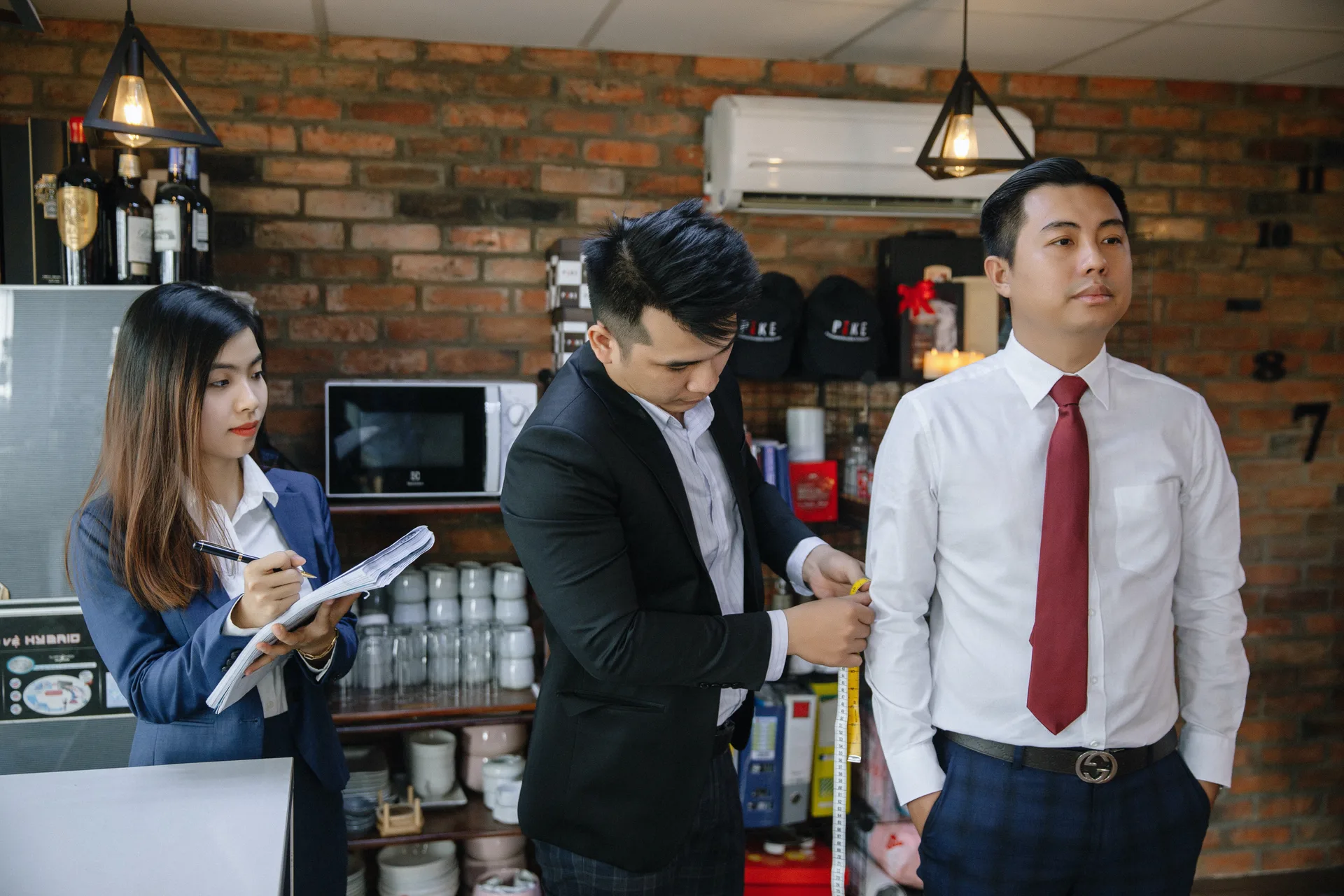
Posture notes: the part that makes the difference
Measurements tell how long and wide your body is. Posture notes tell how your body stands. This is something no size chart contains.
- Uneven or sloping shoulders: the pattern is adjusted so the collar and lapels sit evenly on both sides.
- Stooped or arched back: the tailor adjusts the front and back lengths of the jacket body.
- A protruding belly or a full chest: this affects the curve of the front pattern.
- A stance that leans forward or backward: this makes the skirt of the jacket ride up or hang down.
- Habits: which side you carry a bag on, a phone in the jacket pocket, which wrist you wear a watch on all change the way the jacket hangs.
These notes are what turn a suit from one that "fits a body" into one that "fits only you".
How to take suit measurements: measure yourself or ask an artisan?
You can take a few basic measurements yourself for reference, but the most reliable way is still to have someone else do it.
- Wear thin clothing and stand naturally. Do not puff out your chest and do not pull in your belly.
- Chest: wrap the tape across the fullest point of the chest, under the armpits, keeping the tape level.
- Waist: around the natural waist, level with the navel, without pulling tight.
- Shoulder width: from the shoulder point on one side to the other. It is better to have someone measure for you.
- Sleeve length: from the shoulder point to the wrist with the arm hanging straight.
- Trouser length: from the waistband down to the heel of the shoes you normally wear.
Self-taken measurements are often off because it is hard to measure your own shoulders and back. If you live far away, online made-to-measure lets you be guided through each step by video call, or use measurements already on file. The article how to measure the shoulders of a men's suit jacket explains this most difficult measurement in more detail.
Stored measurements: the real benefit
When your measurements are stored for life, next time you do not start again from the beginning. The artisan only needs to check whether your body has changed, then update what needs updating. For the online made-to-measure service this is also the foundation: you choose fabric remotely, your measurements are already on file, and the garment is delivered to your door. For corporate uniforms, managing the measurements of the whole team makes additional batches quicker and more uniform.
Tips from a Mon Amie master tailor
Be honest about your habits and your build. Many men are reluctant to say that they have a belly or uneven shoulders. A master tailor does not judge; they simply need the information to cut accurately.
Tell us in advance if you plan to change weight. Someone planning to lose a few kilos before an event should say so, so the tailor can allow a sensible margin.
Be re-measured after a big change. Gaining or losing a few kilos is enough to throw off the waist and chest. Measurements are stored for life, but the body does not stand still.
Frequently asked questions
What do men's suit measurements include?
The jacket body (neck, shoulders, chest, belly, waist, seat, jacket length, back length), the sleeves (sleeve length, upper arm, elbow, wrist) and the trousers (waist, seat, thigh, crotch, knee, trouser length), plus notes on posture. In total they exceed 30 measurements.
Is being measured for a suit painful or a hassle?
No. A measuring session consists of a tape measure and a few minutes of standing still. What matters is that you wear thin clothing and relax so the measurements are as accurate as possible.
Can I measure myself and send the numbers to the shop?
For a few basic numbers, yes, but the shoulders and back are hard to measure yourself. The safer way is to book a video call, where a stylist guides you step by step.
What about taking measurements for a suit if I am losing weight?
Let the artisan know your plan so they can allow a sensible margin. Once your weight has stabilised, you should be re-measured to update your stored measurements.
Final thoughts
Suit measurements, more than 30 numbers, sound like a lot, but each one has a reason to exist. They are the difference between a jacket that merely "fits" and one that looks "drawn just for you". You can see the full sequence on the made-to-measure process page, or book a measuring appointment to meet an artisan in person.