
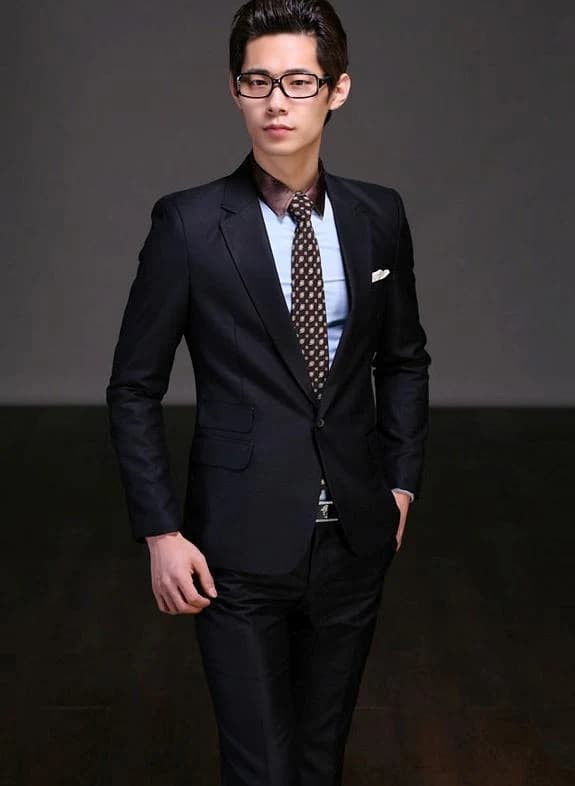
“Why did the tailor tell me not to fasten the bottom button?” Customers often ask this the moment they try on their first suit jacket at the showroom, and a bigger question usually follows right behind: how many buttons on a suit jacket is correct? The short answer is one, two or three on a single-breasted jacket, and four to six on a double-breasted one. But the number of buttons is not decoration; it changes the proportions of the whole suit.
Quick answer
A single-breasted men's jacket has 1, 2 or 3 buttons, and a double-breasted jacket has 4 to 6. Two buttons is the most common and the safest. One button suits evening wear and tuxedos, a trim three suits a tall frame, and double-breasted is imposing and formal. The number of buttons does not decide quality; it decides proportion.
How many buttons on a suit jacket: five common styles compared
| Style | Buttons | How to fasten | Feel | Suits |
|---|---|---|---|---|
| One button | 1 | Fasten the single button when standing | Slim, modern, long upper body | Evening events, tuxedo, tall slim builds |
| Two buttons | 2 | Fasten the top, leave the bottom | Balanced, classic | Every build, daily work |
| Three buttons | 3 | Fasten the middle, leave the bottom | High chest, trim | Tall frames, those who like the classic |
| Three-roll-two | 3 (top button hidden in the lapel) | Fasten the middle | Looks like two buttons, soft lapel | Most builds |
| Double-breasted | 4–6 | Fasten the buttons on the diagonal | Imposing, striking | Tall men, broad shoulders |
The “diagonal-button jacket” that many people search for is simply the double-breasted jacket: two parallel rows of buttons, the left front overlapping the right. A “buttonless jacket”, meanwhile, is usually a soft drape-over style, a cardigan or waterfall blazer, which belongs to fashion rather than to ceremonial suits.
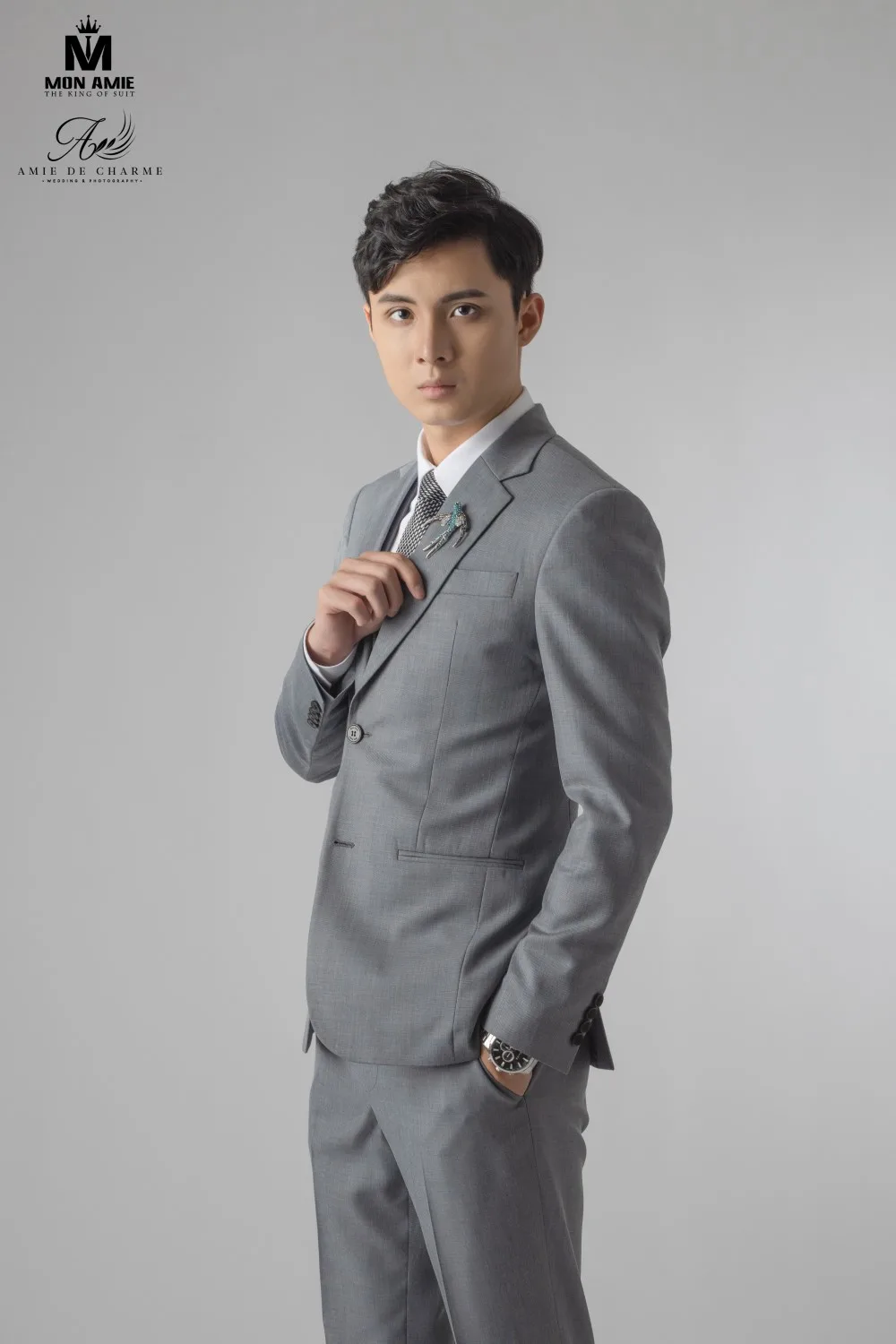
Why the number of buttons changes the proportions of the whole suit
The fastening point decides the depth of the V on the chest. The fewer the buttons, the lower the fastening point and the deeper the V, so the upper body looks long and slim. The more buttons, the higher the fastening point and the narrower the V, so the upper body looks compact and imposing.
For shorter men or men with short legs, one or two buttons help lengthen the body. Taller men can choose three buttons or double-breasted, because they have enough length to carry the lapel and the front. Men with a belly should avoid a six-button double-breasted, because double-breasted adds a layer of cloth at the belly. Slim men can use double-breasted to create volume in the upper body.
Buttoning rules: always, sometimes, never
The classic rule for single-breasted jackets, which every tailor knows:
- Top button (on a two-button jacket): always fasten when standing.
- Middle button (on a three-button jacket): usually fasten, with the top button fastened or left open depending on the lapel.
- Bottom button: never fasten. The jacket is cut with the bottom button open so the front opens correctly when you sit and does not pull and crease.
As for double-breasted jackets, fasten the “main” buttons when standing and you may open them when seated. More detailed rules are in the article how to button a suit jacket by the rules.
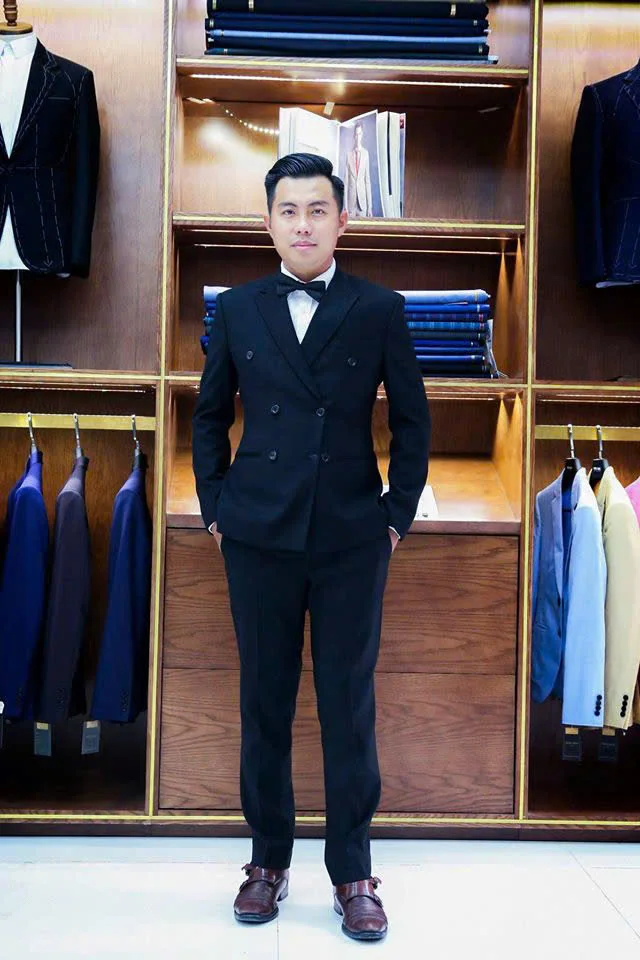
How a double-breasted jacket differs from a single-breasted one
Beyond the number of buttons, a double-breasted jacket differs from a single-breasted one in construction. The front is wider so that it overlaps, which means the chest has two layers of cloth. The lapel is usually a peak lapel to balance the mass of the front, and the shoulder needs more precise structure because a double-breasted jacket exposes every flaw in the cut. In return, double-breasted creates a strong diagonal line, imposing and most at home on tall men with broad shoulders. So if you are choosing double-breasted for the first time, test it carefully seated, walking and with your arms raised.
Sleeve buttons: a small detail that says a lot
Jacket sleeves normally have four buttons. On a high-end made-to-measure suit, the sleeve buttons usually have real buttonholes, meaning they open, whereas on a ready-to-wear suit most of the buttons are stitched shut. There are two ways of setting them: the buttons spaced apart, or overlapping so that they partly touch (kissing buttons). Working sleeve buttons are a mark of made-to-measure craftsmanship, and some gentlemen leave the bottom one undone to show the detail when they want to show off the jacket. Sleeve buttons should not be set too close to the edge of the cuff: the distance from the sleeve edge is usually about 1–1.5 cm.
Button material and colour
Jacket buttons are usually made of horn, urea resin, metal or mother-of-pearl, and sometimes covered in the same cloth. The button colour should be the same tone as the suit or slightly darker. Brown horn buttons suit grey and brown suits. Black buttons suit navy and charcoal suits. Gold buttons suit only a navy double-breasted blazer in a nautical style, and should not be used on an office suit.
Cheap buttons, in shiny plastic with a conspicuous raised seam, are a sign of a mass-made suit. With a made-to-measure suit, you can choose buttons from the tailor's sample set, and this is the smallest item that makes the biggest difference.
How many buttons on a suit jacket is right? Choose by build and occasion
- Daily work: two buttons is the standard, almost never wrong.
- Evening events, weddings, tuxedo: one button or double-breasted.
- Shorter build: one or two buttons, medium lapel.
- Taller build: two or three buttons, or double-breasted.
- Fuller build: two buttons, a jacket of moderate length, not a double-breasted with many buttons.
- Want to stand out: a six-button double-breasted in a stripe or a light check, but the shoulder must be cut correctly.
Common mistakes
- Fastening every button on a two-button jacket. The front pulls into an X, looking tight and older.
- Choosing three buttons on a short torso. A high fastening point cuts the upper body short.
- Wearing a double-breasted jacket unfastened. An open double-breasted usually hangs slack because the overlapping front droops.
- Not looking closely at the buttons. Loosely sewn buttons and shiny plastic ones spoil a good jacket.
A tip from Mon Amie's master tailors
Try on the jacket and look at the fastening point: if the front pulls into a diagonal crease or the button strains, the jacket is a size too tight at the chest or belly, and the number of buttons is not the cause. The shoulder cannot be altered, so choose the jacket by the shoulder first and the number of buttons second. You can try the proportions of one, two and three buttons on a virtual suit at the online suit design page.
Frequently asked questions
How many buttons should a men's suit jacket have for work?
Two. It is the most balanced, suiting every build and every office environment. Fasten the top button and leave the bottom one open.
What is a buttonless suit jacket?
A buttonless jacket is an open-front style, not fastened, usually made in soft cloth, in a waterfall or cardigan form. It suits a relaxed style more than a ceremonial one, so it cannot replace a proper suit in a meeting.
What is a jacket with diagonal buttons?
That is the double-breasted jacket. Two parallel rows of buttons, with the left front overlapping the right when fastened. This style is more imposing and striking than a single-breasted one.
Can suit jacket buttons be replaced?
Yes. A tailor can replace the buttons with ones in the same tone or of higher quality, such as horn. This is usually simple and low in cost, but you should replace the whole set at once to keep them matching.
How many buttons does a double-breasted jacket have?
Usually 4 or 6. Written as 4x2 or 6x2, it means four or six buttons, of which two on the outer row are used for fastening. There is also a 6x1 version in which only one button is fastened.
One jacket, which buttons for you?
If you are still torn between one, two or three buttons, come and try them in person at a Mon Amie showroom or look at the made-to-measure price list first. How many buttons on a suit jacket is also a question about your build, so the master tailor will measure your shoulders and chest and then suggest the number of buttons that suits your frame. To learn about the most common style, see the article the two-button jacket, the most common style.