

Tailors have a familiar rule when a customer stands between two jackets: do not ask which jacket is looser, ask which one fits the shoulders. Most of the dithering in the fitting room, take a 48 or a 50, is settled the moment you look at the shoulder seam. This article helps you choose men's suit size when you fall between two sizes, without buying a jacket and then taking it in for a week of alterations.
Quick answer
When you fall between two sizes, choose the size whose shoulders fit exactly, then have a tailor alter the rest. Shoulders cannot be altered; the waist, sleeves and trouser hems can. If the shoulders fit in the smaller size but the chest is quite tight, go up a size and take in the waist. If both sizes need many alterations, that is a sign to switch to made-to-measure.
Choosing men's suit size: shoulders first, then chest
A suit has many parts, but only a few decide the size. Score them in this order:
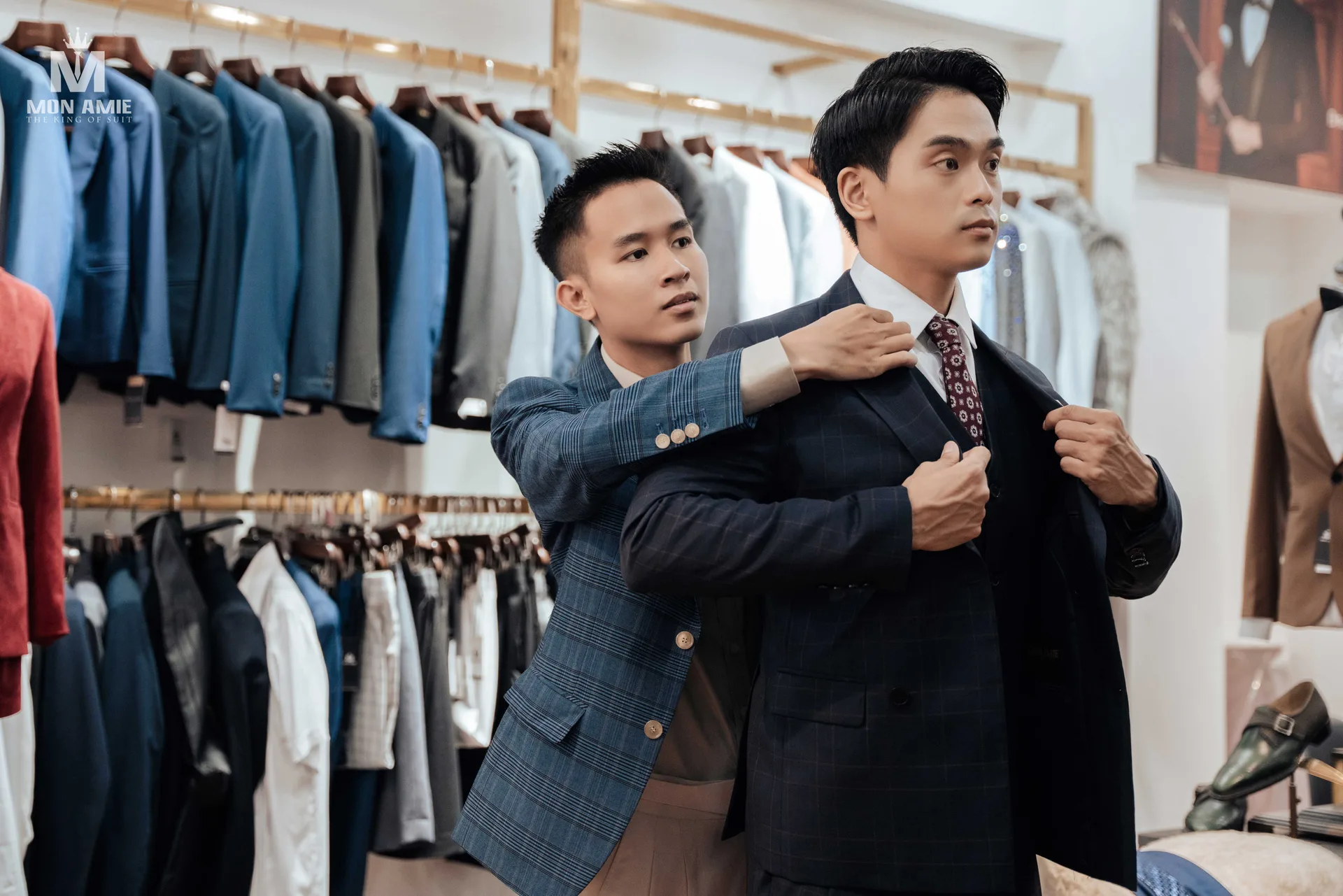
- Shoulders. The shoulder seam must sit exactly at the tip of the shoulder bone. The shoulder is connected to the yoke, collar and lapels, so altering a shoulder means taking apart nearly half the jacket.
- Chest. Fasten one button and let your arms hang: the front must lie flat. An X-shaped crease around the button is the sign of a tight chest.
- Collar. The suit collar must hug the shirt collar and not stand away at the back of the neck.
- Waist and body length. These two can be altered to a moderate degree.
- Sleeves. The easiest to adjust, so leave them for last.
In short: if the shoulders are right, half the jacket is right; if the shoulders are wrong, no size can save it.
What can be altered, and what cannot?
Before deciding whether to take the bigger or the smaller size, you need to know what a tailor can alter. The table below is general knowledge of the tailoring trade; the specific extent depends on the seam allowance of each jacket.
| Area | Alterability | Notes |
|---|---|---|
| Shoulders | Almost not at all | A major job, labour-intensive, and rarely returns to the original shape |
| Collar | Very difficult | Depends on the yoke and lapels |
| Chest | Very little | Can be let out a little if there is spare seam allowance; taking in is easier |
| Waist | Easy to take in, little to let out | Taking in a few centimetres is routine; letting out depends on the seam allowance |
| Sleeve length | Easy if the sleeve has decorative (non-working) buttons | Sleeves with working buttons at the cuff need more careful work |
| Jacket length | Difficult | Affects pocket position and proportions |
| Trouser hem | Very easy | The most common job |
| Trouser waistband | Take in or let out a few centimetres | Depends on the spare seam allowance at the back |
The general rule: taking in is easier than letting out. A seam can only be trimmed back; it cannot grow more cloth by itself. That is why a jacket that is slightly loose can usually be saved, while one that is slightly tight is hard to fix.
Size up or size down? Decision table by situation
| Situation | Choose | Why |
|---|---|---|
| Shoulders fit the larger size, body a little loose | The larger size, take in the waist and body | The shoulders are right, the rest can be altered |
| Shoulders fit the smaller size, chest only slightly snug | The smaller size if it can still be let out, or the larger size if the larger shoulders are not too excessive | Use the shoulders as the standard |
| Shoulders fit the smaller size, chest clearly tight | Consider made-to-measure | Both sizes involve a compromise |
| Shoulders excessive in the larger size, chest tight in the smaller | Made-to-measure | This is a true "between two sizes" case |
| Both sizes fit the shoulders | Choose by cut: neat, the smaller; comfortable, the larger | Both are acceptable |
| Trousers between two sizes | The larger size, then take in the waistband | Taking in is easier than letting out |
When both sizes fit the shoulders, think about how you wear the suit. If you often wear a waistcoat or a thin sweater underneath, the larger size is more comfortable. If you wear a single shirt and want a neat silhouette, the smaller size suits better.
How to measure men's suit size and check when trying on
If you do not know roughly where you sit, measure first, then try on:
- Measure your chest, wrapping the tape across the fullest point of the chest, under the armpits. Halving that gives the European size number (a 96 cm chest is size 48).
- Measure the shoulders, from the shoulder point on one side to the other; it is better to have someone measure for you.
- Measure sleeve length from the shoulder point to the wrist.
- Try on with a thin shirt, the very kind you plan to wear.
- Fasten the button, reach your arms forward, sit down, the three quickest checks.
To look up a size by height and weight, see the men's suit size chart by height and weight or the article what weight is a size 46 or 48 suit.
Alteration cost and when to switch to made-to-measure
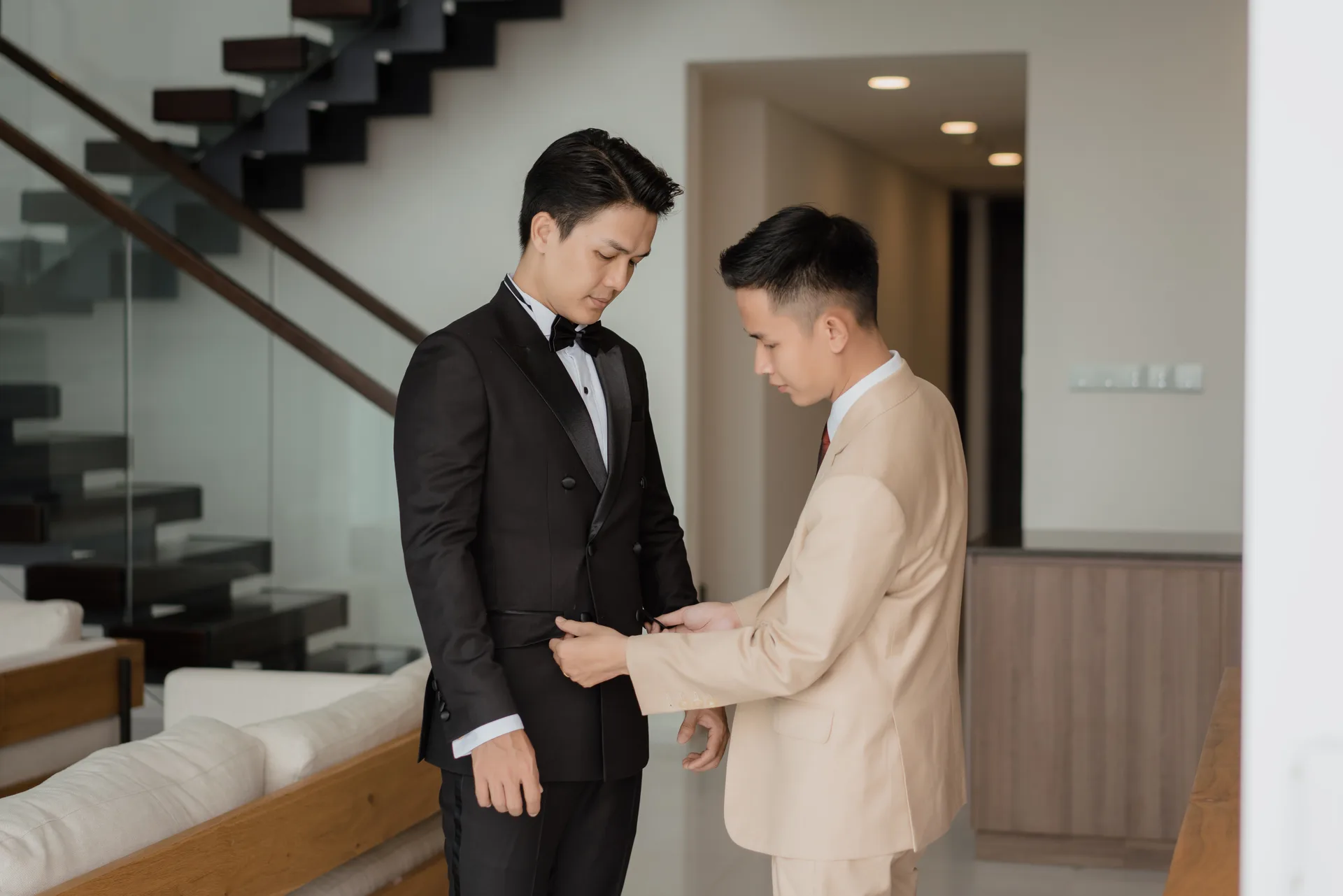
Hemming trousers, narrowing sleeves and taking in the waist a few centimetres are usually small jobs. Bigger jobs such as altering the shoulders or adjusting the chest take more labour and rarely give the result you hoped for. The specific cost varies from place to place, so ask the price before deciding to buy a jacket that needs a lot of alteration.
You should think about made-to-measure when:
- The jacket needs to be touched at the shoulders or chest to fit.
- You have to alter three or more areas (waist, sleeves, jacket length, trouser waistband).
- The total cost of buying plus altering approaches a basic-line made-to-measure suit. Mon Amie's Essential line is priced at VND 4.8–10 million for a complete jacket and trousers; you can see the price list to compare.
- Your build has distinctive features: uneven shoulders, a protruding belly, a full chest, a very small or very large frame.
Common mistakes
- Taking the larger size for "comfort". Wide shoulders make the whole jacket droop.
- Squeezing into the smaller size to look "neat". The button strains, X-shaped creases appear, and you cannot sit down.
- Choosing by label, not by body. Each brand cuts differently; one maker's size 48 may be another's 50.
- Trying on over thick clothing or without a shirt. The measurements are wrong from the start.
- Trying on only when standing. Sit, raise your arms, walk.
Tips from a Mon Amie master tailor
Look at the back of the jacket before the belly. A horizontal crease just below the collar is a sign the jacket is tight at the shoulders or back, while a vertical fold with spare cloth in the middle of the back is a sign it is too loose. Both are hard to fix.
Do not buy a jacket that is "almost right" hoping you will get used to it. The jacket does not stretch, and your body will not shrink on its own.
Ask a second person to look. From behind, another person sees the shoulders and folds more clearly than you can in a mirror.
Frequently asked questions
How do I measure men's suit size at home?
Measure the chest across the fullest point and halve it for the size number; also measure shoulder width and sleeve length, ideally with someone else's help. If you live far away, online made-to-measure can guide you step by step by video call.
Can a suit one size too big be altered?
The waist, sleeves and trouser legs can be altered. But if it is loose at the shoulders it can hardly be fixed. So check the shoulders before you buy.
Can a suit one size too small be let out?
Only a few centimetres at the waist, or at the trouser waistband if there is spare seam allowance. If it is tight at the shoulders or chest it is very hard, so avoid choosing the smaller size and asking for it to be let out.
Do jacket size and trouser size need to match?
No. The jacket follows the chest and shoulders; the trousers follow the waist. Many people wear a size 50 jacket but size 33 or 34 trousers, which is perfectly normal.
Final thoughts
Choosing men's suit size when you fall between two sizes is really choosing which parts you want altered. If the answer is "almost all of them", you have found a reason to try made-to-measure. At the Bespoke tailoring service, the artisan takes more than 30 measurements and provides a long-term warranty on alterations after you receive the garment; you can book a measuring appointment to see the real difference.