
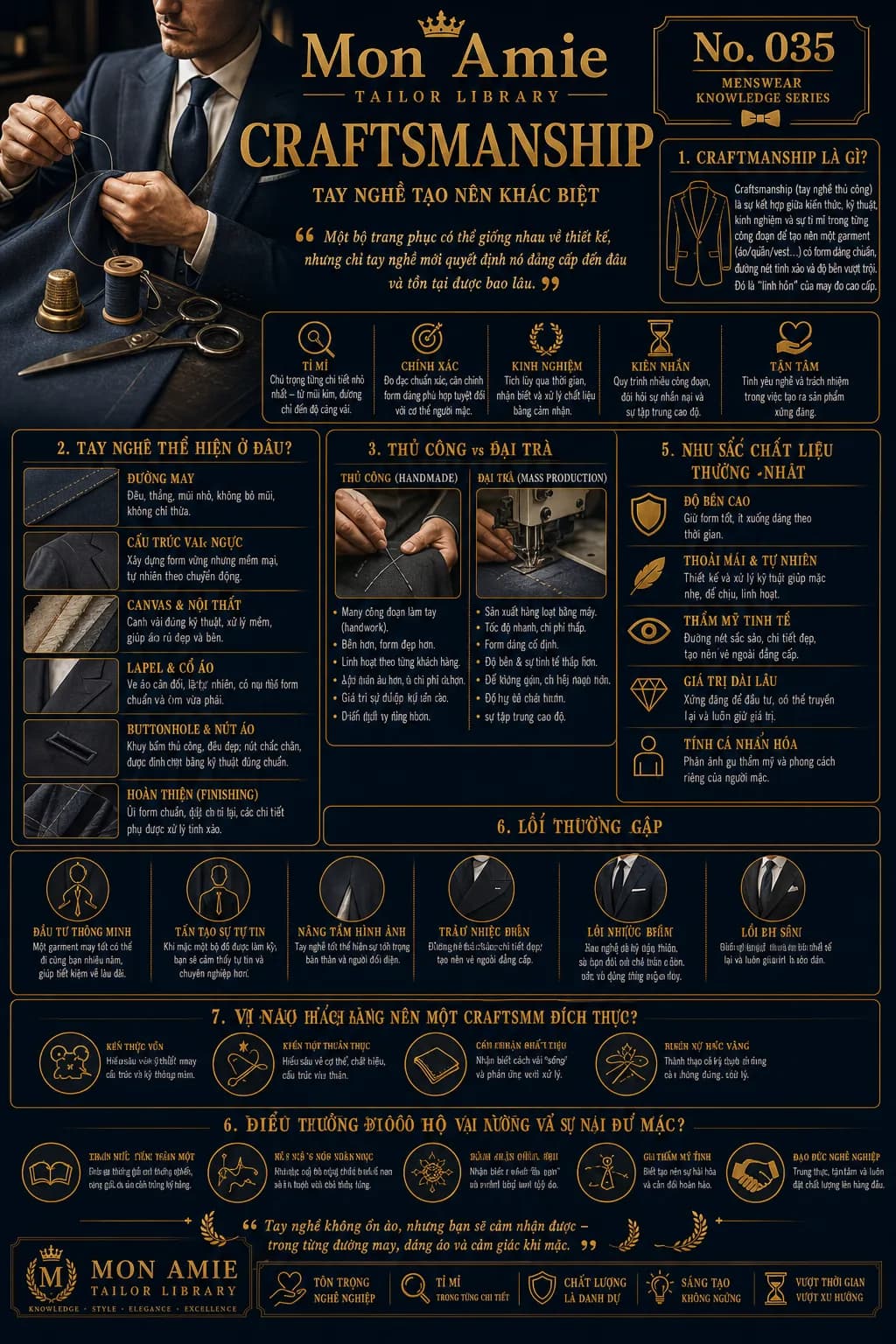
What is craftsmanship? It is handwork — the union of knowledge, technique, experience and patience across every stage of making a garment. Two suits may look alike in design, but only craftsmanship decides how fine they are and how long they last.
What craftsmanship means in tailoring
In fine tailoring, craftsmanship is more than sewing neatly. It is the whole process by which a tailor brings years of accumulated knowledge, technique and experience into every stage — measuring, cutting, building the structure, finishing — to produce a garment with a true shape, clean lines and exceptional durability. Those in the trade still call it the soul of fine tailoring.
Handwork rests on five essential qualities:
- Attention: care for the smallest detail — the stitch, the thread, the tension of the cloth.
- Precision: accurate measuring and a shape aligned exactly to the wearer's body.
- Experience: gathered over time, reading and handling cloth by feel.
- Patience: a process of many stages demanding calm and sustained concentration.
- Devotion: love of the trade and the responsibility to make something worthy of the person wearing it.
Where craftsmanship shows on a suit
You need not be in the trade to recognise good work, provided you know where to look:
- The stitching: even, straight, fine, without skipped stitches or loose threads. This is the first and most honest sign.
- The shoulder and chest: a structure that is firm yet soft, moving naturally with the body — a shoulder that holds without stiffness.
- The canvas and inner construction: an interlining laid on the correct grain and worked soft, so the jacket drapes well and keeps its shape over the years.
- The lapel and collar: a balanced lapel with a natural, soft roll; a collar that hugs the neck without gaping or wrinkling.
- The buttonholes and buttons: hand-worked buttonholes, even and clean, with buttons attached securely and correctly.
- The finishing: pressed to shape, threads cut cleanly, every secondary detail worked carefully right through to the inside of the jacket.
Handmade against mass production
This is where many people hesitate when comparing the price of a ready-made suit with a tailored one. The difference lies in the nature of the process:
- A handmade suit: many stages worked by hand, more durable, better in shape, adaptable to each client, taking more time and costing more — and returning long-term value in exchange.
- A mass-produced suit: made in volume by machine, quickly and cheaply, but with a fixed shape, lower durability and refinement, and little chance of following an individual body closely.
Machines are not the villain here — but a machine cannot read a dropped shoulder, a slightly rounded back or the way a particular man stands. Only the hand and eye of an artisan can do that.
What good craftsmanship gives the wearer
A suit made by a skilled hand offers you very concrete things:
- Durability: it holds its shape and shows little decline over time.
- Comfort and ease: the construction makes the jacket light, pleasant and free to move in.
- Refined looks: crisp lines and fine details that read as quality.
- Lasting value: worth the investment, wearable for years without losing its worth.
- Individuality: a reflection of your own taste and character.
Put another way, investing in craftsmanship is investing wisely: a well-made garment stays with you for years and works out cheaper than several hurried ones. And wearing something made with care, you will feel more confident and more professional — good craftsmanship is a mark of respect, for yourself and for those you meet.
Recognising a true artisan
When choosing a tailoring house, look for the signs of a genuine craftsman:
- Sound knowledge of the body, of cloth, of construction and of technique.
- Assured technique, with a steady hand at every stage.
- A good feel for material — knowing how a cloth behaves and responds when worked.
- Experience with difficult cases: unusual figures, awkward cloths, particular requests.
- Professional integrity: honest, devoted, always placing quality first.
A word from Mon Amie's artisans
Craftsmanship is quiet, but you will feel it — in the stitching, in the line of the jacket, in the way it wears. Mon Amie's advice: when trying a suit, do not only look in the mirror. Turn back the inside of the jacket to inspect the seams and the lining, roll your shoulders, raise your arms and feel how it holds and how it breathes. A good suit must be handsome even where nobody looks. And choose a house willing to keep altering until you are genuinely satisfied — that is the measure of devotion.
Craftsmanship is what turns a suit into an investment rather than a purchase. At Mon Amie, that spirit is present in every tailored suit — from the Kevinlli line at VND 4.8 million for a full suit through to the Canonico, Holland & Sherry, Dormeuil and Scabal collections — each with an alteration guarantee after delivery and your measurements kept for life. We invite you to book an appointment at one of Mon Amie's five Ho Chi Minh City showrooms, or to read about the tailoring process to see where that craft enters each step.