
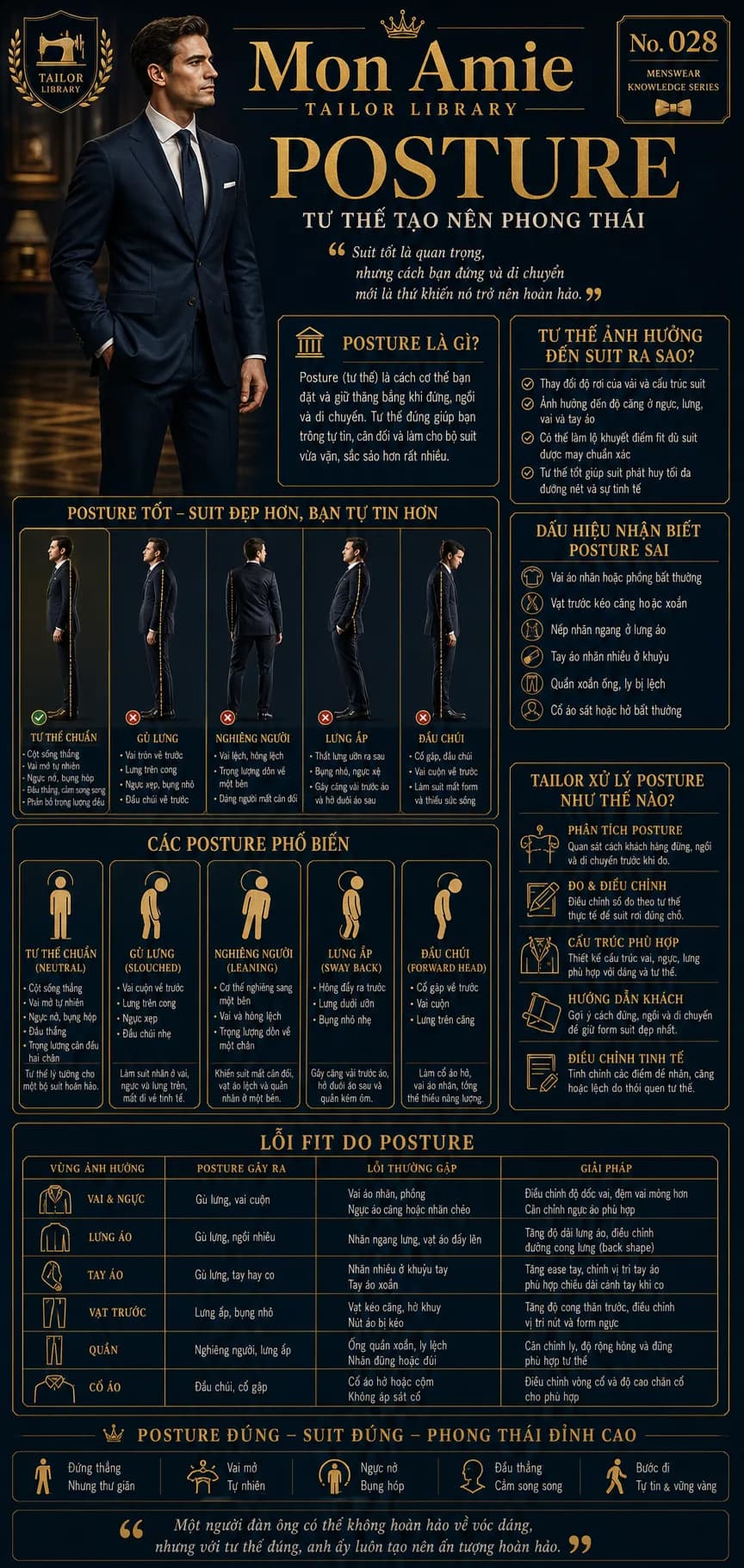
Posture is the way your body sits and holds its balance when standing, sitting and moving. For a made-to-measure suit, posture matters no less than measurements: it governs the drape of the cloth, the tension across chest, back and sleeve — in other words, whether the suit looks settled or strained. A good suit matters, but the way you stand and move is what makes it perfect.
What posture is and why tailors pay attention to it
Good posture makes you look confident and balanced, and makes a suit fit far more sharply. Poor posture, by contrast, affects a suit in four direct ways:
- It changes the drape of the cloth and the structure of the suit — wool falls along the axis of the body, and a shifted axis shifts every fold with it.
- It affects tension across the chest, back, shoulders and sleeves.
- It can expose fit faults even when the suit was cut precisely to measure.
- Good posture, conversely, lets the suit express fully the line and refinement the tailor built into the shape.
This is why bespoke houses always watch a client stand naturally before taking up the tape — static measurements are only half the story.
Common postures and their effect on a suit
In made-to-measure work, five posture groups are commonly encountered:
- Neutral: spine straight, shoulders naturally open, chest lifted, stomach drawn in, head level, weight evenly distributed. This is the ideal posture for a perfect suit.
- Slouched: shoulders rolled forward, upper back rounded, chest collapsed, head tipped slightly down. This creases the suit at the shoulders, chest and upper back, and costs it its refinement.
- Leaning: the body tilted to one side, shoulders and hips uneven, weight resting on one leg — the suit loses its balance, the front edges sit unevenly and the trousers crease on one side.
- Sway back: hips pushed forward, lower back arched, stomach slightly out — this strains the front of the jacket, lifts the back skirt away and leaves the trousers sitting poorly.
- Forward head: neck bent forward, shoulders rolled, upper back tight — the collar gaps, the shoulders crease, and the whole look loses energy.
Signs that a suit is revealing poor posture
If your suit shows any of the following, the cause usually lies in posture rather than in the sewing:
- Creasing or unexpected bunching at the shoulders.
- The front edges pulling or twisting.
- Horizontal creases across the back.
- Heavy creasing at the elbow of the sleeve.
- Twisting trouser legs, with the crease running off line.
- A collar sitting unusually tight to the neck, or gapping away from the shirt collar.
In the trade these creases are called drag lines — they always point towards the point of tension, letting the tailor read the body like a map.
Fit faults caused by posture, and how they are resolved
Each area of a suit has its own postural culprit and its own technical remedy:
- Shoulders and chest: slouching and rolled shoulders create creasing and bunching at the shoulder and diagonal strain across the chest — resolved by adjusting the shoulder slope, using a thinner shoulder pad and rebalancing the chest.
- Back: slouching and long hours seated create horizontal creases and push the skirt of the jacket up — the back length is increased and the back shape adjusted.
- Sleeves: men who habitually hold their arms bent see creasing at the elbow and twisting of the sleeve — the tailor adds sleeve ease, corrects the sleeve pitch and sets the length accordingly.
- Jacket fronts: sway back and a fuller stomach pull the fronts tight and strain the button — the front balance is increased, the button position and chest shape adjusted.
- Trousers: leaning and sway back cause twisting legs and off-line pleats — the pleats, leg width and rise are balanced to the posture.
- Collar: a forward head and bent neck cause the collar to gap or stand proud — the neckline and collar stand height are adjusted.
How a tailor addresses posture
A serious made-to-measure process handles posture in five stages:
- Posture analysis: observing how the client stands, sits and moves before measuring.
- Measuring and correction: adjusting the measurements to the actual posture so the suit falls where it should.
- Appropriate structure: designing shoulder, chest and back structure to suit that individual build and posture.
- Guiding the client: suggesting how to stand, sit and move to keep the suit at its best.
- Fine adjustment: refining the points prone to creasing, strain or imbalance during fittings.
A word from Mon Amie's artisans
When you come to be measured at Mon Amie, we always ask you to stand and walk as naturally as possible — do not push the chest out or brace the shoulders, because the suit will be cut for your real posture, not your photographed one. Mon Amie keeps your measurements for life and guarantees alterations after handover, so if your posture or build changes over the years, you need only return for us to refine it. And one simple daily habit: stand tall but relaxed, shoulders naturally open, head level, chin parallel to the ground — your suit will look better for it on its own.
A man may not have a perfect build, but with the right posture he always makes a perfect impression. If you would like a suit built for your own posture, we invite you to book an appointment at one of Mon Amie's five showrooms in Ho Chi Minh City, or to read about the tailoring process beforehand — hotline 0888.111.118.