
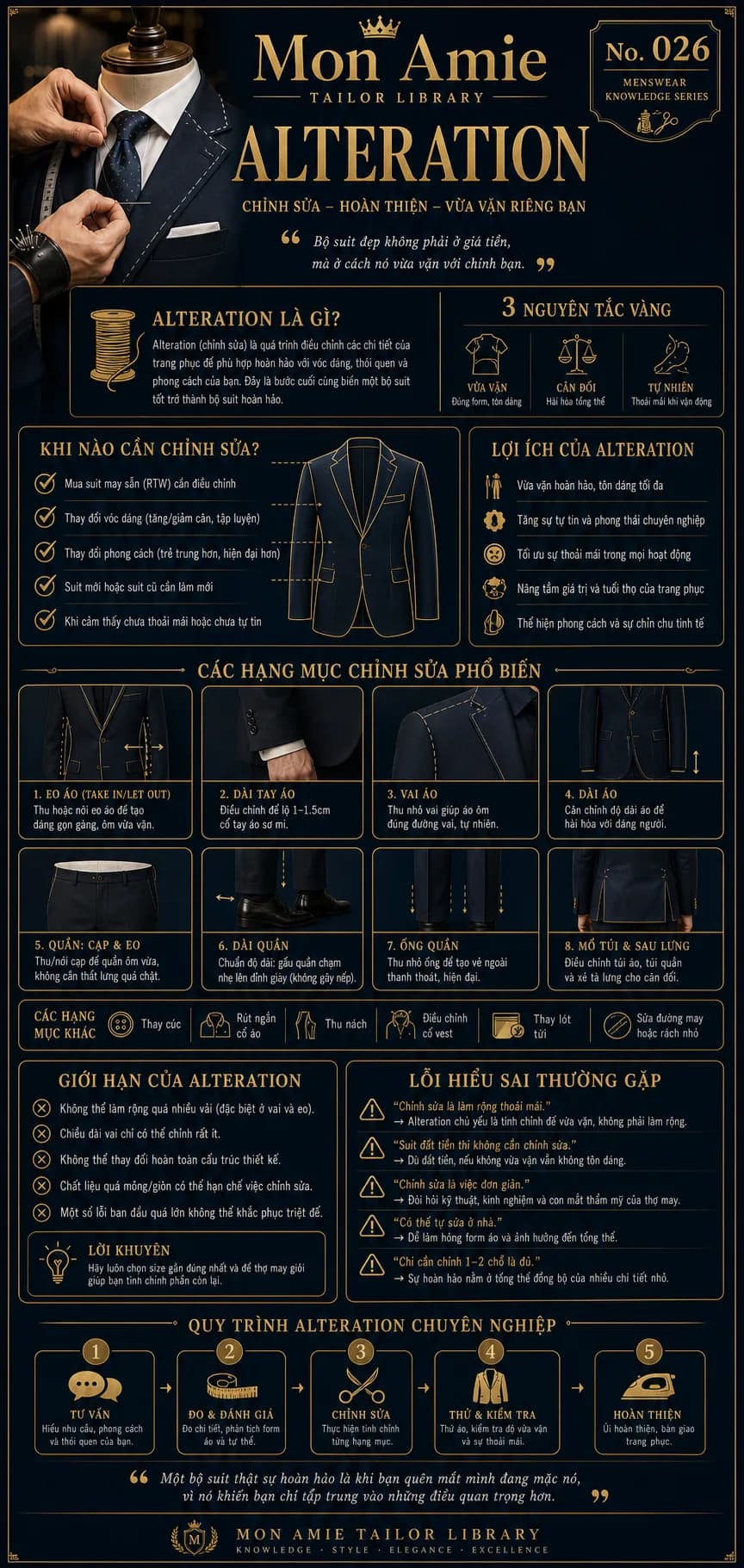
Alteration is the process of adjusting the details of a garment so that it suits the wearer's build, habits and personal style perfectly. It is the final step that turns a good suit into a perfect one. As Mon Amie often tells its clients: a beautiful suit is not defined by its price, but by how well it fits you.
The three golden rules of a proper alteration
When a tailor stands before a suit with pins in hand, every decision comes back to three criteria:
- Fit — the jacket and trousers must hold their shape and flatter the wearer, with no excess cloth and no tightness.
- Balance — every adjusted detail must sit in harmony with the whole; taking in the waist without rebalancing the shoulders still leaves the suit off.
- Ease — you must move comfortably: raising your arms, sitting down, walking. A suit that looks immaculate on a mannequin but restricts you in wear is a failed alteration.
When do you need a suit alteration?
Alteration is not only for ready-to-wear. The most common situations include:
- Buying ready-to-wear (RTW): almost always needs adjusting, since industrial sizing is cut for the average, not for anyone in particular.
- A change in build: weight gained or lost, or training that reshapes the shoulders, chest and waist.
- A change in style: wanting an older suit to look younger and more contemporary.
- A new or an older suit that needs its shape restored.
- Simply feeling that something is not quite comfortable or confident when you wear it.
The benefits are clear: a suit that fits perfectly and flatters your figure, greater confidence and a professional bearing, comfort through every activity, and a garment whose value and lifespan are both extended. A well-fitting suit always speaks to the quiet precision of the man wearing it.
Common alteration items
On a finished suit, a tailor can intervene at many points:
- Jacket waist (take in / let out): taking in or letting out the waist to create a clean, close silhouette.
- Sleeve length: adjusted to reveal roughly 1–1.5 cm of shirt cuff — the classical proportion of menswear.
- Shoulders: narrowing the shoulder so the jacket sits naturally on the shoulder line. This is the most demanding item, requiring almost the entire upper jacket to be dismantled.
- Jacket length: balanced against your overall proportions.
- Trousers — waistband and waist: taking in or letting out the waistband so the trousers sit correctly without over-tightening the belt.
- Trouser length: the correct length lets the hem rest lightly on the top of the shoe, with no break.
- Trouser leg: tapering the leg for a cleaner, more modern line.
- Pockets and centre back: adjusting jacket pockets, trouser pockets and the back vents for balance.
There are also smaller items: replacing buttons, shortening the collar, adjusting the armhole, reshaping the lapel, replacing pocket bags, and repairing seams or small tears.
The limits of alteration — what you should know first
Alteration is not magic. There are technical limits that even the finest tailor cannot cross:
- A garment cannot be let out very far, because the seam allowance is finite — particularly at the shoulders and waist.
- Shoulder width can only be changed marginally.
- The structural design of a jacket cannot be fundamentally rebuilt.
- Cloth that is very fine or brittle restricts alteration, since old stitch lines may leave marks.
- Some original faults are too great to be fully corrected.
Hence the advice that always holds true: choose the closest possible size, and let a skilled tailor refine the rest.
Common misconceptions about suit alteration
- "Alteration means letting things out for comfort." In practice, alteration is mostly about refining the fit, not enlarging it.
- "An expensive suit needs no alteration." However costly, a suit that does not fit will not flatter.
- "Alteration is simple work." It calls for technique, experience and a tailor's eye.
- "You can do it yourself at home." It is very easy to ruin the shape of a jacket and unbalance the whole.
- "One or two adjustments are enough." Perfection lies in the combined harmony of many small details.
The professional alteration process
A properly conducted alteration goes through five stages:
- Consultation — understanding your needs, style and habits.
- Measuring and assessment — detailed measurements, analysis of the current shape and identification of the points to be addressed.
- Alteration — carrying out each adjustment.
- Fitting and checking — trying the garment on, verifying fit and comfort in movement.
- Finishing — final pressing and handover.
A word from Mon Amie's artisans
Mon Amie's experience across thousands of suits is this: do not wait until you feel uncomfortable to think about alteration — whenever your weight shifts by three or four kilograms, bring the suit in to have its shape reviewed. With a suit made to measure at Mon Amie, you receive an alteration guarantee after handover and your measurements are kept for life, so every later adjustment is quick and precise. A truly perfect suit is one you forget you are wearing, because it leaves you free to think about more important things.
If you own a suit that has never felt quite right, bring it to one of Mon Amie's five showrooms in Ho Chi Minh City or call 0888.111.118 for a consultation. You may book an appointment and read about the tailoring process at Mon Amie beforehand.