
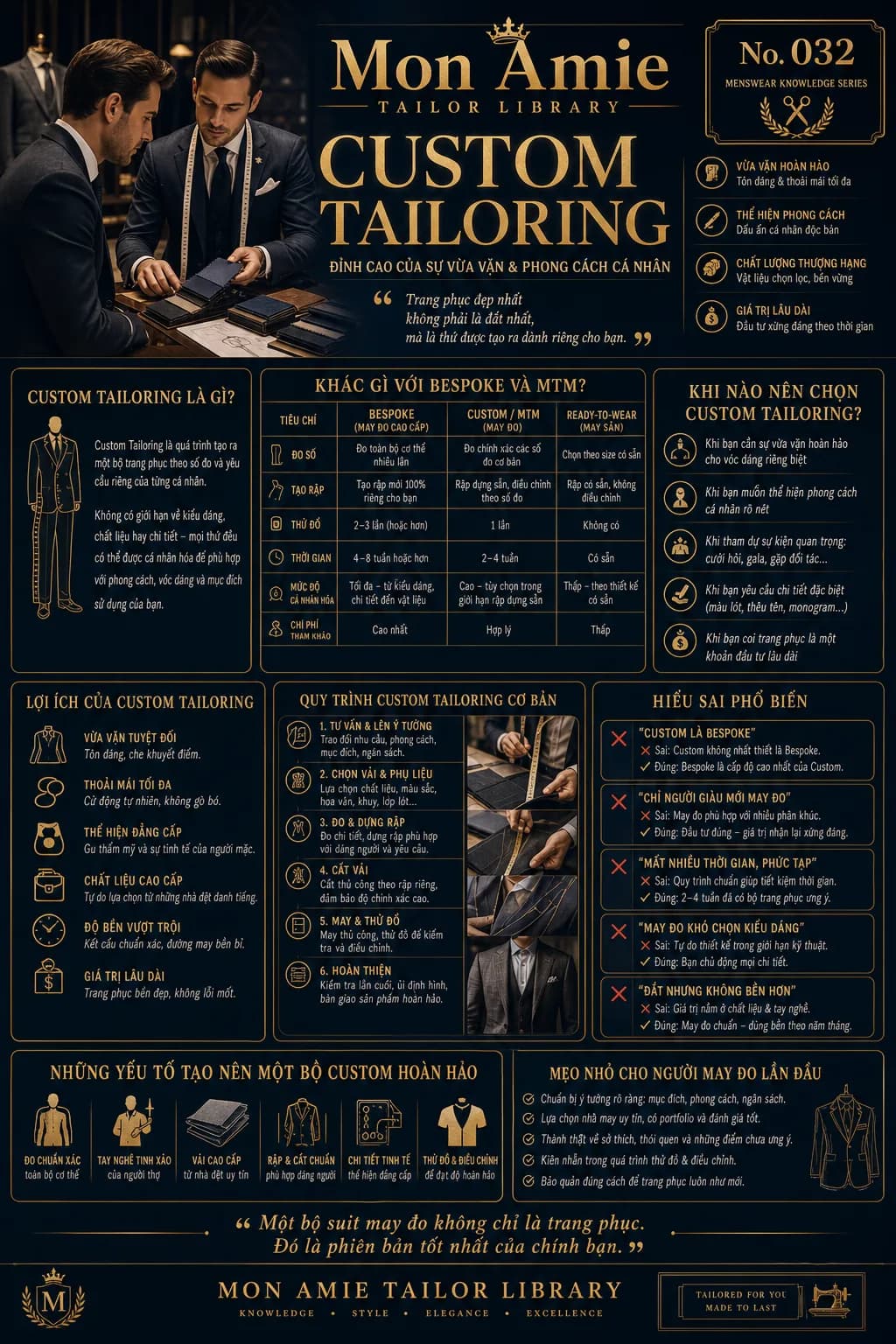
Custom tailoring is the making of a garment from an individual's own measurements and preferences, rather than picking a ready-made size off the rack. For you, that means the cut, the cloth and every detail are personalised to your style, your build and the way you intend to wear it. The finest garment is not the most expensive one. It is the one made for you alone.
What is custom tailoring?
Custom tailoring is a method in which the tailor measures you directly, then builds and adjusts the garment to those measurements and requests. Unlike off-the-rack clothing, there is no fixed limit on cut, cloth or detail:
- You choose the silhouette: close-fitting, comfortable or classic.
- You choose the cloth: from everyday qualities to the great mills.
- You decide the details: lapel, button count, lining colour, sleeve buttons, an embroidered name or monogram.
The result is a suit that flatters your frame, disguises what you would rather not emphasise and carries your signature — something no ready-made size can fully achieve.
How does it differ from bespoke and off-the-rack?
Three tiers of menswear are routinely confused. They can be told apart by a few key criteria:
- Measuring: bespoke measures the whole body across several sessions; custom and made-to-measure record accurate core measurements; off-the-rack means simply choosing an existing size.
- Patterns: bespoke draws an entirely new pattern for each client; custom adapts an existing block to your measurements; off-the-rack uses a fixed pattern with no adjustment.
- Fittings: bespoke involves two to three fittings or more; custom usually one; off-the-rack none at all.
- Timeline: bespoke takes four to eight weeks or longer; custom around two to four weeks; off-the-rack is wearable the day you buy it.
- Degree of personalisation: bespoke is total, from cut to every material detail; custom offers choices within the limits of the block; off-the-rack is lowest.
- Cost: bespoke is highest, custom is reasonable, off-the-rack is lowest.
To be clear: bespoke is the highest tier of tailoring, while custom tailoring is the balanced route between fit, personalisation and cost.
When should you choose custom tailoring?
- When you need a truly precise fit for a distinctive build — uneven shoulders, a slight forward stoop, arms longer or shorter than standard.
- When you want your own style to read clearly rather than dressing like everyone else.
- When you are preparing for an important occasion: a wedding, a gala, a meeting with partners.
- When you want particular details: a chosen lining, an embroidered name, a monogram.
- When you regard clothing as a long-term investment rather than something worn a handful of times.
The essential tailoring process
A suit made at a serious tailoring house typically passes through six stages:
- Consultation and direction — discussing your needs, style, purpose and budget.
- Choosing cloth and trimmings — fabric, colour, pattern, buttons, lining.
- Measuring and pattern-making — detailed body measurements, then a pattern drawn for your figure and requests.
- Cutting — cut by hand to your own pattern, with close attention to precision.
- Making and fitting — sewing, then a fitting on the body to check and adjust.
- Finishing — a final inspection, pressing to shape and handover of the completed garment.
Common misconceptions about tailoring
- "Custom is bespoke" — no. Custom is not necessarily bespoke; bespoke is the highest tier of tailoring.
- "Only the wealthy have clothes made" — no. Tailoring suits a wide range of budgets, and invested well, the value returned is worth it.
- "It takes too long and it's complicated" — no. A proper process saves you time; two to four weeks for a garment you are happy with is reasonable.
- "It's hard to choose a style with tailoring" — no. You lead every detail and design freely within technical limits.
- "Expensive but no more durable" — no. The value lies in cloth and craft; a properly tailored suit lasts for years.
What makes a custom garment truly right
- Accurate measurements taken across the whole body.
- Refined skill on the part of the tailor.
- Fine cloth from a reputable mill.
- A sound pattern and clean cutting, suited to your figure.
- Considered details that speak of quality.
- Fittings and adjustments until the result is right.
A word from Mon Amie's artisans
For those coming to tailoring for the first time, Mon Amie suggests arriving at the showroom with a clear idea of purpose, style and budget. Be candid with your tailor about your preferences, your habits of dress and the aspects of your figure you are less content with — that is the most valuable information for drafting a pattern. Finally, be patient through fittings and adjustments: one thorough fitting is worth more than several hurried makes. At Mon Amie your measurements are kept for life and every suit carries an alteration guarantee after delivery, with options ranging from the Kevinlli line at VND 4.8 million for a full suit to the Canonico, Holland & Sherry, Dormeuil and Scabal collections.
A tailored suit is not merely clothing — it is the finest version of yourself. We invite you to book an appointment at one of Mon Amie's five Ho Chi Minh City showrooms, or to read the tailoring process before beginning your own custom tailoring journey.