
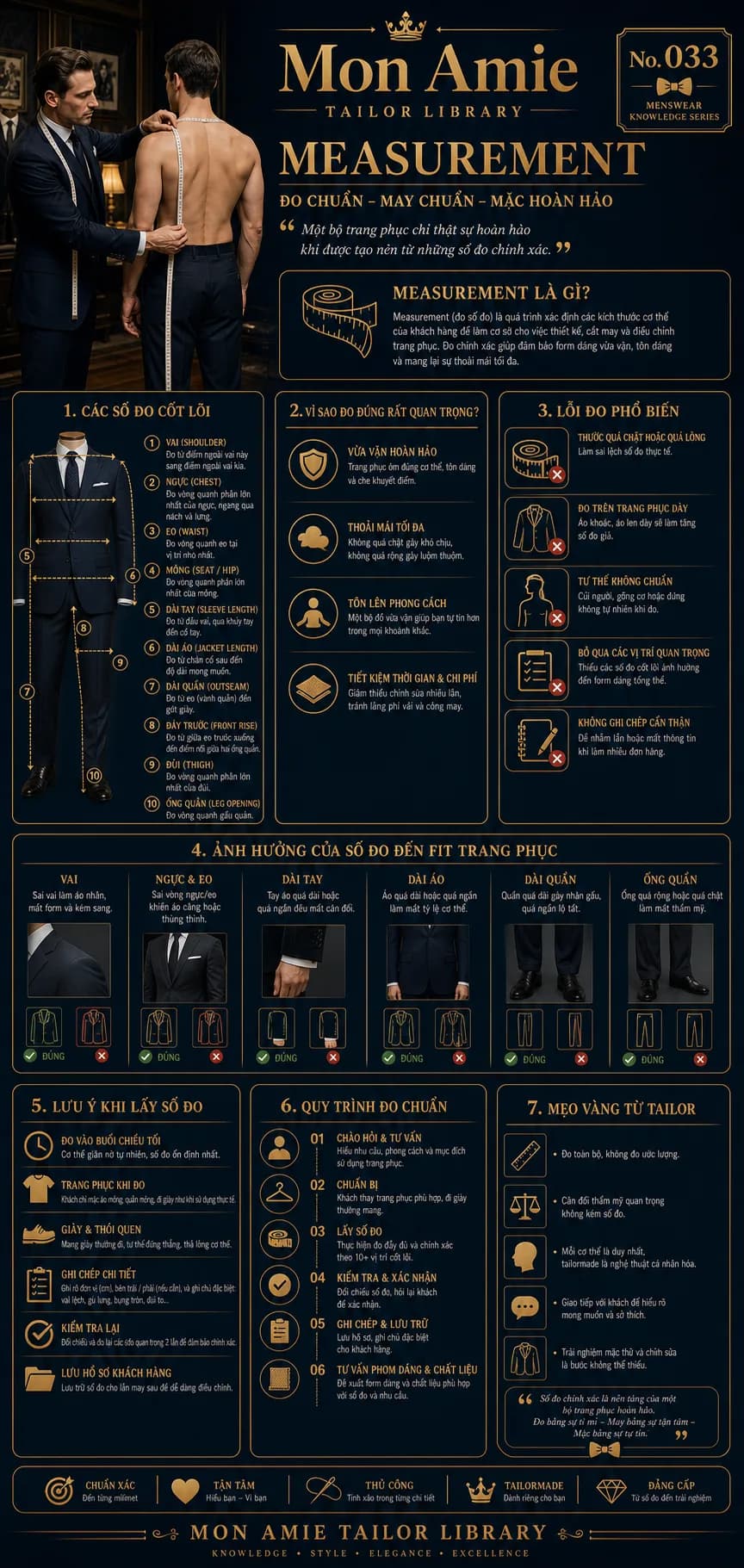
Measurement is the process of establishing a client's body dimensions as the basis for designing, cutting and adjusting a garment. A suit is only truly right when it is built on accurate figures — measure well and the making follows, and only then does the wearing feel perfect. In this article, Mon Amie shares the core measurements, the errors most often made, and the proper measuring procedure of an experienced tailor.
The core measurements for a suit
To draft a suit that fits, a tailor needs at least ten core measurements:
- Shoulder: taken from one shoulder point across to the other — the figure that governs the jacket's shape more than any other.
- Chest: taken around the fullest part of the chest, passing under the arms and across the back.
- Waist: taken around the waist at its narrowest point.
- Seat: taken around the fullest part of the seat.
- Sleeve length: from the shoulder point, over the elbow, to the wrist.
- Jacket length: from the base of the collar at the back to the desired length.
- Outseam: from the waistband down to the heel of the shoe.
- Front rise: from the centre front waist down to the join between the two legs.
- Thigh: around the fullest part of the thigh.
- Leg opening: around the trouser hem, which determines how clean the leg line reads.
In bespoke work, a tailor will take a good many additional measurements and note the particulars of the body: a dropped shoulder, a rounded back, a fuller waist — the things a tape measure alone cannot express.
Why measuring well matters so much
Accurate figures are not merely technical. They shape the experience of wearing the garment directly:
- A precise fit: the garment follows the body, flatters the frame and disguises what it should.
- Genuine comfort: never so tight as to restrict, never so loose as to look careless.
- A stronger sense of style: a garment that fits gives you confidence in every moment.
- Time and money saved: fewer rounds of alteration, less cloth and labour wasted.
The effect of each measurement is very specific. A wrong shoulder makes the jacket ripple and lose its line. A wrong chest or waist leaves the jacket straining or hanging loose. Sleeves too long or too short unbalance the whole. A jacket too long or too short distorts your proportions. Trousers too long crease at the hem, too short and the sock shows. A leg opening too wide or too narrow undermines the look entirely.
Common measuring errors to avoid
Even experienced hands can fall into these:
- Pulling the tape too tight or too slack — the figure no longer reflects the body.
- Measuring over heavy clothing — a jacket or thick knit inflates every reading.
- A poor stance — leaning, tensing the muscles or standing unnaturally during measuring.
- Skipping key points — missing a core measurement affects the shape of the whole garment.
- Careless record-keeping — figures get confused or lost, especially across many orders.
How to ensure the most accurate figures
You can prepare for a measuring session to get the best result:
- Come in the late afternoon or evening: the body has settled naturally and the figures are most stable.
- What to wear: a light shirt and light trousers, with the shoes you would actually wear.
- Shoes and habits: bring your usual shoes, stand upright and let the body relax.
- Detailed notes: record the unit (cm), left or right where it matters, and any particulars of shoulder, back, waist or thigh.
- Check again: repeat the important measurements twice and compare to be sure.
- Keep the client record: store the figures for the next commission so adjustments are simple — at Mon Amie, your measurements are kept for life.
The six-step measuring process
A properly conducted measuring session follows this order:
- Welcome and consultation: understanding your needs, your style and how the garment will be worn.
- Preparation: changing into suitable clothing and putting on your usual shoes.
- Taking the measurements: working through more than ten core points, fully and accurately.
- Checking and confirming: comparing the figures and confirming them with you.
- Recording and filing: storing the record along with any particular notes.
- Advising on cut and cloth: recommending a silhouette and fabric suited to your figures and your needs.
A word from Mon Amie's artisans
Mon Amie's artisans always tell their apprentices the same thing: measure everything, never estimate — and visual balance matters as much as the tape. Every body is unique, so tailoring is truly an art of personalisation; a good tailor measures with the tape and talks with the client at the same time, to understand what is wanted and what is preferred. Fittings and adjustments are indispensable, because a figure is only perfect once it has been proven on your own body.
Accurate measurement is the foundation of a garment that is truly right: measured with care, made with devotion, worn with confidence. Mon Amie has five showrooms in Ho Chi Minh City (Nguyen Trai, Ho Van Hue, 3 Thang 2, Caravelle Hotel in District 1, and Nguyen Thi Thap), with full suits from VND 4.8 million in the Kevinlli line through to the Canonico, Holland & Sherry, Dormeuil and Scabal collections, each with an alteration guarantee after delivery. You are welcome to book an appointment to be measured by our artisans in person, or to read about the tailoring process beforehand — our hotline 0888.111.118 is always open.