
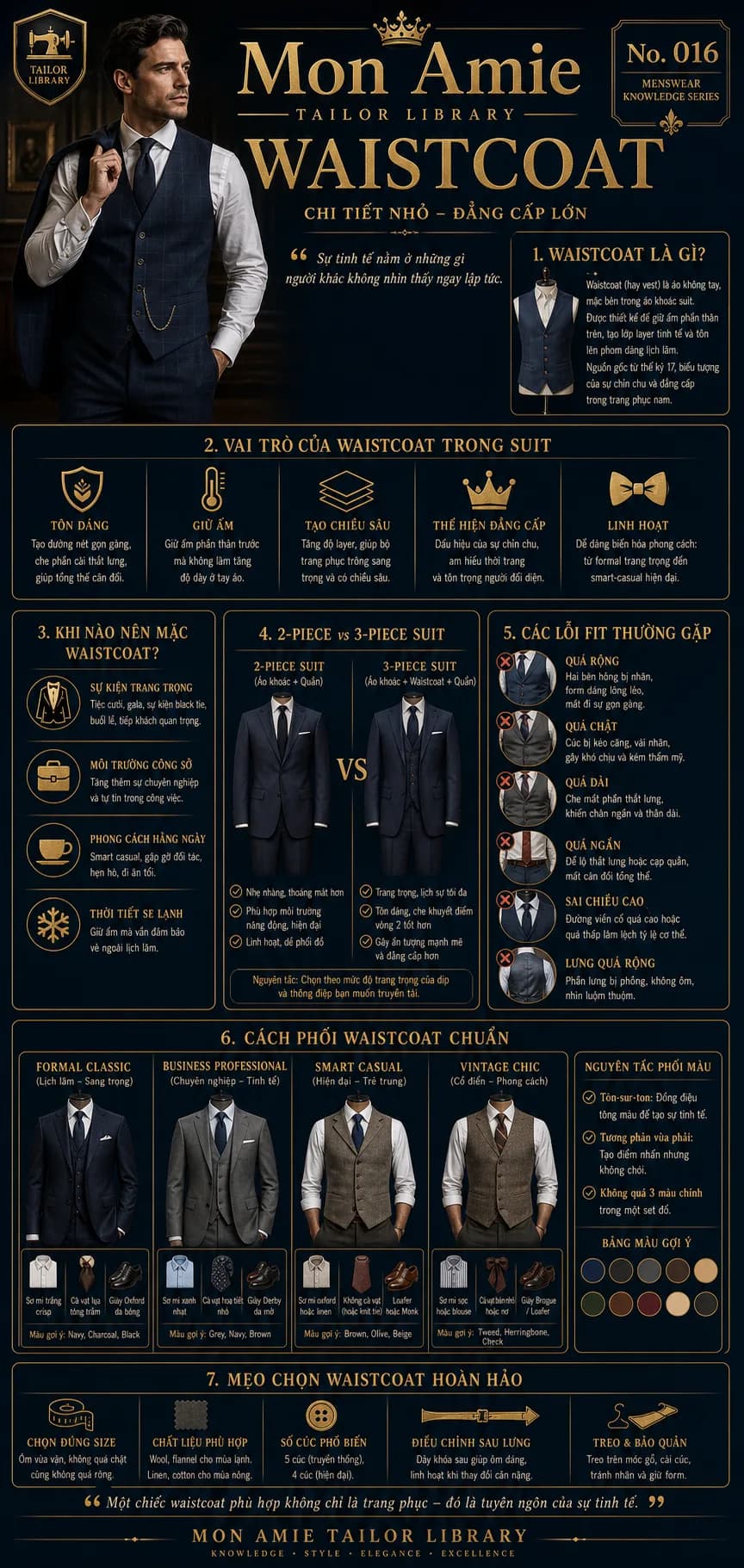
The waistcoat is the sleeveless garment worn beneath a suit jacket — the piece that turns two into the classic three-piece suit. Designed to warm the torso, it adds a refined layer and sharpens the wearer's silhouette. As Mon Amie often tells its clients: elegance lives in the things nobody notices straight away.
What a waistcoat is, and why it has lasted three centuries
The waistcoat emerged in seventeenth-century England, when Charles II introduced it at court as a new standard of gentlemanly dress. Ever since, this sleeveless garment has signalled composure and standing in menswear.
Within a complete suit, the waistcoat performs five roles:
- Flatters the figure: it draws a clean line, conceals the waistband, and balances the whole.
- Provides warmth: it warms the front of the body without adding bulk at the sleeves.
- Creates depth: the extra layer gives the outfit richness and dimension.
- Signals standing: a mark of care, of knowing dress, and of respect for the people you meet.
- Offers versatility: it moves easily from strict formality to modern smart-casual.
When you should wear a waistcoat
Not every occasion calls for all three pieces, but four situations let the waistcoat show its full worth:
- Formal occasions: weddings, galas, black-tie events, ceremonies or important receptions — where maximum polish is noticed and valued.
- The office: added authority and confidence at work, particularly in professions where image carries weight.
- Everyday style: smart casual for meeting a partner, a date, or dinner — jacket off, waistcoat and shirt alone remain perfectly courteous.
- Cooler weather: warmth without reaching for a sweater that would spoil the line of the suit.
Two-piece or three-piece: how to choose
A two-piece suit (jacket and trousers) is lighter, cooler, well suited to dynamic modern settings and easier to mix and match. A three-piece suit (jacket, waistcoat and trousers) reads as formal and correct, flatters the figure, disguises the midsection more kindly, and leaves a stronger, more distinguished impression.
The principle Mon Amie usually offers: choose according to the formality of the occasion and the message you wish to send. An internal meeting may need only two pieces; a wedding or a significant signing deserves all three.
Common fit faults with a waistcoat
The waistcoat sits closest to the body of anything in a suit, so the smallest error shows at once:
- Too loose: the sides wrinkle, the shape slackens, and all crispness is lost.
- Too tight: buttons pull, the cloth creases, and comfort goes with the look.
- Too long: it swallows the waistband, shortening the legs and lengthening the torso.
- Too short: the belt or trouser waistband appears, cutting the figure in half.
- Wrong neckline height: an opening set too high or too low throws off the proportion against the jacket lapel.
- Back too full: the back balloons instead of following the body, looking untidy the moment the jacket comes off.
The trade's standard: a waistcoat must cover the trouser waistband completely, follow the waist gently, and never reveal shirt in any position — standing, seated, or with arms raised.
Four proven ways to style a waistcoat
- Formal Classic (refined and luxurious): a matching three-piece, a crisp white shirt, a silk tie in a deep tone, polished Oxford shoes. Suggested colours: navy, charcoal, black.
- Business Professional (professional and considered): a pale blue shirt, a small-patterned tie, matte Derby shoes. Suggested colours: grey, navy, brown.
- Smart Casual (modern and youthful): an oxford or linen shirt, tie optional or a knit tie, loafers or monk straps. Suggested colours: brown, olive, beige.
- Vintage Chic (classic and characterful): tweed or herringbone cloth, a striped shirt, a narrow tie or bow tie, brogues or loafers.
On colour, three rules hold: tone-on-tone for quiet refinement; measured contrast for interest without glare; and never more than three principal colours in a single outfit.
Choosing the right waistcoat
- Correct size: close to the body, neither tight nor slack.
- Cloth by season: wool and flannel for cool weather; linen and cotton for the heat.
- Button count: five by tradition, four for a modern look — and always leave the lowest one open.
- Back adjuster: the rear buckle refines the fit and allows for changes in weight.
- Hanging and care: use a wooden hanger, keep it buttoned when hung, and it will resist creasing and hold its shape.
A word from Mon Amie's artisans
With a ready-made waistcoat it is nearly impossible to avoid a gaping back or a mistaken length, because this garment depends entirely on each man's torso proportions. Made to measure at Mon Amie, the artisan takes separate measurements for body length, neckline opening and waist position so the waistcoat meets the jacket lapel and the trouser waistband seamlessly. It is also worth commissioning the waistcoat from the same bolt as the suit from the outset — adding one later rarely matches the dye lot. Mon Amie keeps your measurements for life, so future commissions need only adjustment for changes in your body.
A well-fitted waistcoat is more than clothing — it is a statement of refinement. If you are preparing for an important occasion, book an appointment with Mon Amie at one of our five showrooms in Ho Chi Minh City, or read the tailoring process first to see how your three-piece suit will come into being.