
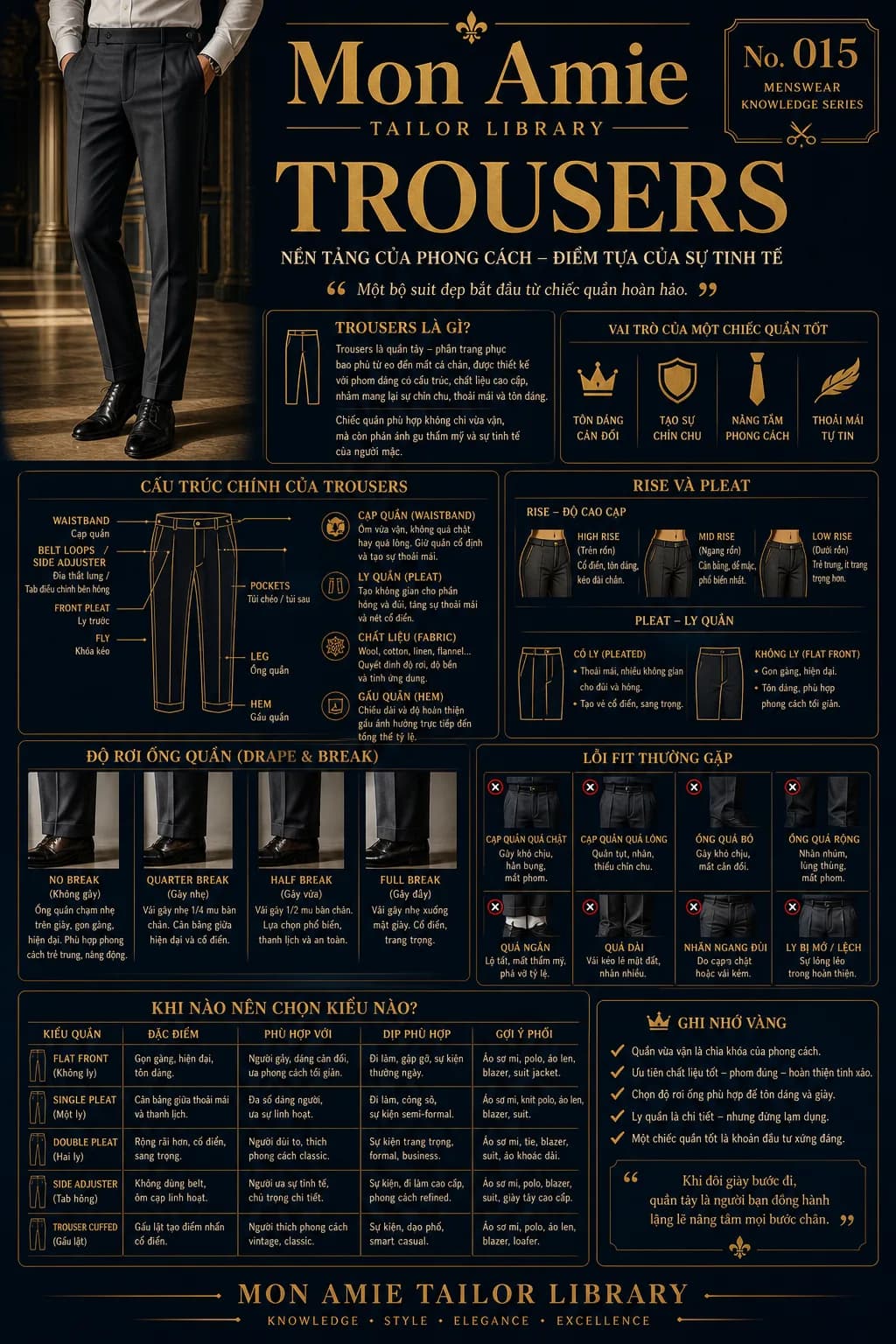
Trousers are the garment covering you from waist to ankle, cut with a considered structure and made in fine cloth to give polish, comfort and a flattering line. A handsome suit begins with a faultless pair of trousers: a jacket can conceal a little, but trousers reveal your proportions and your taste completely. Understanding trousers, then, is the first step to mastering your own style.
What a good pair of trousers does for you
The right trousers are not merely well fitted; they reflect the taste and discernment of the wearer. In practice, a proper pair of suit trousers carries four roles:
- Flattering the figure — visually lengthening the leg and balancing the upper and lower body.
- Creating polish — a clean leg and a crisp crease keep the whole ensemble tidy.
- Elevating the outfit — trousers with the right line support everything from jacket to shoes.
- Comfort and confidence — when trousers fit, you forget what you are wearing and attend to your work.
The principal parts of a pair of trousers
Every pair of trousers is the sum of many parts, and quality lies in how each one is handled:
- Waistband: it should sit comfortably, neither tight nor loose, holding the trousers in place through a long day. On it sit the belt loops, or side adjusters for those who prefer a cleaner line.
- Pleat: the fold at the front creates room across the hip and thigh, adding comfort and a classic air.
- Fabric: wool, cotton, linen, flannel and others determine drape, durability and how widely the trousers can be worn.
- Hem: the length and the finish of the hem bear directly on the proportions of the whole.
- Other details include the side and back pockets, the fly and the leg — where a maker's finishing skill shows.
Rise and pleat: the two choices that shape the line
Rise is the distance from the crotch to the top of the waistband, and it decides where the trousers sit on the body:
- High rise (above the navel): classic and flattering, lengthening the leg — the familiar choice of sartorial style.
- Mid rise (at the navel): balanced and easy to wear, the most common today.
- Low rise (below the navel): youthful but less formal, at home in casual settings.
Pleats divide trousers into two schools:
- Pleated: comfortable, with generous room through thigh and hip; classic and refined in effect.
- Flat front: neat and modern; slimming, and suited to a minimal style.
The fall of the leg: drape and break
The break is the point at which the trouser leg meets the shoe — a small detail that determines the bearing of the whole suit:
- No break: the leg just touches the shoe, neat and modern; suited to a youthful, energetic style.
- Quarter break: the cloth folds lightly over about a quarter of the instep — a balance of modern and classic.
- Half break: the cloth folds over about half the instep — the common choice, elegant and safe.
- Full break: the cloth falls softly onto the shoe — classic and formal, best with a wider leg.
Common fit faults
Even costly trousers can spoil an outfit if any of these occur:
- Waistband too tight — uncomfortable, marks the waist and distorts the line.
- Waistband too loose — the trousers slip and crease, and look unkempt.
- Leg too slim — uncomfortable and out of proportion.
- Leg too wide — creased and shapeless, the line lost.
- Trousers too short — the sock shows, the look suffers and the proportions break.
- Trousers too long — the cloth drags on the floor and creases heavily.
- Horizontal creases across the thigh — caused by a tight waist or poor cloth.
- Pleats gaping or pulling askew — a sign of loose work in the finishing.
Which style, and when?
- Flat front: neat and modern — for slim, well-proportioned builds and minimal tastes; for work, meetings and everyday occasions; with shirts, polos, knitwear and blazers.
- Single pleat: a balance of comfort and elegance — suits most builds; for work, the office and semi-formal occasions.
- Double pleat: roomier, classic and refined — for fuller thighs and a taste for classic style; for formal and business occasions.
- Side adjusters: no belt, with a flexible hold at the waist — for those who value refinement and detail; for high-end occasions, a refined manner and fine dress shoes.
- Cuffed trousers: a turn-up as a classic accent — for vintage and classic tastes; for strolling and smart casual.
A few golden reminders: fit is the key to style; favour good cloth, a correct line and fine finishing; choose the break that flatters both your figure and your shoes; pleats are a valuable detail but should not be overdone; and a good pair of trousers is an investment well made.
A word from Mon Amie's artisans
When making to measure, Mon Amie always advises deciding the break together with the shoes you wear most often — trouser length is only correct when fitted over those very shoes. If you sit for much of the day, consider a single pleat, so the thigh is comfortable while the line stays clean when you stand. Your measurements are kept for life, and every pair is covered for alterations after delivery, so you may refine them until they are exactly right.
As the shoes carry you forward, your trousers are the quiet companion that elevates every step. If you would like a pair of suit trousers cut to your own line — from the Kevinlli range, with full suits from VND 4.8 million, through the Canonico, Holland & Sherry, Dormeuil and Scabal collections — you are welcome to book an appointment at one of Mon Amie's five showrooms in Ho Chi Minh City, or to read about the tailoring process; hotline 0888.111.118.