
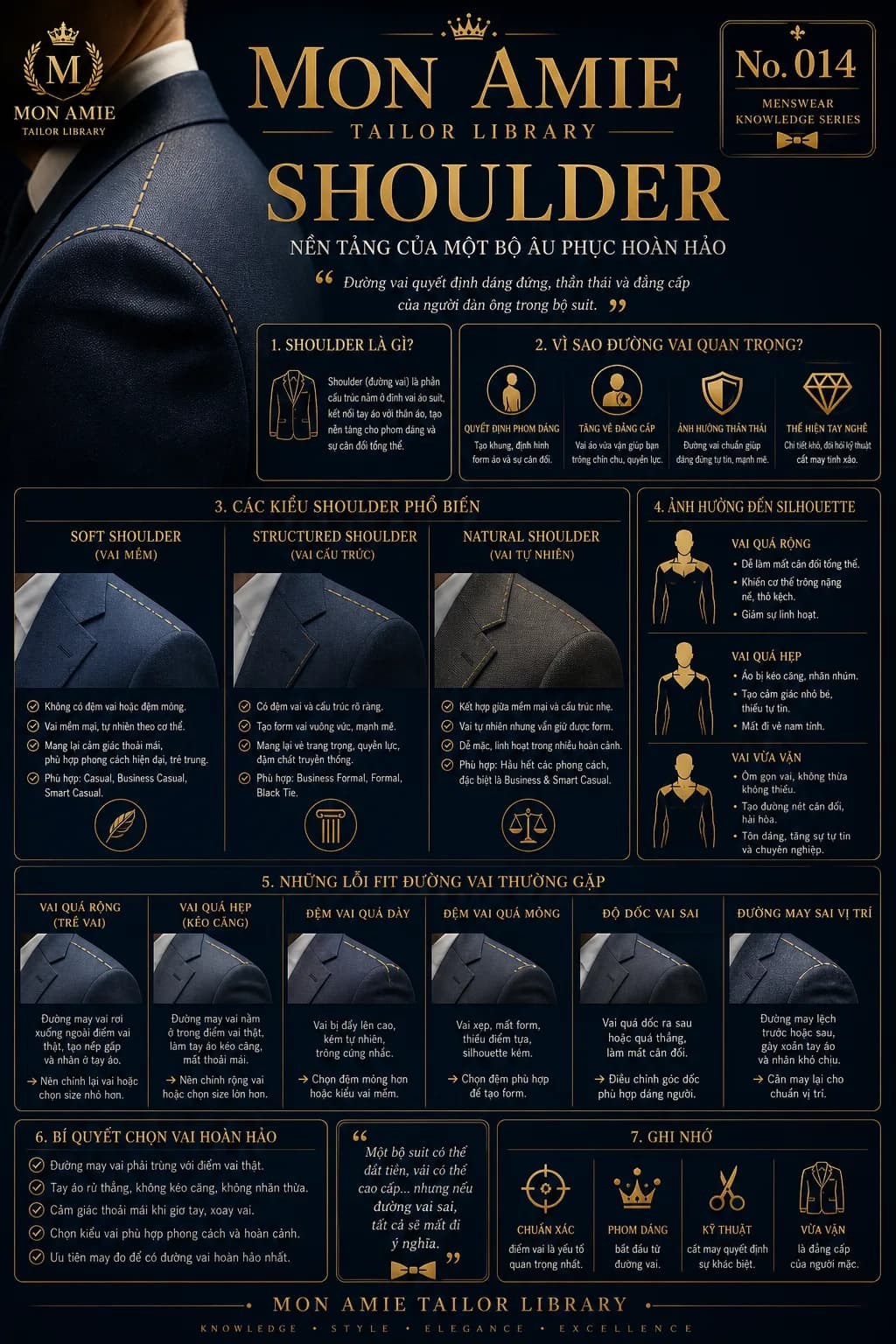
The shoulder is the structure at the top of a suit jacket, where the sleeve meets the body and where the entire silhouette finds its foundation. In tailoring there is an almost immovable principle: a suit may be expensive and the cloth superb, but if the shoulder is wrong, none of it counts. The shoulder decides a man's stance, his bearing and his distinction before any other detail has a chance to speak.
Why the shoulder matters so much
When an experienced tailor appraises a jacket, he looks at the shoulder first, for four reasons:
- It decides the silhouette: the shoulder frames the jacket and governs the balance of the whole line. Body, lapel and sleeve all hang from this foundation.
- It conveys quality: a shoulder that fits makes you look composed and authoritative, whether in a meeting room or at a reception.
- It shapes your bearing: a correct shoulder line makes your stance more confident and assured — a visual effect no accessory can replace.
- It reveals craftsmanship: the shoulder is the hardest part of a jacket to make, demanding real skill in cutting and sewing. One look at the shoulder tells a professional the calibre of the workshop.
Unlike the waist or the sleeve, the shoulder can barely be altered once the jacket is finished — reworking it means detaching the sleeve and collar and rebuilding the structure. Getting it right from the start is the only real option.
Three common shoulder styles
Soft shoulder
- No padding, or very thin padding.
- Soft, following the body naturally.
- Comfortable, in keeping with a modern, youthful manner.
- Best for: casual, business casual, smart casual.
This is the signature school of southern Italian tailoring — Naples — where the jacket is likened to a second skin.
Structured shoulder
- Clear padding and a defined internal structure.
- Creates a square, powerful shoulder line.
- Formal, authoritative, deeply traditional — the spirit of English tailoring on Savile Row.
- Best for: business formal, formal, black tie.
Natural shoulder
- A blend of softness and light structure: padding thin enough to hold the line without adding to the body.
- Natural yet neat, and it keeps its shape.
- Easy to wear and versatile across settings.
- Best for: most styles, particularly business and smart casual.
For Vietnamese men of average build, the natural shoulder is usually the safest point of balance — formal enough for work, easy enough for daily life.
How the shoulder shapes the silhouette
On the same wearer, shoulder width alters the visual impression entirely:
- Too wide: the whole is thrown out of balance, the body looks heavy and coarse, and movement is less free.
- Too narrow: the jacket pulls and creases, making the wearer look small and uncertain, and stripping away masculinity.
- Correctly fitted: it sits cleanly on the shoulder, neither surplus nor short; the lines are balanced and harmonious; the figure is flattered and the bearing confident and professional.
Common shoulder fit faults
At a fitting, you can check for these six familiar faults yourself:
- Too wide (overhanging): the shoulder seam falls beyond the true shoulder point, creating folds and creases at the sleeve head. Remedy: rework the shoulder or take a smaller size.
- Too narrow (pulling): the seam sits inside the true shoulder point, making the sleeve pull and the jacket uncomfortable. Widen the shoulder or take a larger size.
- Padding too thick: the shoulder is pushed up, looking unnatural and stiff. Choose thinner padding or move to a soft shoulder.
- Padding too thin: the shoulder collapses, loses its line and lacks support, weakening the silhouette. Choose the right padding to hold the shape.
- Wrong shoulder slope: the jacket slopes too far back or sits too straight against your own shoulder, unbalancing the line. The angle must be adjusted to your build — this is why sloping and square shoulders cannot share the same pattern.
- Seam in the wrong place: a seam set too far forward or back twists the sleeve and creates awkward creases. It must be re-set correctly.
How to get the shoulder right
- The shoulder seam must fall exactly on your true shoulder point.
- The sleeve should hang straight, with no pulling and no surplus wrinkles.
- You should feel comfortable raising your arm and rotating the shoulder — a good suit must never imprison its wearer.
- Choose the shoulder style to match your manner and your occasions: structured for ceremony, soft for daily life.
- Favour made-to-measure for the finest shoulder line, because no two pairs of shoulders are alike — slope, thickness and the difference between left and right are all individual measurements.
A word from Mon Amie's artisans
In our workshop we often tell clients: forget the waist and the sleeves at the first fitting, and look only at the shoulder. If the shoulder is right, everything else can be adjusted; if it is wrong, no adjustment matters. When you are measured at Mon Amie, your shoulder measurements — including the difference between left and right that the eye rarely catches — are kept for life, so that your second and third suits are better still than the first. And after delivery, alterations remain covered, so the shoulder can follow every change in your body.
A correct shoulder is the foundation of a fine suit — and of the bearing of the man in it. If you would like to feel for yourself the difference of a shoulder cut for your body alone, you are welcome to book an appointment at one of Mon Amie's five showrooms in Ho Chi Minh City, or to read first about the tailoring process. Hotline: 0888.111.118.