
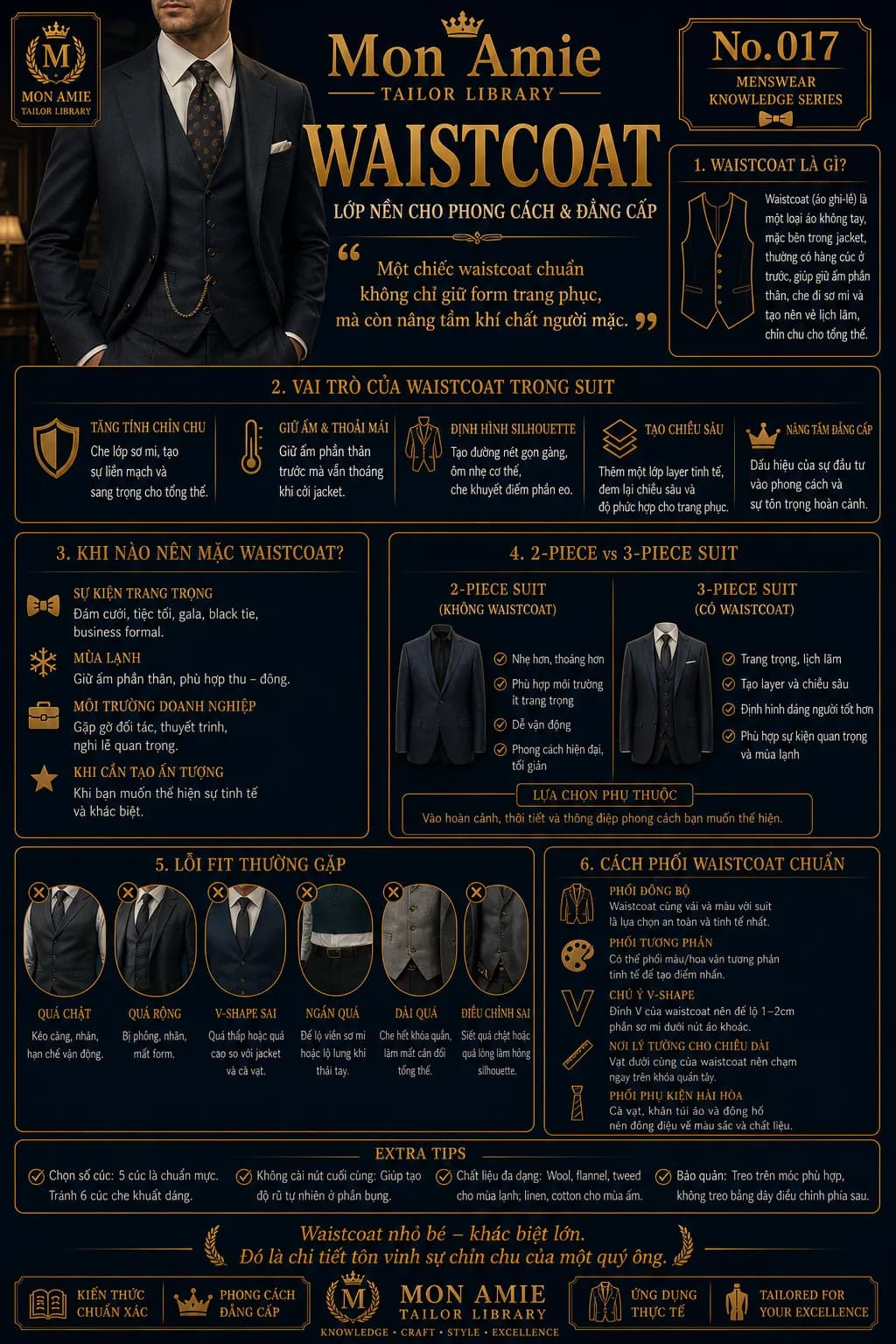
What is a waistcoat? It is the sleeveless garment worn beneath the jacket, usually buttoning down the front, that warms the torso, covers the shirt and lends the whole outfit an air of composure. A well-cut waistcoat does not merely hold the outfit together; it lifts the bearing of the man wearing it — which is why Mon Amie regards it as "the foundation of style and standing".
What a waistcoat is, and why it deserves your attention
In the classical menswear canon, the waistcoat is the third piece that completes a three-piece suit. Sleeveless, close to the body, buttoning at the front, it sits between shirt and jacket. Born in the English court of the seventeenth century, it still serves the same purpose today: a refined transition between shirt and outer jacket, so that even with the jacket off you remain properly dressed.
The waistcoat's role within the suit
Many men take the waistcoat for decoration, but it carries five clear duties:
- Added polish: it covers the shirt and unifies the outfit, especially when you remove your jacket mid-dinner or mid-meeting.
- Warmth and comfort: it warms the front of the body yet stays breathable once the jacket is off — ideal for air-conditioned rooms or cool weather.
- Defining the silhouette: it draws a clean line, follows the body gently, and softens the waist.
- Creating depth: an additional refined layer that brings dimension and complexity to the outfit.
- Raising the register: a sign of genuine investment in style and of respect for the occasion.
When to wear a waistcoat
- Formal occasions: weddings, dinners, galas, black tie, business formal — the moments where three pieces always read better than two.
- Cold seasons: the waistcoat warms the torso, suiting autumn and winter or deeply air-conditioned spaces.
- Corporate settings: meeting partners, presenting, attending important ceremonies — where a polished image is part of the message.
- When you want to make an impression: when you wish to appear more considered than the majority in two-piece suits.
Two-piece or three-piece: how to choose
A two-piece suit, without the waistcoat, is lighter and cooler, suited to less formal settings, easy to move in and modern in spirit. A three-piece suit, with the waistcoat, is more formal and more elegant, creating layers and depth, defining the figure more strongly, and fitting important occasions and colder months.
Neither choice is absolutely right — it depends on the setting, the weather and the message you wish your style to carry. Mon Amie's experience: if you are commissioning a suit for your wedding or for ceremonial occasions, commission all three pieces; you will still wear two for daily work, keeping the waistcoat for days that call for the full effect.
Common fit faults with a waistcoat
Because the waistcoat sits close to the body, every error in measurement announces itself:
- Too tight: the cloth pulls and creases, restricting movement.
- Too loose: the garment balloons and wrinkles, losing its shape.
- A misjudged V-shape: the V opening sits too low or too high against the jacket and tie.
- Too short: the shirt hem shows, or the back is exposed when you raise your arms.
- Too long: it covers the trouser fly entirely and unbalances the whole.
- Wrong adjustment: a back strap pulled too tight or left too slack ruins the silhouette equally.
How to style a waistcoat properly
- Matching: a waistcoat in the same cloth and colour as the suit is the safest and most refined choice.
- Contrasting: a subtly contrasting colour or pattern can create a focal point — but it demands a sure hand with colour.
- Mind the V-shape: the point of the V should leave 1–2 cm of shirt visible below the tie knot.
- Ideal length: the lowest point of the waistcoat should sit just above the trouser fly, with no shirt showing in between.
- Harmonious accessories: tie, pocket square and watch should agree in colour and material.
A few further notes: five buttons is the standard, and six is best avoided as it obscures the line; leave the last button open so the cloth falls naturally over the stomach; choose cloth by season — wool, flannel and tweed for cold weather, linen and cotton for warm; and store it on a proper hanger, never suspended by the rear adjuster.
A word from Mon Amie's artisans
For a tailor, the waistcoat is the sternest test of craft in the entire suit, because it must sit close without constricting. Mon Amie's advice: at the fitting, sit down, raise your arms and fasten every button — if the cloth does not pull, the back does not gape, and the front still covers the trouser fly, you have the right waistcoat. And remember the rule that never changes: the last button always stays open.
The waistcoat is a small thing that makes a large difference — the detail that honours a gentleman's attention to dress. If you would like a three-piece suit fitted to the centimetre, you are welcome to book an appointment at one of Mon Amie's five showrooms in Ho Chi Minh City, or to read the tailoring process beforehand — hotline 0888.111.118.