
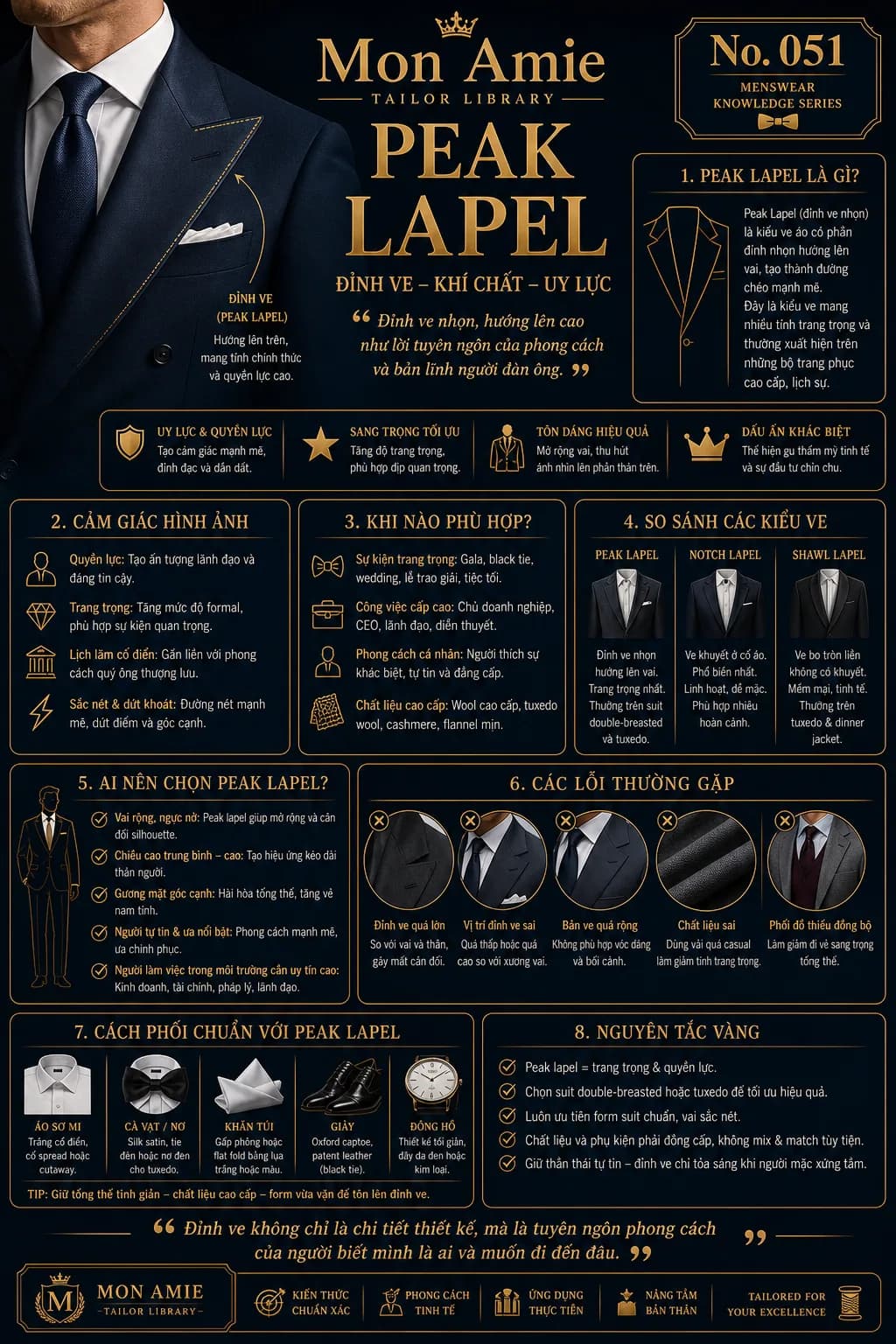
What is a peak lapel? It is a jacket lapel whose points angle upward toward the shoulder, drawing a strong diagonal across the chest — the most formal and commanding of the three classic lapel styles. If the notch lapel is the safe choice for every occasion, the peak lapel is a statement of style and self-assurance, and it appears most often on the finest, most ceremonial garments.
What a peak lapel is, and why it reads as powerful
The defining feature is that the lapel does not cut inward with a notch; instead it sweeps diagonally upward toward the shoulder, making the upper body appear broader and more solidly built. This lapel gives the wearer four things:
- Authority and presence: it conveys strength and command — the reason the peak lapel is so closely tied to the image of leadership.
- Maximum elegance: it raises formality noticeably, making it right for important occasions.
- A flattering line: the upward diagonal visually widens the shoulders and draws the eye to the upper body.
- A distinctive signature: it signals refined taste and careful investment — in a room full of notch lapels, the man in a peak lapel is noticed first.
Visually, the peak lapel creates four impressions: powerful and trustworthy; formal and suited to significant events; classically debonair, in the manner of the old gentleman's wardrobe; and crisp and decisive, thanks to its strong, angular line.
When to wear a peak lapel suit
Not every occasion calls for this degree of formality. The peak lapel earns its place in the following situations:
- Formal events: galas, black tie, weddings, award ceremonies, evening receptions.
- Senior professional settings: business owners, chief executives, leaders, and anyone speaking before an audience.
- Personal style: for the man who enjoys standing apart, with confidence and polish, in everyday dress.
- Fine cloth: the peak lapel deserves premium wool, tuxedo wool, cashmere or a smooth flannel — cloths refined enough to carry so formal a lapel.
Peak lapel compared with notch and shawl lapels
Here is how to tell the three classic lapels apart at a glance:
- Peak lapel: points angled up toward the shoulder, the most formal of the three. Most often seen on double-breasted suits and tuxedos.
- Notch lapel: has a V-shaped cut where the collar meets the lapel — the most common style, versatile and easy to wear, appropriate almost anywhere from the office to a party.
- Shawl lapel: a smooth, continuous curve with no notch at all, soft and refined; usually reserved for tuxedos and dinner jackets.
Knowing the three lapels lets you choose a suit by purpose rather than by instinct: choose notch for versatility, peak for authority, and consider shawl for a formal evening.
Who should choose a peak lapel
The peak lapel suits a wide range of builds and temperaments, particularly:
- Broad shoulders and a full chest: the pointed lapel widens and balances the silhouette.
- Average to tall height: the upward diagonal lengthens the line of the body.
- Angular features: it harmonises with the whole and heightens a masculine look.
- Confident men who enjoy being noticed: a bold, commanding style.
- Professions that demand gravitas: business, finance, law, leadership.
For a smaller frame or narrower shoulders, the peak lapel still works — but the lapel width must be scaled down accordingly, and this is precisely where made-to-measure has the advantage over ready-to-wear.
Common mistakes with peak lapels
The more distinctive the lapel, the more visible the errors. The five Mon Amie sees most often:
- Peaks that are too large relative to the shoulders and the body, throwing off the balance.
- Peaks placed incorrectly: too high or too low relative to the shoulder bone.
- Lapels cut too wide for the wearer's build and the occasion.
- The wrong cloth: an overly casual fabric undercuts the formality that is the lapel's whole reason for existing.
- Inconsistent styling: accessories in the wrong register diminish the overall elegance.
How to style a peak lapel suit
The general principle: keep everything else restrained, the cloth fine and the fit precise, so that the lapel can do its work. In practice:
- Shirt: classic white, with a spread or cutaway collar.
- Tie or bow tie: silk satin; a black tie or black bow tie for a tuxedo.
- Pocket square: a puff or flat fold in white or neutral silk.
- Shoes: cap-toe Oxfords, or patent leather for black tie.
- Watch: a minimal design on a black leather or metal strap.
And the golden rules: a peak lapel means formality and authority; a double-breasted suit or tuxedo shows it to best effect; keep the fit true and the shoulder line crisp; keep cloth and accessories at the same level of quality rather than mixing at random; and above all, wear it with composure, because the lapel only shines when the man wearing it does.
A word from Mon Amie's artisans
With a peak lapel, everything comes down to proportion: lapel width, the angle of the peak and the position of the gorge line must all be calculated against each man's shoulder width and height, and a few millimetres changes the effect entirely. Our experience is that a client trying a peak lapel for the first time should begin with a navy or charcoal single-breasted suit and a moderate lapel width before moving on to double-breasted or a tuxedo. When you come in for your fitting, bring the shoes and shirt you intend to wear so our artisans can balance the whole look from the very first session.
A lapel is not merely a design detail; it is the statement of a man who knows who he is and where he intends to go. If you would like a peak lapel suit cut precisely to your figure — in cloths ranging from Kevinlli (full suits from VND 4.8 million) to Canonico, Holland & Sherry, Dormeuil and Scabal — we invite you to book an appointment at one of Mon Amie's five showrooms in Ho Chi Minh City, or to read about the tailoring process first; our hotline 0888.111.118 is always open.