
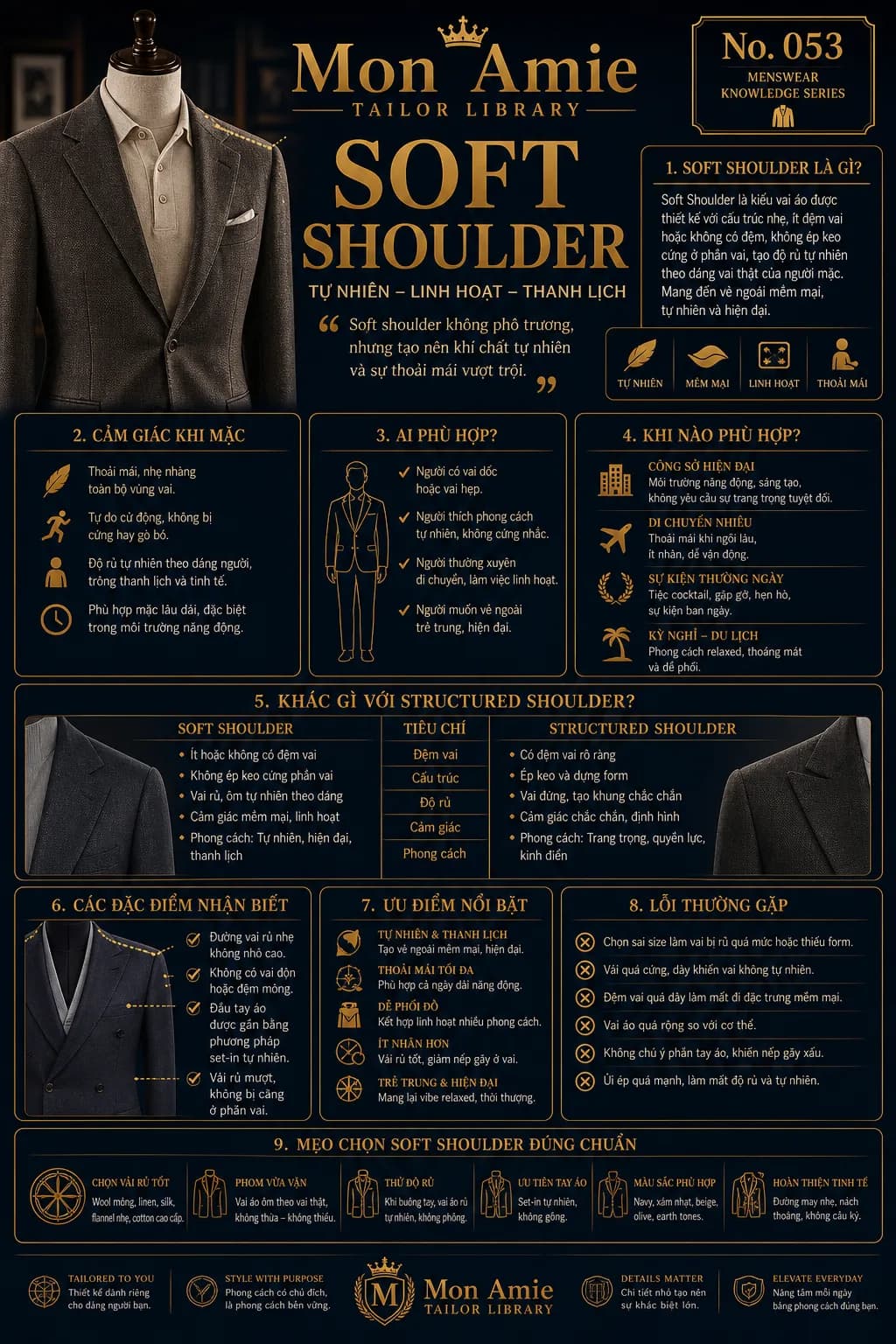
A soft shoulder is built with a light internal structure: little or no shoulder padding and no stiff fusing across the shoulder, so the jacket falls naturally along the wearer's own shoulder line. The result is supple, natural and modern — unassuming, yet remarkably easy to live in. For a man whose working days are active, a soft shoulder is often the more sensible choice over a traditional built-up shoulder.
How a soft shoulder feels to wear
The first thing you notice when you slip on a soft-shouldered jacket is the feel:
- Comfortable and light across the entire shoulder area — closer to a substantial cardigan than to a suit of armour.
- Free movement, with no stiffness or restriction when you reach, drive or type.
- A natural drape that follows your body, elegant and refined rather than boxed in.
- Wearable all day long, particularly in an active working environment.
Because it is light and lightly built, a soft shoulder also tends to wear cooler — a considerable advantage in Ho Chi Minh City's climate.
Who suits a soft shoulder?
Not every shoulder needs heavy padding. The soft shoulder is especially good for:
- Sloping or narrow shoulders — a soft shoulder follows your true line and avoids the sense of a jacket larger than the man.
- Men who prefer a natural look and dislike anything stiff or overly formal.
- Men who are always on the move and need a suit that holds up through a long day.
- Men who want a youthful, contemporary look — the soft shoulder is the signature of Italian tailoring, and of Naples in particular.
Conversely, if your shoulders slope steeply and you want a broad chest line for genuinely formal occasions, the structured shoulder still has its place.
When to wear a soft shoulder
- The modern office: dynamic, creative environments that do not demand absolute formality.
- Travel days: comfortable when seated for long stretches, resistant to creasing, easy to move in — ideal for business trips and flights.
- Everyday occasions: cocktail parties, meetings with friends, dinners, daytime events.
- Holidays: exactly the relaxed spirit you want, cool to wear and easy to combine.
How it differs from a structured shoulder
Placed side by side, the two differ on five counts: padding, internal structure, drape, feel and character.
- Soft shoulder: little or no padding; no stiff fusing at the shoulder; the shoulder falls and follows the body; supple and flexible; natural, modern and elegant in character.
- Structured shoulder: distinct padding; fused and built up; a standing shoulder that creates a firm frame; solid and shaped; formal, commanding and classic in character.
In short: a structured shoulder puts the suit on the man, while a soft shoulder lets the suit follow him. Neither is absolutely right — only one is right for your shoulder line, your work and your character.
How to recognise a well-made soft shoulder
When you handle or try on the jacket, check for:
- A shoulder line that falls gently, with no ridge standing up at the shoulder end.
- No padding at all, or only a very thin layer.
- A sleeve head set in naturally, with a smooth transition from shoulder into sleeve.
- Cloth that drapes cleanly, with no pulling or breaking across the shoulder.
The advantages follow: a natural elegance, maximum comfort over a long day, easy versatility across styles, fewer creases thanks to good drape, and a youthful, contemporary spirit.
Common mistakes when choosing a soft shoulder
A soft shoulder is easy to wear, but easy to spoil if chosen carelessly:
- The wrong size, leaving the shoulder collapsing or shapeless.
- Cloth that is too stiff or too heavy, so the shoulder never looks natural.
- Padding that is too thick, which undoes the very quality that defines the style.
- Shoulders cut too wide for the body.
- Neglecting the sleeve, which leaves an unattractive break at the shoulder end.
- Heavy pressing later on, which flattens the drape and the natural look.
Cloth choice is therefore decisive: light wool, linen, silk, light flannel and fine cotton all drape beautifully. The fit must be true — following your real shoulder, neither generous nor tight. With your arms down, the shoulder should fall naturally rather than bunch. Favour a naturally set-in sleeve with no forced shape. As for colour, navy, light grey, beige, olive and earth tones all suit the easy spirit of a soft shoulder. Finally, the making should be light, with a clean, comfortable armhole and no unnecessary elaboration.
A word from Mon Amie's artisans
With a soft shoulder, we always encourage you to move a great deal during the fitting: raise your arms, fold them, sit down — a soft shoulder is only beautiful when it follows your true shoulder line. If your shoulders are slightly uneven, made-to-measure has even more to offer, because the tailor can balance each side rather than hide the difference under padding. And remember: never let anyone press the shoulder hard — that natural drape is the soul of the jacket.
The soft shoulder is the choice of a man who understands that elegance need not be rigid. If you would like a soft-shouldered suit cut to your own line, we invite you to book an appointment at one of Mon Amie's five showrooms in Ho Chi Minh City, or to read about the tailoring process first — hotline 0888.111.118.