
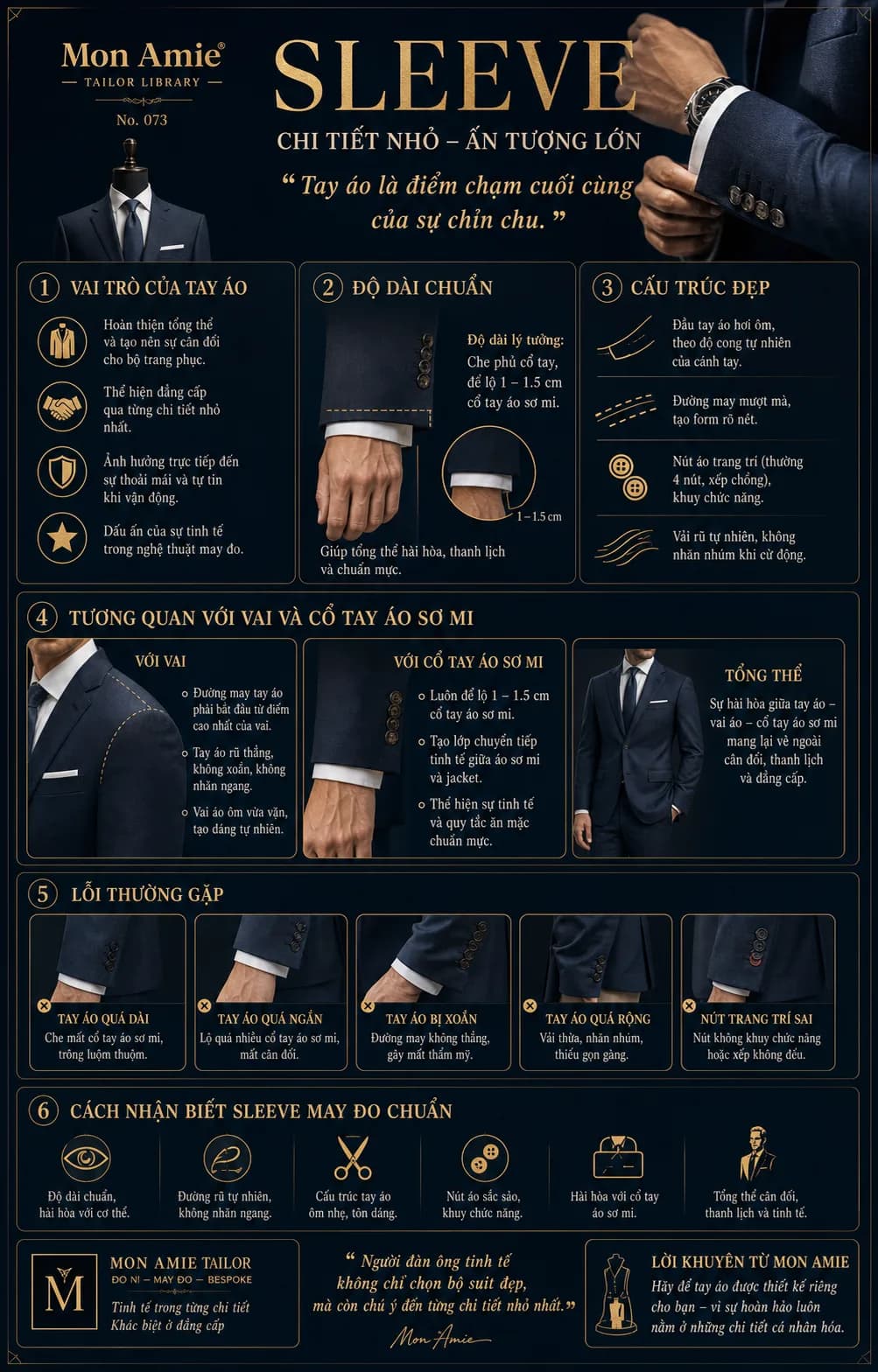
A correct suit sleeve covers the wrist and leaves about 1–1.5 cm of shirt cuff on show. It is a small detail, yet it carries much of the impression a suit makes, because the sleeve is the last place the eye settles — when you shake hands, adjust a watch or offer a business card. Here, Mon Amie shares how to recognise a properly tailored sleeve and the faults worth avoiding.
What the sleeve does for a suit
Many people think of the sleeve as simply where the jacket ends. To a tailor, it is where the quality of the whole garment shows:
- It completes and balances the suit — a sleeve off by a couple of centimetres changes the look of the whole figure.
- It reveals quality through the smallest details: the seams, the buttons, the drape of the cloth.
- It bears directly on comfort and confidence in movement — a correct sleeve does not pull or catch when you raise your arm or sit at a desk.
- It is a hallmark of refinement in tailoring: a tailor can read from a sleeve how carefully a suit was made.
The correct length of a suit sleeve
The classical rule of tailoring: the jacket sleeve covers the wrist and shows 1–1.5 cm of shirt cuff. That sliver creates a transition of colour between shirt and jacket, and gives the whole a harmonious, well-judged elegance.
Note that this length is taken with you standing straight, arms hanging naturally. So when having a suit made, wear the shirt you actually use — a longer or shorter shirt cuff changes how the jacket sleeve reads. It is also why well-dressed men have their shirts and suits made by the same house, so the two sets of measurements agree.
The structure of a well-made sleeve
A properly tailored sleeve is not only the right length but the right shape:
- The sleeve head sits close and follows the natural curve of the arm — the arm hangs slightly forward, so a sleeve cut dead straight will crease.
- The seams run cleanly, holding a defined line from shoulder to cuff.
- The cuff buttons are usually four, gently overlapping in kissing buttons, ideally with working buttonholes — the familiar sign of tailored clothing.
- The cloth drapes naturally, without rumpling as you move.
The relationship with shoulder and shirt cuff
A sleeve does not stand alone; it succeeds or fails on the two anchors at either end.
At the shoulder:
- The sleeve head seam must start at the highest point of the shoulder, neither dropping onto the upper arm nor climbing toward the neck.
- The sleeve hangs straight, without twisting or horizontal creasing.
- The shoulder fits closely, giving the whole arm a natural line.
At the shirt cuff:
- Always show 1–1.5 cm of cuff, as described above.
- That margin creates a subtle transition between shirt and jacket, and shows a command of the classical rules of dress.
When sleeve, shoulder and shirt cuff agree with one another, your appearance is balanced and elegant without any visible effort.
Five common sleeve faults
- Too long: the shirt cuff disappears and the look turns sloppy — the most common fault in ready-to-wear.
- Too short: too much cuff shows, unbalancing the line and making the jacket look tight.
- Twisted: the seams run untrue and the cloth winds around the arm.
- Too wide: excess cloth gathers and rumples, losing all neatness.
- Poor cuff buttons: non-working buttonholes or uneven spacing — a small thing that a discerning eye catches immediately.
How to recognise a properly tailored sleeve
When you receive a suit, six quick checks will tell you a great deal:
- Correct length, in proportion to your body.
- A natural fall, with no horizontal creasing when the arms hang.
- A sleeve that follows the arm closely and flatters its shape.
- Crisp buttons with working buttonholes.
- Agreement with the shirt cuff, showing exactly 1–1.5 cm.
- A balanced, elegant and refined whole.
A word from Mon Amie's artisans
A discerning man does not only choose a handsome suit; he attends to the smallest details. Mon Amie's advice is to have the sleeve designed for you alone — measured while wearing the shirt and the watch you use every day, since both affect the ideal length. If the suit you own has a sleeve fault, do not give up on it: most length problems can be corrected, and Mon Amie always guarantees post-delivery alterations for its clients.
The sleeve is a small detail that leaves a large impression — the point where a suit's perfection becomes personal. We invite you to book an appointment at one of Mon Amie's five showrooms in Ho Chi Minh City to have your sleeves measured to the centimetre, or to read the tailoring process first; our hotline 0888.111.118 is always at your service.