
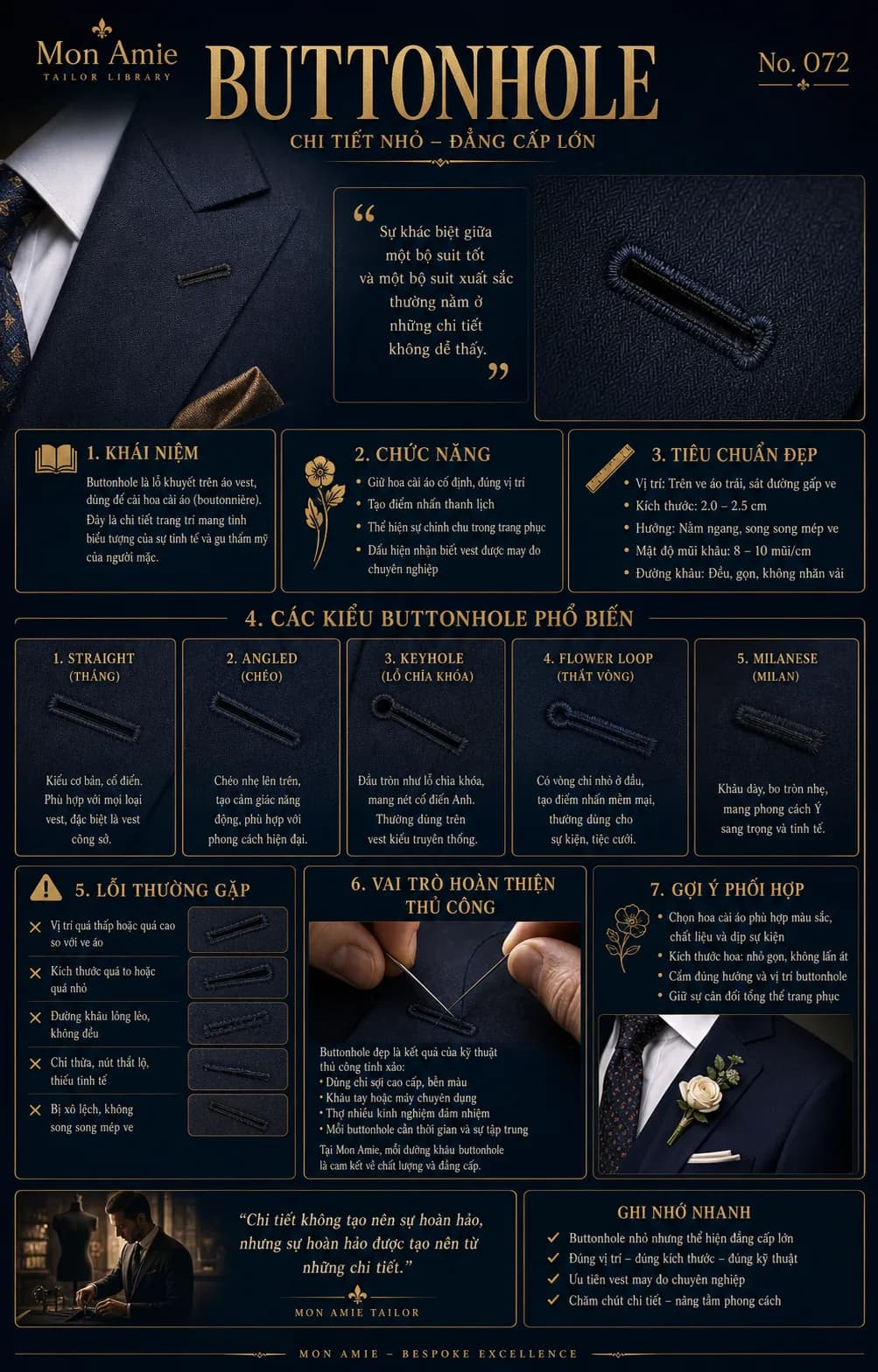
The buttonhole on a suit jacket is the opening worked into the left lapel, made to hold a flower — the boutonniere. It is a decorative detail that has become a symbol of refinement: the difference between a good suit and an exceptional one usually lies in details as quiet as this. In this article, Mon Amie looks at its purpose, the marks of a well-made buttonhole and the styles most often used in the trade.
What a buttonhole is, and why it matters
The lapel buttonhole comes from the European tailoring tradition, when a gentleman would pin a fresh flower to his lapel for formal occasions. Today it stands empty most of the time, yet it is still kept as a mark of the wearer's taste.
In practice, the buttonhole serves four purposes:
- It holds a boutonniere firmly in place, so the flower does not shift as you move.
- It creates an elegant focal point on the lapel — the first place the eye tends to rest.
- It signals care in dress, particularly at formal occasions.
- It marks a professionally tailored jacket: an evenly hand-worked buttonhole appears almost exclusively on made-to-measure and bespoke garments, and rarely on mass-produced clothing.
What makes a buttonhole beautiful
Tailors judge a lapel buttonhole by very specific criteria:
- Position: on the left lapel, close to the fold line.
- Size: roughly 2.0 – 2.5 cm — enough for a flower stem, never so large as to look coarse.
- Direction: horizontal, parallel to the lapel edge.
- Stitch density: 8 – 10 stitches per centimetre, giving the edge a full, substantial finish.
- Stitching: even and neat, with no puckering of the surrounding cloth.
Density and evenness alone tell an experienced eye exactly how well a suit has been finished.
Five common buttonhole styles
- Straight: the basic, classical form, suited to any jacket and especially to business suits.
- Angled: tilted slightly upward for a livelier feel, at home in modern styling.
- Keyhole: rounded at one end like a keyhole, an English classic often found on traditional jackets.
- Flower loop: a small thread loop behind the lapel to hold the flower stem, a softer touch favoured for events and weddings.
- Milanese: densely worked in silk thread with a gentle curve, an Italian style of great elegance — the most labour-intensive of all and the one most prized by connoisseurs.
Faults to avoid
A carelessly made buttonhole ruins the whole lapel. The most common faults are:
- Sitting too high or too low on the lapel.
- Sized out of proportion to the lapel, too large or too small.
- Loose stitching with uneven work.
- Stray threads or visible knots, betraying a lack of care.
- A skewed opening that does not run parallel to the lapel edge.
This is why the buttonhole is often treated as a tailor's examination piece.
The role of handwork
A fine buttonhole is the result of exacting handwork: high-quality colourfast thread, a hand needle or a specialist machine, and above all an experienced tailor at the work. Each buttonhole takes time and concentration — it cannot be rushed. At Mon Amie, every buttonhole stitch is a commitment to the quality of the suit we hand over to you.
Pairing the buttonhole with a boutonniere
When you wish to wear a boutonniere on a formal occasion, keep these points in mind:
- Choose a flower that suits the colours, the cloth and the character of the occasion.
- Keep the flower small so it does not overwhelm the lapel.
- Set it in the correct direction and position, with the stem tucked neatly behind the lapel.
- Preserve the balance of the whole outfit — the flower is an accent, not the centrepiece.
A word from Mon Amie's artisans
Details do not make perfection, but perfection is made of details. When trying on a jacket, spend a few seconds looking at the opening on the left lapel: even stitches, a clean edge and a line parallel to the lapel are the signs of a serious tailor. For a wedding or an important occasion, you might ask for a flower loop or a Milanese buttonhole to give the lapel a little more grace — Mon Amie's artisans will advise on the style that suits your lapel shape and cloth.
The buttonhole is small, yet it speaks volumes: right position, right size, right technique. If you would like to see a properly worked buttonhole on a made-to-measure suit — from the Kevinlli line, a full suit from VND 4.8 million, to our Canonico, Holland & Sherry, Dormeuil and Scabal collections — we invite you to book an appointment at one of Mon Amie's five showrooms in Ho Chi Minh City or call 0888.111.118, and to read more about the tailoring process.