
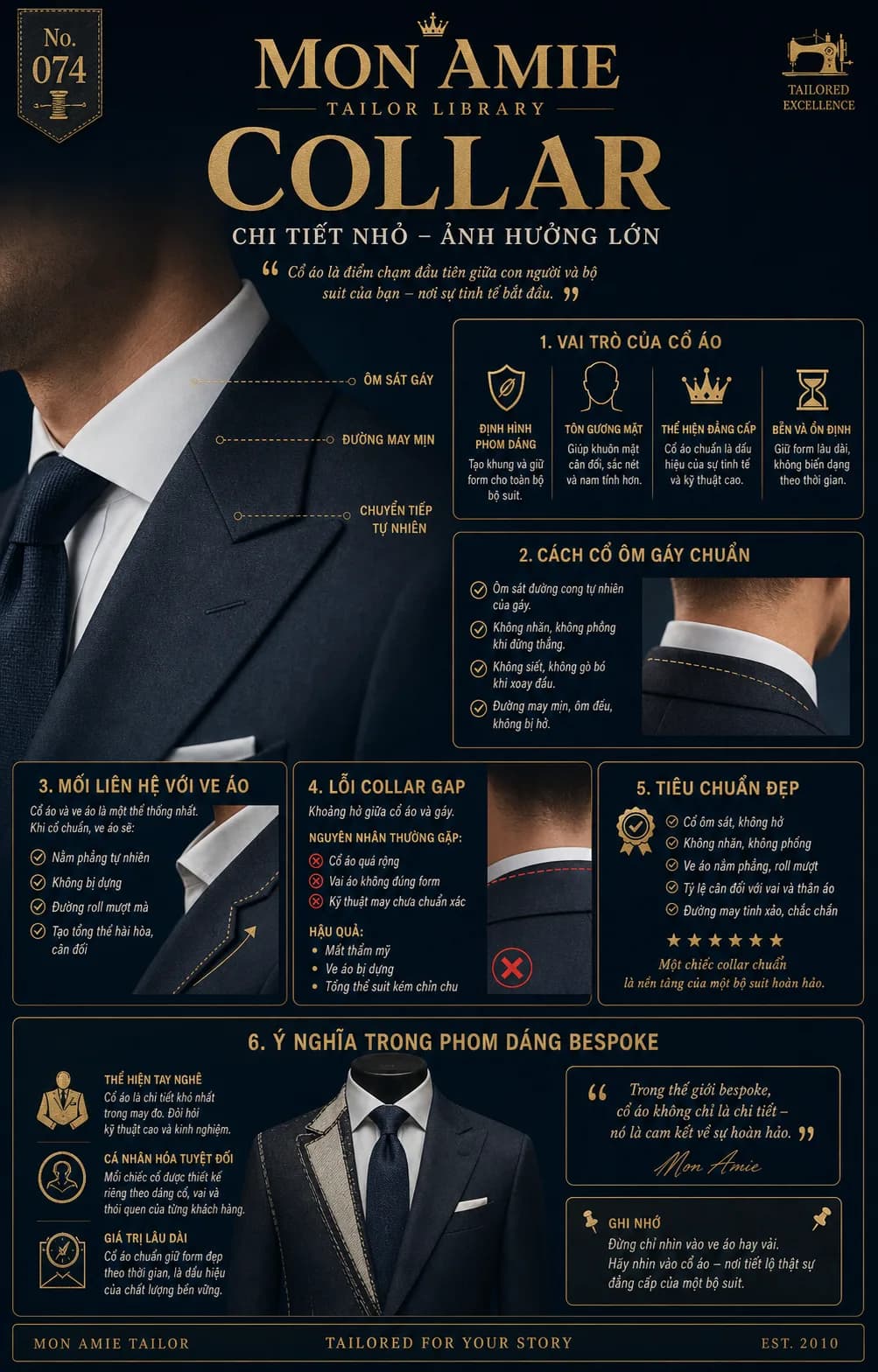
The collar is the first point of contact between a man and his suit, the place where refinement begins. A correct collar must sit close to the neck, with smooth seams and a natural transition into the lapel. In tailoring it is regarded as the smallest detail with the greatest influence on how a suit is perceived.
What the collar does for a suit
At a fitting, many men look only at the shoulders, the waist or the sleeve length, forgetting that the collar is where the suit takes hold of the body. It serves four essential purposes:
- It sets the shape: the collar frames the jacket and holds its form. Only with a correct collar will the body of the jacket fall true and the shoulders lie easy.
- It flatters the face: a close collar makes the face look balanced, defined and more masculine — this is the area people look at first in conversation.
- It signals quality: a well-made collar is a mark of refinement and high craft. Connoisseurs look at the collar before they judge anything else.
- It gives durability: a well-constructed collar holds its shape for years without distorting.
What a correct collar hug looks like
The highest standard for a suit collar is to embrace without gripping. Standing before the mirror, check these four points:
- The collar follows the natural curve of the neck, ideally showing about half a centimetre of shirt collar above it.
- No creasing and no bubbling when you stand straight — the cloth behind the neck must lie perfectly smooth.
- No pinching or restriction when you turn your head; you move freely and the jacket does not pull out of line.
- Smooth, even seaming with no gap anywhere along the collar base.
If all four hold true, the rest of the suit has almost certainly been made to an equally serious standard.
How collar and lapel work together
Collar and lapel are one unit — joined by the gorge line and together forming the V that defines a jacket. When the collar is right, the lapel will:
- Lie flat and naturally across the chest, needing no adjustment all day.
- Stay put rather than lifting or springing open as you move.
- Show a smooth, soft roll rather than a hard break.
- Create harmony and balance between collar, lapel and body.
Conversely, when something is wrong at the collar, the lapel is the first to tell on it: a lifting lapel, a warped lapel or a broken roll almost always begins at the back of the neck.
The collar gap — the most feared gap in tailoring
A collar gap is the space that opens between the jacket collar and the neck — the most common and most visible fault in ready-to-wear suits and in tailoring that falls short. The usual causes are:
- A collar cut too wide for the wearer's actual neck.
- A shoulder that does not follow the body: sloping shoulders, square shoulders or a forward head posture all push the collar away from the neck.
- Imprecise technique in setting the collar and joining the shoulders.
The consequences go beyond appearance. When the collar gaps, the lapel lifts with it, the body of the jacket loses its anchor, and the whole suit looks unkempt no matter how costly the cloth. This is why, at a fitting, a good tailor always looks at you from behind first.
The marks of a fine collar
In summary, a collar that meets the standard must have:
- A close hold with no gap at the neck, standing or seated.
- No creasing and no bubbling across the cloth.
- A flat-lying lapel with a smooth roll.
- Proportions balanced against the shoulders and the body.
- Fine, secure stitching.
A correct collar is the foundation of a perfect suit — every other detail is built upon it.
The collar's meaning in bespoke fit
In the world of bespoke, the collar is the most demanding detail of all, calling for high technique and years of a tailor's experience. No two collars are alike: each is drafted for the shape of the neck, the slope of the shoulder and even the habitual posture of the individual client. That is a level of personalisation ready-to-wear cannot reach. And it is the collar, too, that carries lasting value: properly built, it holds its shape over the years, the signal of enduring quality. As Mon Amie tells its clients: in bespoke, the collar is not merely a detail — it is a promise of perfection.
A word from Mon Amie's artisans
At a fitting, do not look only at the lapel or the cloth — ask someone to photograph you from behind. The collar is where the true quality of a suit, and of the hands that made it, is revealed. At Mon Amie, every fitting includes a collar check in several positions, and your neck and shoulder measurements are kept for life so that every future suit sits correctly from the very first fitting.
A few centimetres behind the neck can lift a suit or sink it — which is why it deserves the attention of a skilled hand. We invite you to book an appointment at one of Mon Amie's five showrooms in Ho Chi Minh City to experience how a real tailored collar sits, or to read more about the tailoring process.