
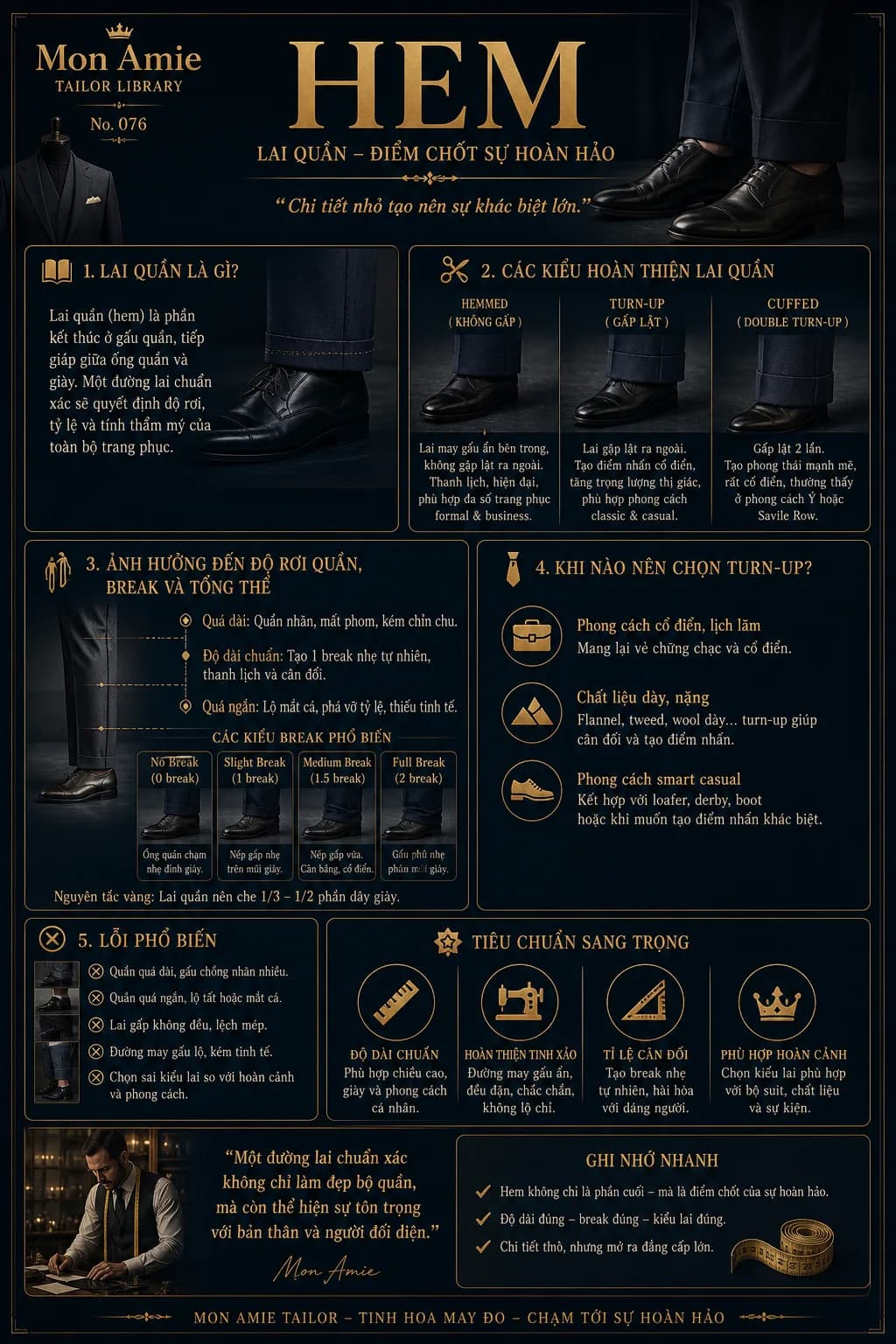
The hem is the finish at the bottom of the trouser leg, where the fabric meets your shoe. A precise hem determines how the cloth falls, the proportion of your silhouette and the overall polish of the outfit. This small detail is the final full stop of a well-made suit: measured correctly, sewn correctly, styled correctly — only then do the clothes truly stand on the body.
What the hem is, and why it matters so much
In tailoring, hemming is not merely folding the raw edge out of sight. It is the last place the eye rests when taking in an outfit, and the place where a tailor's skill shows most plainly.
A well-executed hem does three things at once:
- It shapes how the leg falls — cloth hanging straight, without kinks or bunching.
- It holds the right proportion between leg, shoe and the figure as a whole.
- It completes the finish: an even edge, a closed seam, no visible stitching.
There is an old saying in the trade: look at the hem and you know where the suit was made. The upper body can hide its flaws behind lining and structure; the hem hides nothing.
Three common hem finishes
There are three ways to finish a trouser hem that you will meet at any serious tailoring house:
- Hemmed (plain): the hem is sewn on the inside, with nothing turned back. This is the most elegant and modern finish, suited to most formal and business dress. If you choose only one finish for your business suits, plain hemmed is the safe answer.
- Turn-up: the hem is folded back once on the outside, creating a classic accent and adding visual weight at the bottom. Turn-ups suit both classic and casual styles, and the added weight helps the leg hang more decisively.
- Cuffed (double turn-up): folded back twice for a strong, distinctly traditional look — often seen in Italian tailoring and on Savile Row. The depth is usually 4 to 5 cm, and the cloth needs enough body to hold the fold.
No finish is universally correct; there is only the finish that suits the cloth, the occasion and the man wearing it.
Hem length and the break
The break is the gentle fold that forms where the hem meets the top of the shoe. Length determines the break, and the break sets the character of the whole suit:
- Too long: the trouser bunches at the ankle, loses its line and looks careless.
- Correct length: a light, natural break — elegant and balanced.
- Too short: the ankle shows, proportion is broken and refinement is lost (unless you are deliberately after a very casual cropped look).
Four break levels are standard in the trade:
- No break: the leg just grazes the top of the shoe — modern, clean, ideal with a tapered leg.
- Slight break: a light fold over the shoe — the balanced choice, and the most popular today.
- Medium break: a moderate fold, balanced and classic.
- Full break: the hem rests lightly over the shoe — traditional, best on taller men and wider legs.
The golden rule: standing straight, the hem should cover roughly one third to one half of the laces. That is the balance between clean and formal.
When to choose a turn-up
Turn-ups are not for every pair of trousers, but in the right place they are worth a great deal:
- Classic, considered dressing: a turn-up lends gravitas and recalls the spirit of traditional tailoring.
- Heavier cloths: flannel, tweed, weighty wool — the folded cuff balances the weight of the cloth and anchors the leg.
- Smart casual: paired with loafers, derbies or boots, or when you want a point of difference from the plain-hemmed majority.
Conversely, for the most formal occasions — tuxedos and evening dress — the classic rule still holds: a plain hem, no turn-up.
Common hem mistakes
These are the faults Mon Amie sees most often when clients bring ready-made trousers in for alteration:
- Trousers too long, with the hem stacking in folds at the ankle.
- Trousers too short, showing sock or ankle when that was never the intention.
- Uneven turn-ups, with the two legs sitting at different depths.
- Visible stitching at the hem, betraying a rushed finish.
- The wrong finish for the occasion or style — a deep cuff on a lightweight cloth, say, or a turn-up on evening dress.
A hem that meets a luxury standard needs four things at once: a length matched to your height, your shoes and your personal style; a fine finish with blind, even, secure stitching and no visible thread; balanced proportion giving a light natural break in harmony with your figure; and appropriateness — the finish must suit the suit, the cloth and the occasion.
A word from Mon Amie's artisans
When we tailor for you, Mon Amie always asks that you bring the exact shoes you intend to wear with the suit — a few millimetres of sole height visibly changes the break. With pleated trousers and a straight leg, a little break or a turn-up helps the cloth fall well; with a modern tapered leg, a plain hem with no break or a slight break is the most sensible choice. And if you are undecided, take the slight break: it is the elegant safe ground for almost every figure. A precise hem does more than flatter the trousers — it shows respect for yourself and for the people you meet.
The hem is a small detail that opens onto something much larger. The right length, the right break, the right finish are the closing note of a perfect suit. If you would like to be measured and advised on the finish best suited to your figure, your shoes and your occasions, we invite you to book an appointment at one of Mon Amie's five showrooms in Ho Chi Minh City, or to read about the tailoring process beforehand so your visit is all the more rewarding.