
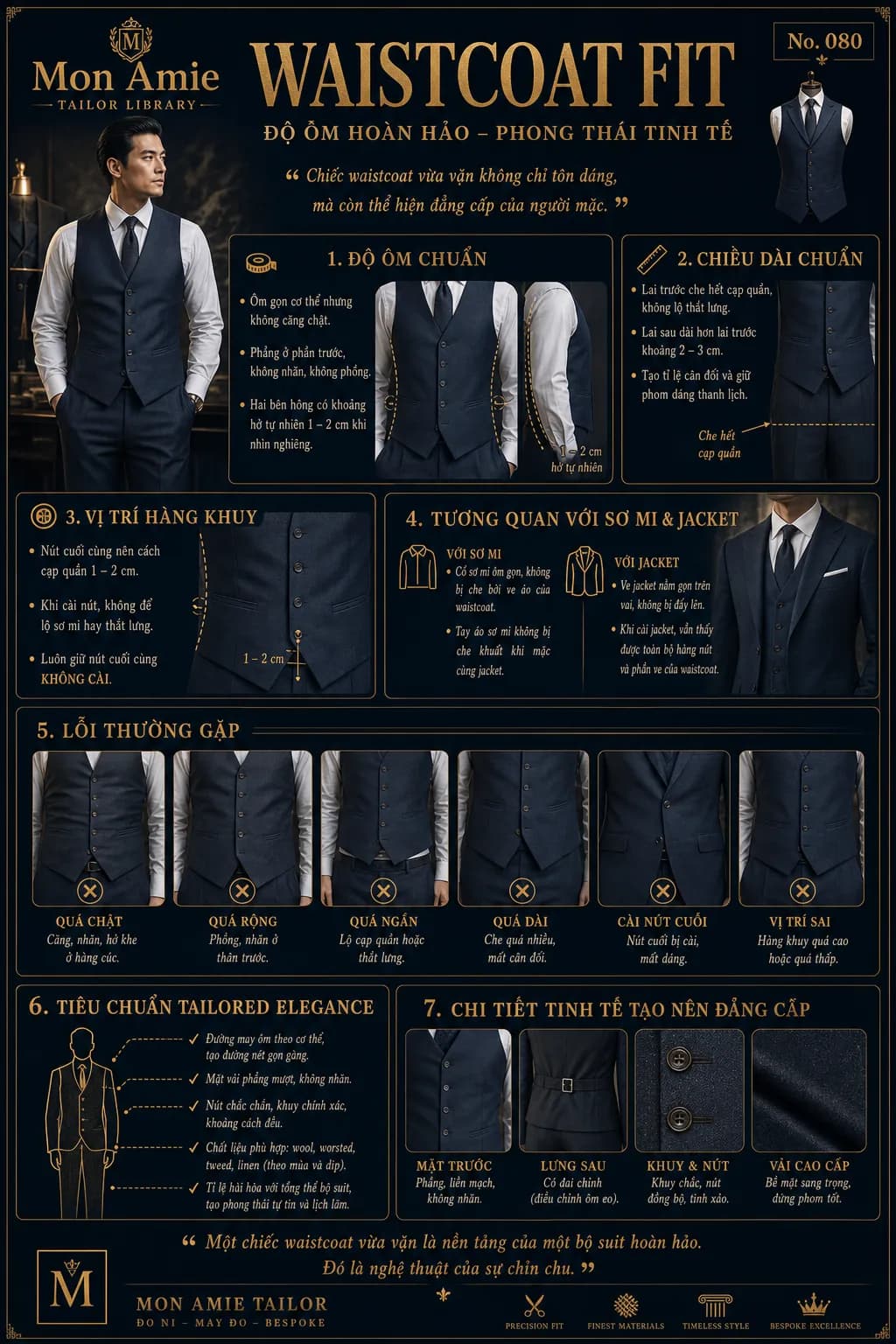
A well-fitting waistcoat sits close to the body without straining, lies flat across the front, covers the trouser waistband entirely, and always has its bottom button left undone. Those are the four core criteria for judging the fit of a waistcoat in a three-piece suit. Mon Amie sets out each of them in detail below, along with the faults worth avoiding when you commission or choose a waistcoat.
The correct closeness of fit
The waistcoat is the layer that sits nearest the body in a suit, so its fit determines much of how a man carries himself. A properly fitted waistcoat should:
- Sit close to the body without straining — the cloth follows the line of the torso with no pulling at the button line.
- Lie flat across the front: no wrinkles, no bubbling. A smooth surface shows the piece was cut to the right shape.
- Show a natural gap of roughly 1–2 cm at the sides when seen in profile, enough for easy movement while the line stays trim.
When you sit down or raise your arms, the buttons should not gape and no drag lines should appear across the stomach. If they do, the waistcoat is a size smaller than the body.
Correct length: covering the waistband
Length is the point most often overlooked and the easiest to see:
- The front points must cover the trouser waistband completely, never revealing the belt or a strip of shirt between waistcoat and trousers.
- The back should sit about 2–3 cm lower than the front, so the waistcoat still covers the waist when you lean forward.
- Balanced proportions in length keep the whole silhouette elegant, without chopping the torso into pieces.
This is also why a bespoke waistcoat always outperforms a ready-made one: the length is cut to each man's actual torso and the exact height of his waistband.
Button placement and the bottom-button rule
The button line is the visual spine of a waistcoat:
- The bottom button should sit 1–2 cm above the trouser waistband — close enough to hide the shirt, far enough for the points to fall naturally.
- With the waistcoat fastened, no shirt or belt should show in any position.
- Always leave the bottom button undone. This is a classic convention of menswear; it lets the front hang softly and gives you room to move when seated.
A button line set too high or too low breaks the proportions of the torso — a cutting fault the eye recognises at once, even when it cannot name it.
How it works with shirt and jacket
The waistcoat does not stand alone; it must agree with the other two layers of the suit.
With the shirt:
- The shirt collar should sit neatly and not be obscured by the waistcoat's lapels.
- The shirt cuff should not be unnaturally covered when the jacket is worn.
With the jacket:
- The jacket lapels should sit cleanly on the shoulder, not pushed up by the layer beneath.
- With the jacket fastened, the full button line and the lapels of the waistcoat remain visible — the very detail that makes a three-piece read richer than a two-piece.
If putting the waistcoat on suddenly makes the jacket feel tight or lifts the lapels, the two layers were not made to work together.
Six common faults
In alterations for clients, Mon Amie regularly encounters six faults:
- Too tight: straining, wrinkling and gaping at the buttons.
- Too loose: bubbling and creasing across the front, with the shape lost.
- Too short: the waistband or belt shows — the most common fault in ready-made pieces.
- Too long: it covers too much of the lower body and unbalances the proportions.
- Bottom button fastened: it stiffens the front and spoils the line.
- Wrong button placement: the line sits too high or too low for the torso.
Stand in front of a mirror, look straight on and then in profile, and check these six points; you can assess your own waistcoat.
The standard of tailored elegance
A waistcoat that meets bespoke standards brings together:
- Seams shaped to the body, creating a trim line.
- A smooth, flat cloth surface, free of wrinkles.
- Secure buttons, accurate buttonholes and even spacing.
- Appropriate cloth: wool, worsted, tweed or linen — chosen for season and occasion.
- Proportions in harmony with the suit as a whole, producing a confident, refined presence.
Four small details make the difference: an unbroken flat front; a back strap for adjusting the waist; matched, finely made buttons and buttonholes; and a fine cloth with a luxurious surface that holds its shape well.
A word from Mon Amie's artisans
When trying on a waistcoat, do not simply stand still in front of the mirror — sit down, lean forward, raise your arms as you would in a real working day. If the front still lies flat, the waistband is still covered and the buttons do not gape, then the fit is right. For a man commissioning his first three-piece, Mon Amie recommends favouring wool or worsted with good body, and always trying the waistcoat on with the exact shirt and trousers it will be worn with.
A well-fitting waistcoat is the foundation of a perfect suit — the art of being properly turned out. If you would like to be measured and advised in person at one of Mon Amie's five showrooms in Ho Chi Minh City, we invite you to book an appointment or to read about the tailoring process, hotline 0888.111.118.