
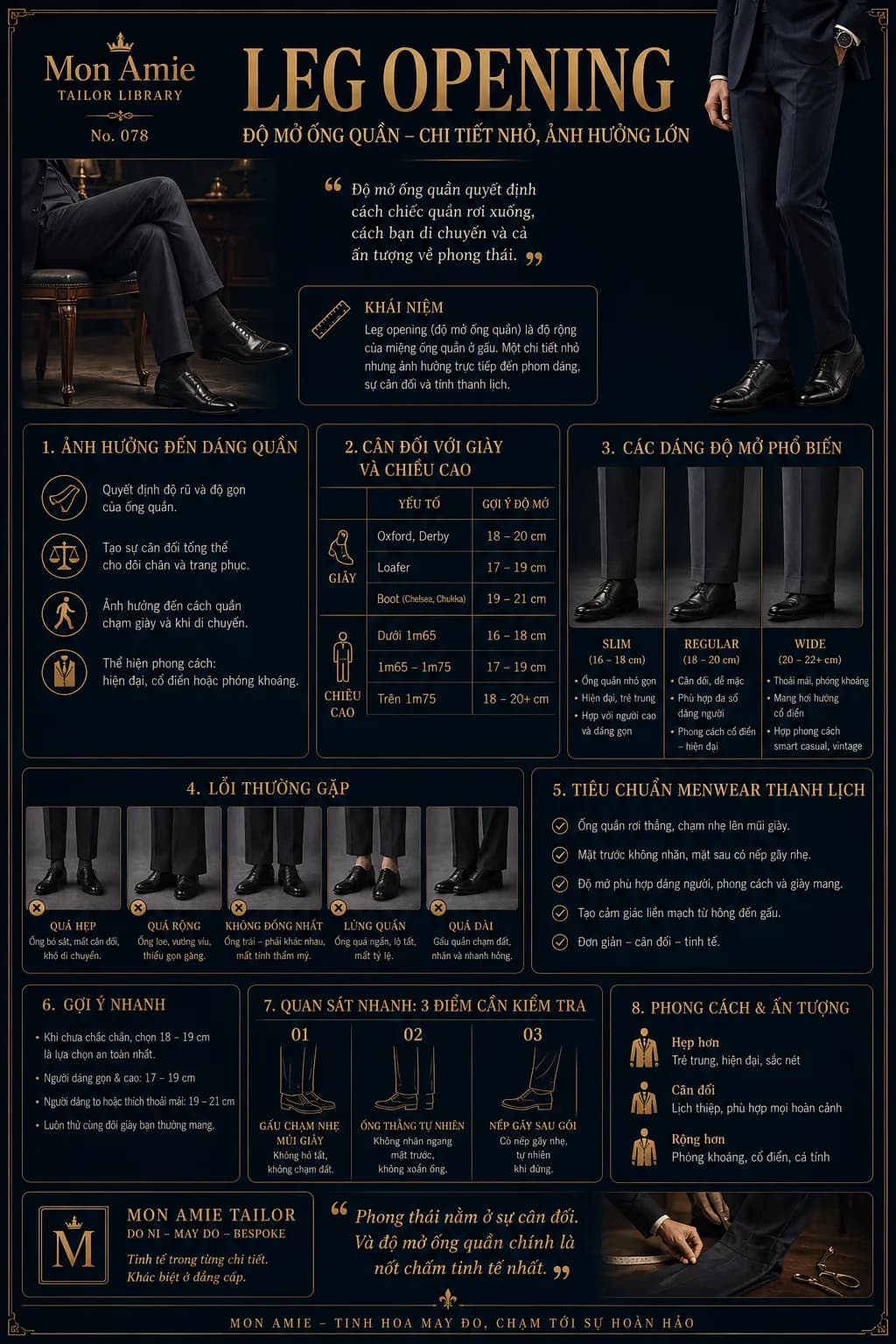
Leg opening is the width of the trouser leg measured at the hem. A few centimetres either way is all it takes to change how the trousers fall, how you move and the impression you leave. For a man in a suit, the leg opening is the last fine point of balance.
Why leg opening matters so much to the line of the trouser
Many men fuss over the shoulder and the waist and forget the hem — the place where the eye lands with every step. The leg opening directly affects:
- How cleanly the leg drapes: the right width falls straight and smooth; the wrong width clings, flares or twists.
- The overall balance of leg and outfit: the hem is the transition between trouser and shoe, and it sets the proportion of the whole figure.
- How the trouser meets the shoe in motion: too narrow and it catches on the collar of the shoe, too wide and it swamps the toe.
- Personal style: modern, classic or relaxed — it all shows in these final few centimetres.
Matching leg opening to your shoes and your height
The tailor's first rule: the hem must be on speaking terms with the shoe. Suggested widths by shoe type:
- Oxfords and derbies: 18–20 cm — a slim shoe that wants a moderate opening so the hem rests lightly on the toe.
- Loafers: 17–19 cm — a low-cut shoe, so a neater leg lets its shape show.
- Boots (Chelsea, Chukka): 19–21 cm — a higher shaft needs a slightly wider opening to sit without pinching.
And by the wearer's height:
- Under 1m65: 16–18 cm — a neat leg makes the legs look longer and finer.
- 1m65 to 1m75: 17–19 cm — the safe zone for most Vietnamese builds.
- Over 1m75: 18–20 cm and up — taller men need a more generous opening to keep the proportions harmonious.
Three common silhouettes
- Slim (16–18 cm): neat and modern, youthful, suited to tall and lean figures.
- Regular (18–20 cm): balanced and easy to wear, suited to most builds; this is the classic-with-a-modern-touch choice Mon Amie most often recommends for business suits.
- Wide (20–22 cm and up): comfortable and relaxed, with a classic air; at home in smart casual and vintage-leaning dress.
Common faults at the hem
- Too narrow: the leg clings, balance is lost and movement becomes awkward.
- Too wide: the leg flares, catches and looks untidy.
- Inconsistent: the two legs differ in width, which spoils the look — a frequent result of hurried alterations.
- Too short: the leg rides up, showing sock and breaking the proportion.
- Too long: the hem drags on the floor, wrinkles and wears through quickly.
The elegant menswear standard
A pair of trousers meets the standard when it satisfies all of the following:
- The leg falls straight and the hem rests lightly on the toe of the shoe.
- The front is free of wrinkles; the back shows a light, natural break.
- The opening suits the wearer's build, style and the shoes being worn.
- The line reads as continuous from hip to hem, with no interruption.
- The whole is simple, balanced and refined.
When trying trousers on, you can check three things quickly: the hem grazes the toe (no exposed sock, no contact with the floor), the leg hangs naturally (no horizontal creasing at the front, no twisting), and a light natural break appears behind the knee when standing.
A word from Mon Amie's artisans
When in doubt, choose an opening of 18–19 cm — it is the safest choice for most builds and most occasions. Lean and tall figures do well around 17–19 cm; larger builds and those who prefer ease should look at 19–21 cm. And one piece of trade experience Mon Amie always shares with clients: when trying trousers on, wear the very shoes you intend to wear with that suit. The hem can only be judged against real shoes.
A narrower opening reads young and sharp; a balanced one reads courteous and fits every occasion; a wider one reads relaxed, classic and confident. Presence lives in proportion, and the last few centimetres at the hem are where that proportion is completed. If you would like trousers with a leg opening calculated for your own figure and your own shoes, we invite you to book an appointment with Mon Amie at one of our five showrooms in Ho Chi Minh City, or to read about the tailoring process first — hotline 0888.111.118.