
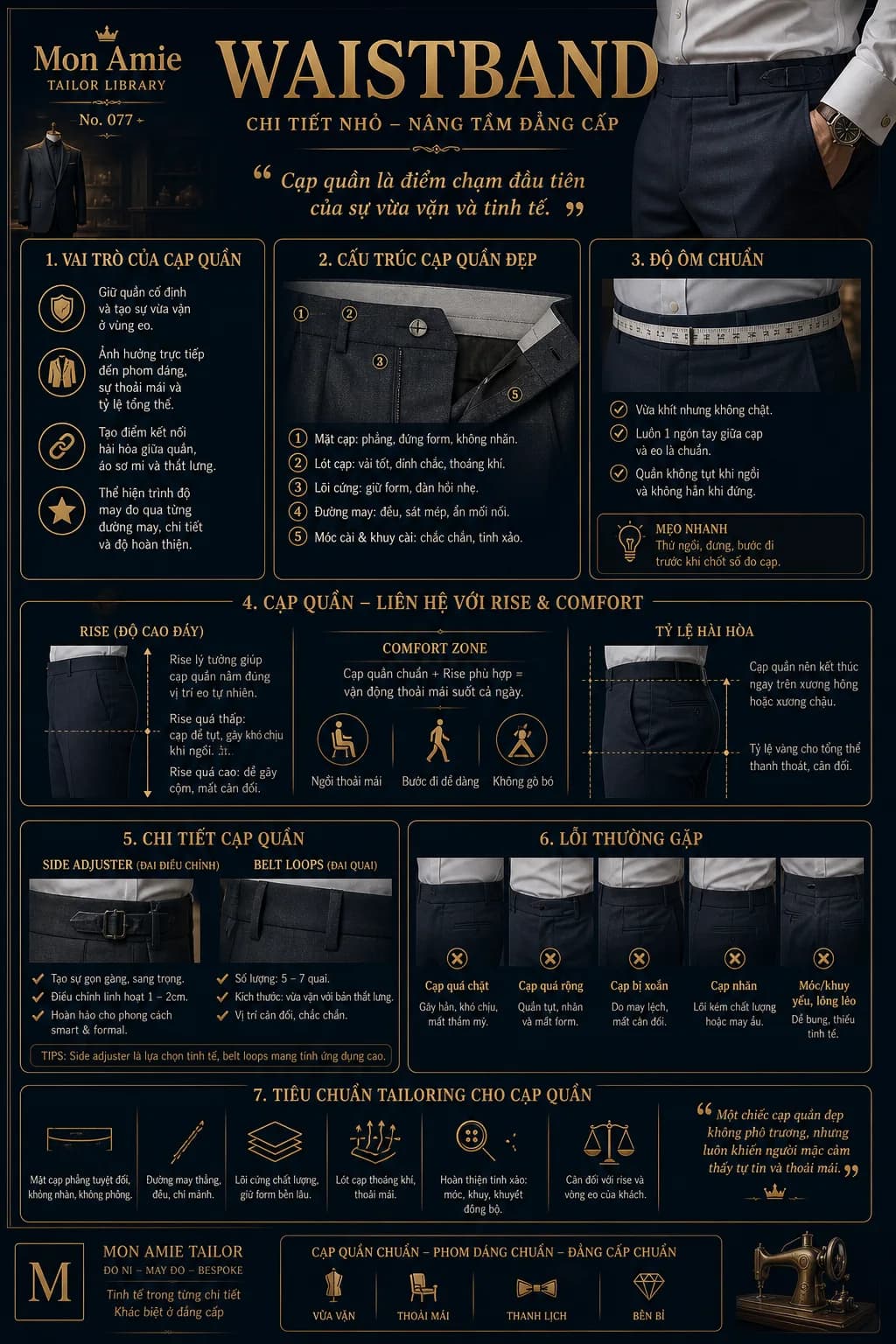
The waistband is the band of cloth that encircles the waist, and it decides whether trousers hold their shape, feel comfortable and sit in balance. In tailoring, the waistband is the first point of contact between fit and refinement: a well-made one keeps the trousers exactly where they belong, without slipping when you sit or digging in when you stand, and it flatters the proportions of the whole suit.
What the waistband does for a suit
Many men trying on trousers look only at the leg and the length, when it is the waistband that carries most of the wearing experience:
- It holds the trousers in place and creates the fit through the waist — the foundation on which every other detail sits correctly.
- It affects shape, comfort and the overall proportion of the outfit directly.
- It forms the visual link between trousers, shirt and belt — an important transition when the jacket is buttoned.
- It reveals the level of craftsmanship through its seams, details and finish. A tailor need only look at the waistband to know how carefully a pair of trousers was made.
How a fine waistband is built
A proper waistband is more than a folded strip of cloth. It has five components, each with its own standard:
- The outer face: flat, holding its shape, free of wrinkles — smooth and continuous with the trouser body.
- The curtain: made from good cloth, firmly attached and breathable, since it sits against the body all day.
- The stiffener: it holds the shape with a little give, so the band does not buckle when you sit yet stands cleanly when you rise.
- The stitching: even, close to the edge, with joins concealed — the sign of a finished hand.
- Hook and button: solid, finely made, opening and closing smoothly and holding fast over years of wear.
The right degree of hold
A correct waistband is close but never tight. The simple check every tailor uses:
- One finger should slide between the band and your waist — that is the right hold.
- The trousers should not slip when you sit, nor leave a red mark at the waist after standing a while.
- A quick tip: before confirming the waist measurement, sit, stand and take a few steps — the waist always expands when seated, and good trousers must be comfortable in both positions.
The waistband, the rise and comfort
The waistband does not stand alone — it is bound to the rise, the height from the crotch up to the top of the band:
- An ideal rise places the waistband at the natural waist, usually finishing just above the hip bone.
- Too low a rise and the band slips and feels uncomfortable seated; too high and it bunches and throws the proportions off.
- A correct waistband plus a suitable rise creates the comfort zone: easy to sit in, easy to walk in, unrestricted through a full day of movement.
- In terms of proportion, a band sitting at the natural waist makes the legs look longer and the whole line more graceful — which matters especially in a three-piece suit or with a waistcoat.
Side adjusters or belt loops?
Two common ways to finish a waistband, each with its own spirit:
- Side adjusters: clean and refined; they allow 1–2 cm of adjustment and are ideal for smart and formal dressing, since they dispense with the belt entirely and leave an unbroken line into the shirt.
- Belt loops: five to seven is the standard count, sized to your belt width, evenly placed and firmly stitched.
Mon Amie's experience: side adjusters are the more refined choice for bespoke suit trousers, while belt loops offer greater versatility when you need one pair of trousers to serve many occasions.
Common waistband faults
These are the faults that leave expensive trousers looking less than considered:
- Too tight: it digs in, feels uncomfortable and spoils the line at the waist.
- Too loose: the trousers slip and wrinkle and lose their shape, however well the leg is cut.
- A twisted band: the result of crooked sewing, throwing the back of the trousers out of balance.
- A wrinkled band: a sign of a poor stiffener or hurried work.
- Weak or loose hooks and buttons: quick to give way, and conspicuous on the very detail people notice most when you take your jacket off.
A word from Mon Amie's artisans
At Mon Amie we always ask clients to sit and walk during the fitting before the waist measurement is confirmed, because a number taken standing still never tells the whole story of a working day. The face of the band must be perfectly flat, the stitching straight and even, the stiffener capable of holding its shape for years, the curtain breathable and every hook and button finished to match — these are the tailoring standards we apply to every pair of trousers. A fine waistband never announces itself, but it always leaves the wearer feeling confident and at ease. Your waist measurement is kept on file at Mon Amie for life, so every pair that follows fits better still.
A correct waistband means a correct shape, and a correct shape means true quality. If you would like to feel the difference a properly tailored waistband makes, we invite you to book an appointment at one of Mon Amie's five showrooms in Ho Chi Minh City, or to read about the tailoring process first — hotline 0888.111.118.