
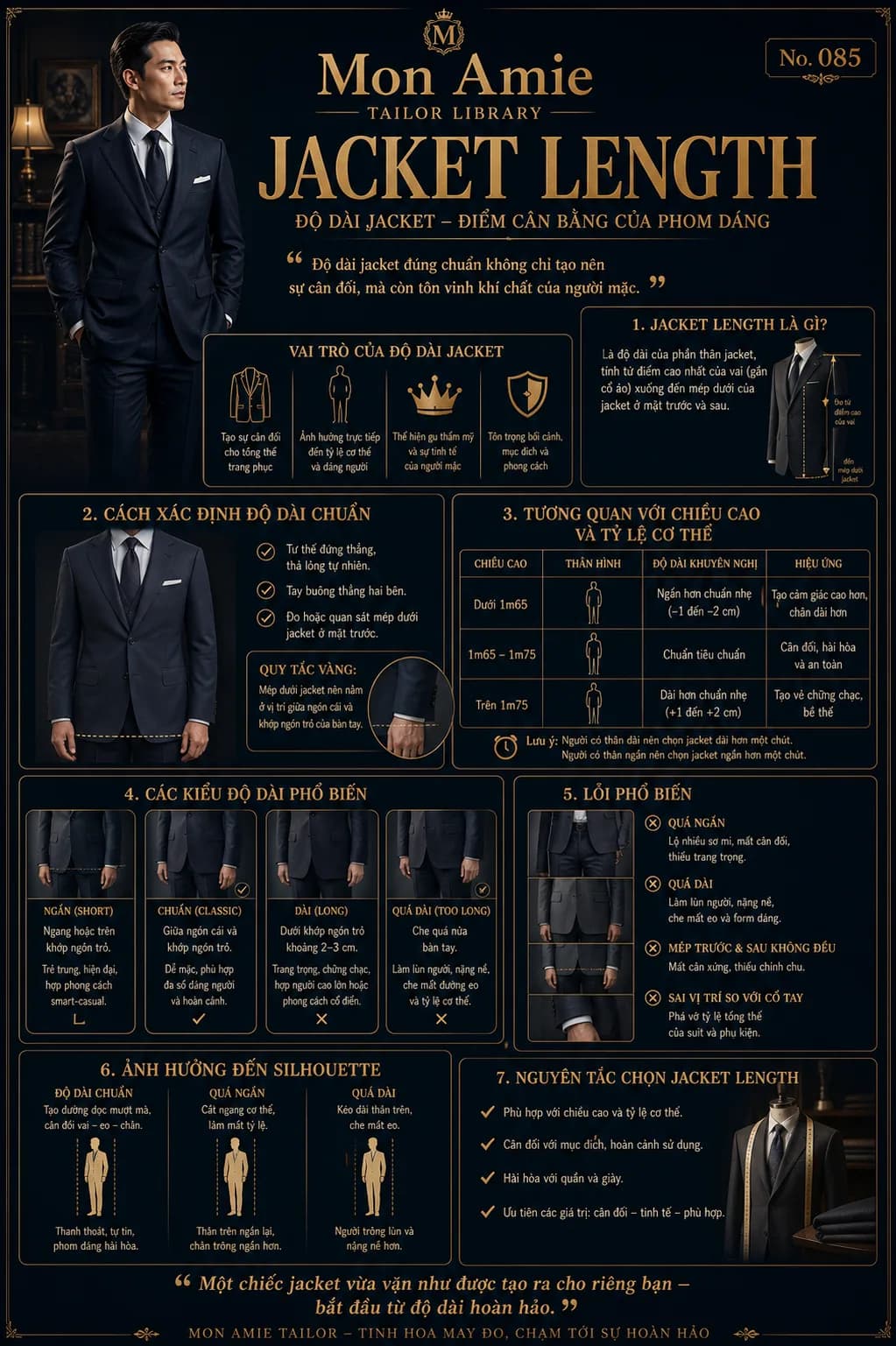
Jacket length is the length of the body of a suit coat, measured from the highest point of the shoulder — close to the collar — down to the bottom edge of the jacket, both front and back. The correct length not only balances the outfit as a whole but also brings out the wearer's presence. It is among the most important figures a tailor weighs when shaping a suit.
The role of jacket length
Many men focus on the shoulders, waist or sleeves when commissioning a suit, but it is the length of the coat that decides the overall proportion. Specifically, jacket length performs four roles:
- It balances the outfit, connecting the upper body to the trousers and shoes.
- It affects body proportion directly: a few centimetres longer or shorter can make the legs look markedly longer or shorter.
- It reveals the wearer's taste and refinement.
- It respects context, purpose and style — a formal ceremony and a smart-casual meeting call for different lengths.
Put another way, get the length wrong and a suit cut from the finest cloth can still look out of proportion and poorly considered.
How to find the correct length
To check the length of a suit jacket, follow this simple sequence:
- Stand upright in a natural posture with the body relaxed.
- Let the arms hang straight at your sides, neither tensed nor bent at the elbow.
- Measure or observe the bottom edge of the jacket at the front.
The golden rule tailors still use: the bottom edge of the jacket should fall between the thumb and the knuckle of the index finger when the arm hangs straight. This is a point of balance proven over generations of tailoring — long enough to cover the seat and hold a formal line, short enough not to overwhelm the figure.
Another check often mentioned is to cup the hand naturally: the edge of the coat should touch the palm as you close your fingers loosely. Both methods lead to the same safe zone.
Height and body proportion
The golden rule is a starting point, but a good tailor adjusts it to each man's build:
- Under 1m65: cut slightly shorter than standard, by 1 to 2 cm. The visual effect is greater height and longer legs.
- 1m65 to 1m75: keep the standard length. This is the safe zone, giving a balanced, harmonious whole.
- Over 1m75: you may go slightly longer, adding 1 to 2 cm, for a more substantial, authoritative look.
Beyond height, the ratio of torso to legs must be taken into account: a man with a long torso should choose a slightly longer jacket to rebalance the proportion, while a short-torsoed man should go slightly shorter. This is precisely why two men of the same height may need two different lengths — and precisely the advantage bespoke holds over ready-made.
The common lengths
In practice, jacket length falls into four bands:
- Short: the edge sits level with or above the index knuckle. Youthful and modern, suited to smart-casual dress and typical of contemporary Italian design.
- Classic: the edge sits between the thumb and the index knuckle. Easy to wear, suited to most builds and occasions — the length Mon Amie recommends for a first suit.
- Long: some 2 to 3 cm below the index knuckle. Formal and dignified, suited to taller men or to a classical style.
- Too long: covering more than half the hand. This shortens the figure, looks heavy and hides the waist and the body's proportions — best avoided.
Faults to avoid
At a fitting, look closely for four familiar faults:
- Too short: too much shirt shows below, leaving the outfit unbalanced and insufficiently formal.
- Too long: it shortens the figure, looks heavy and conceals the waist and shape.
- Front and back edges uneven: the coat tips out of true, unbalanced and unpolished — usually because shoulder slope or posture was not addressed when the jacket was built.
- Wrong position relative to the wrist: it breaks the proportion of the whole suit and everything worn with it.
As for the silhouette, a correct length creates a smooth vertical line, balancing shoulders, waist and legs for a poised, confident figure. A jacket cut too short cuts across the body, shortening the torso and making the legs look shorter. A jacket cut too long extends the torso, hides the waist and makes the wearer appear shorter and heavier.
Principles for choosing jacket length
In summary, four principles should guide the decision:
- Suit it to your own height and proportions rather than following a trend mechanically.
- Match it to the purpose and setting: the office, an event or a wedding.
- Keep it in harmony with the trousers and shoes worn with it.
- Favour the enduring qualities: balance, refinement and appropriateness.
A word from Mon Amie's artisans
At a fitting at Mon Amie, the tailor always asks the client to stand upright with his arms hanging naturally before a full-length mirror before drawing any conclusion about length — because a tensed shoulder or a slight lean puts the hem out by several centimetres. Our experience is that you should never judge the length against an old jacket, since posture and build change over the years. And if you are torn between two lengths, take the classic: it never dates and suits the widest range of occasions. Mon Amie keeps your measurements for life, so later commissions need only fine-tuning rather than measuring afresh.
A well-fitting jacket looks as though it were made for you alone — and that fit begins with a perfect length. If you would like to be measured and advised on the right length for your build at one of Mon Amie's five showrooms in Ho Chi Minh City, do book an appointment or read our tailoring process; hotline 0888.111.118.