
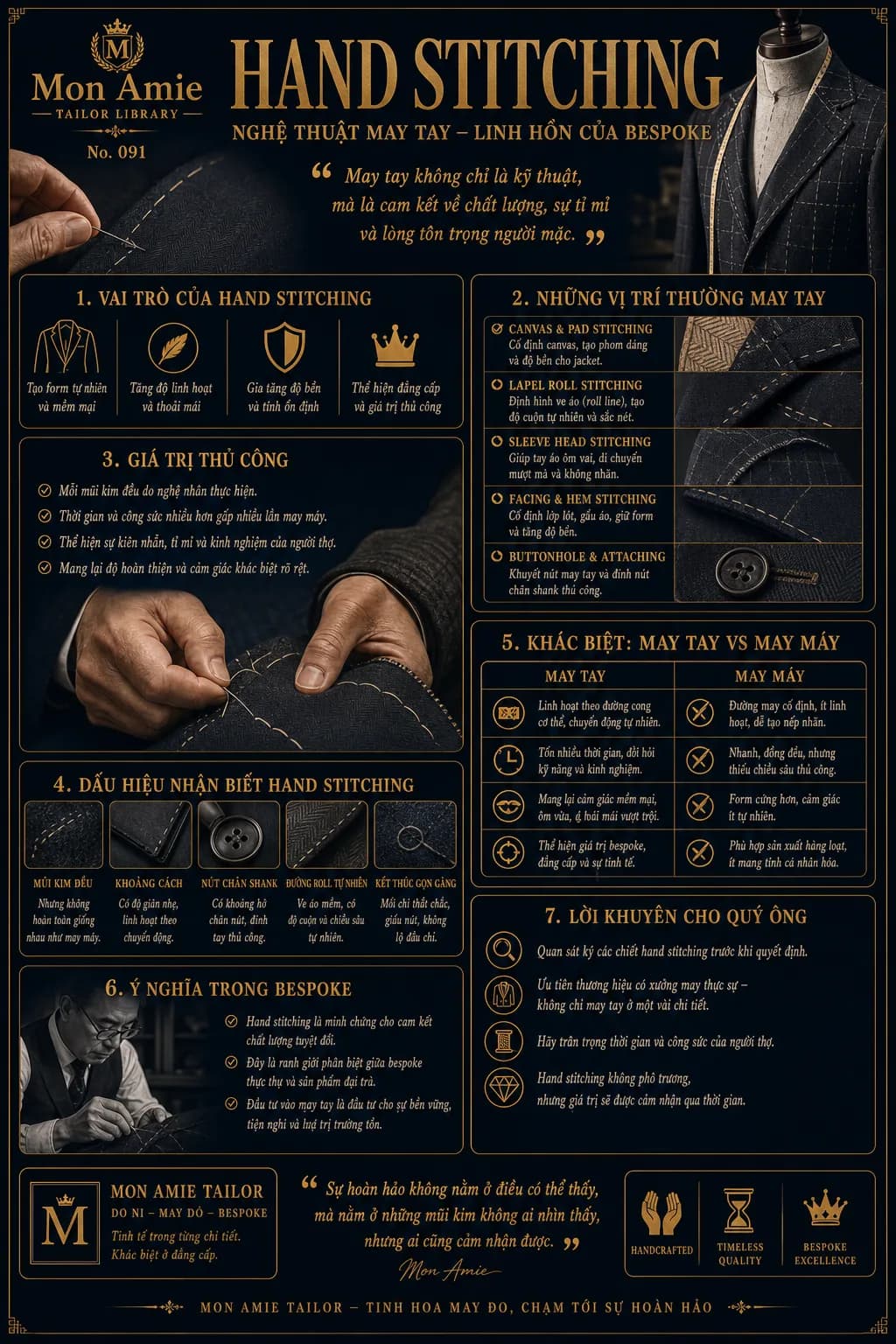
Hand stitching is the art of setting each stitch by the artisan's own hand rather than by machine, and it is widely regarded as the soul of a bespoke suit. Handwork is not merely a technique; it is a commitment to quality, to patience, and to respect for the man who will wear the garment. In this article, Mon Amie invites you to explore the role of hand stitching, the places it appears on a jacket, and how to recognise genuine handwork.
The role of hand stitching in a suit
Why do the great houses persist with the needle when modern machines are so precise? Because handwork offers qualities that machinery struggles to replicate:
- A natural, supple shape: a hand-set stitch carries a slight give, allowing the cloth to follow the curves of the body instead of being pinned flat.
- Greater flexibility and comfort: the seam yields gently with movement, so you can wear the garment all day without feeling constrained.
- Durability and stability: the internal layers are held firmly yet still allowed to breathe, keeping the jacket's shape for many years.
- A mark of craftsmanship: every stitch bears the signature of its maker, and that is what sets fine made-to-measure and bespoke apart.
Where hand stitching appears
On a properly made jacket, handwork appears exactly where shape and longevity are decided:
- Canvas and pad stitching: securing the canvas inside the chest to build shape and resilience — the structural heart of the jacket.
- Lapel roll stitching: shaping the roll line so the lapel curves naturally and crisply — the first detail a knowing eye looks for.
- Sleeve head stitching: helping the sleeve sit cleanly into the shoulder, moving smoothly without rippling.
- Facing and hem stitching: anchoring linings and hems to hold the shape and add durability.
- Buttonholes and button attachment: hand-worked buttonholes and hand-set shank buttons — a classic signature of bespoke.
The craft behind every stitch
A hand-sewn seam takes many times longer than its machine equivalent. Each stitch is placed by an artisan and calls for patience, precision and experience accumulated over years with a needle in hand. In return, the finished garment feels distinctly different: softer, more alive, carrying the story of the person who made it. This is why hand stitching has always marked the line between true bespoke and mass production — investing in handwork is investing in durability, comfort and lasting beauty.
How to recognise genuine hand stitching
You can assess a garment yourself using the following signs:
- Stitches that are even yet not identical, unlike machine work — that intentional imperfection is the signature of a human hand.
- Slight elasticity between stitches, allowing the seam to move with the cloth.
- Buttons set on a shank: the small gap beneath the button shows it was attached by hand.
- A natural lapel roll: the lapel is soft, with curve and depth rather than being pressed flat.
- Clean finishing: knots tied firmly and tucked away, with no thread ends showing.
Hand stitching versus machine sewing
Placed side by side, the difference is clear enough. A hand-sewn seam follows the curves of the body and moves naturally; a machine seam is fixed, less yielding, and more prone to puckering. Handwork takes time and demands skill and experience; machine work is fast and uniform but lacks the depth of craft. In terms of how the garment feels, hand stitching gives a suppleness, closeness of fit and comfort that machine work cannot match, while machine construction reads stiffer and less natural. In short: machine sewing suits mass production, while hand stitching expresses the value of bespoke — refinement made personal.
Advice for choosing a tailor
- Examine the hand-stitched details closely — lapel, buttonholes, button shanks — before you decide.
- Favour a house with a genuine workshop, not one that applies handwork to a few showpiece details.
- Respect the time and effort of the maker: a hand-sewn suit cannot be rushed.
- Hand stitching never announces itself, but its value reveals itself over the years.
A word from Mon Amie's artisans
When you receive a suit, lift the lapel gently and look at the underside: the fine ripple of pad stitching beneath the cloth is the sign of a lapel whose roll was nurtured by hand. Our artisans often say that perfection lies not in what can be seen, but in the stitches no one sees and everyone feels. If you are torn between two suits at a similar price, choose the one with more handwork — that is where the real value has been placed.
Hand stitching is proof of an uncompromising commitment to quality, and it is what gives a bespoke garment its soul. With five showrooms in Ho Chi Minh City, lifetime measurement records and alteration coverage after delivery, Mon Amie is ready to accompany you on the journey to a suit worthy of the name. We invite you to book an appointment or learn more about Mon Amie's bespoke service.