
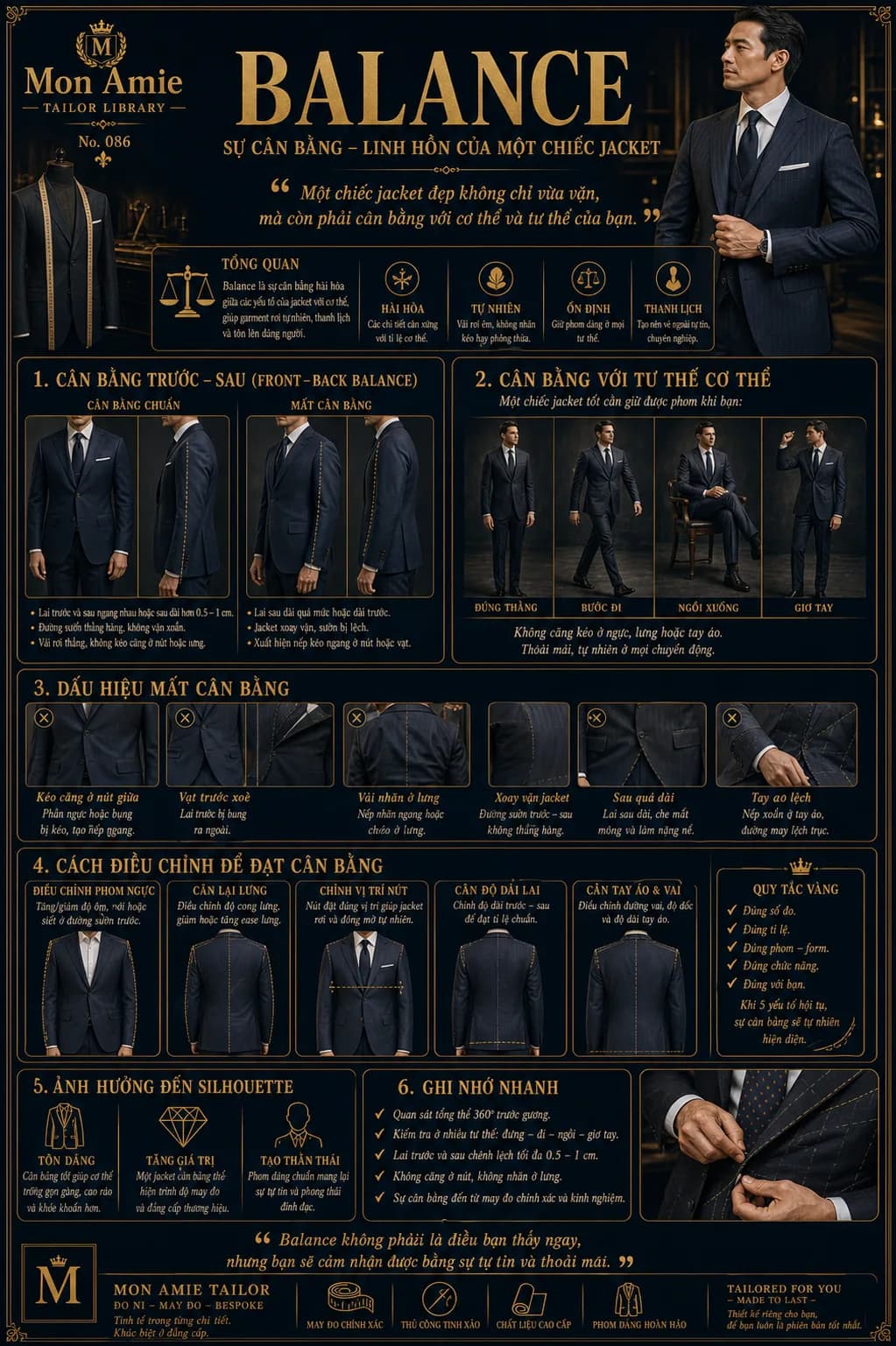
Balance — the equilibrium of a jacket — is the harmony between the garment and the body wearing it, allowing the cloth to fall naturally, elegantly, and flatteringly. A fine jacket is not merely accurate in its measurements; it must also be in balance with your body and your posture. This is the first thing an experienced tailor checks, because it decides whether a jacket lives on you or merely hangs from you.
What balance means in tailoring
In tailoring terms, balance describes how a jacket distributes cloth and weight around the body so that every line falls where it should. A jacket in balance shows four qualities:
- Harmony: every detail is proportionate to the body, with nothing overpowering the whole.
- Naturalness: the cloth falls smoothly, with no drag lines or excess bubbling anywhere.
- Stability: the shape holds in any position, from standing tall to sitting at a desk.
- Elegance: it creates a confident, professional presence without any effort on your part.
What is interesting is that the people around you may never name "balance", yet they always feel it: a balanced suit makes the wearer look markedly neater and more composed.
Front-back balance
This is the most important axis of a jacket. When it is correct:
- The front and back hems sit almost level, with the back roughly 0.5 – 1 cm longer.
- The side seam runs straight from the armhole to the hem, without twisting.
- The cloth falls cleanly, with no pulling at the button or across the back.
A jacket out of front-back balance, by contrast, reveals itself at once:
- The back hem drops far below the front, or the front hem kicks upward.
- The jacket rotates on the body and the side seam swings off its axis.
- Horizontal drag lines appear at the button or across the fronts.
The cause usually lies in posture: an erect chest, a slightly rounded back, sloping or square shoulders each call for a different ratio between forepart and back. Ready-to-wear is cut to one average posture, so it rarely balances perfectly on any individual.
Balance in posture and movement
A good jacket must do more than photograph well standing still. It has to hold its shape in four basic situations:
- Standing: the lapels hug the chest and the collar sits close to the neck, with no gap.
- Walking: the skirt of the jacket moves in rhythm, without flaring or swinging off-line.
- Sitting: the cloth does not bunch across the back or strain at the button.
- Raising your arms: sleeve and shoulder allow movement without lifting the whole jacket.
The general principle is simple: no pulling at the chest, back, or sleeves; comfort and ease in every movement. At a fitting, you should run through all of these in front of the mirror rather than merely standing at attention.
Six signs a jacket is out of balance
You can assess the suit you own right now against the following signs:
- Strain at the waist button: the chest or waist pulls into an X-shaped crease around the button — the jacket is tight or the chest shape is wrong.
- Flaring fronts: the front hem swings outward instead of falling straight.
- Creasing across the back: horizontal or diagonal wrinkles indicate too much or too little cloth in the back.
- A rotating jacket: front and back side seams no longer align and the jacket turns on the body.
- An overlong back: the back hem drops too far, covering the seat and weighing down the line.
- Twisted sleeves: spiral creases in the sleeve, with the seam off the axis of the arm.
If even one of these appears regularly, the jacket needs correcting — it will not "wear in".
How a tailor restores balance
Once imbalance is identified, a tailor has several routes, depending on where the fault lies:
- Reshaping the chest: adding or reducing close fit, letting out or taking in at the front side seam.
- Rebalancing the back: adjusting the curve of the back and reducing or increasing ease in the back panel.
- Repositioning the button: a correctly placed button lets the jacket fall and close naturally.
- Evening the hems: bringing the front-to-back difference back to the correct ratio.
- Truing sleeve and shoulder: adjusting the shoulder seam, shoulder slope, and sleeve length.
It all comes back to five golden rules: correct measurements, correct proportion, correct shape, correct function, and correct for you. When those five converge, balance appears on its own, without effort.
Why balance determines the value of a suit
Balance affects the silhouette — the overall line of the wearer — directly:
- Flattering the figure: good balance makes the body look trimmer, taller, and more defined.
- Adding value: a balanced jacket demonstrates the level of tailoring and the class of the garment.
- Creating presence: a true shape brings confidence and composure.
A quick checklist for your next fitting: look at yourself from all 360 degrees in the mirror; check standing, walking, sitting, and with your arms raised; keep the front-to-back hem difference within 0.5 – 1 cm; no strain at the button, no creasing across the back. And most importantly: balance comes from precise measuring and the experience of the tailor.
A word from Mon Amie's artisans
At Mon Amie we always ask our clients to move during a fitting — take a few steps, sit down, extend a hand as if greeting a partner — because balance only reveals itself when the body is in motion. Do not judge a suit by a photograph taken at attention; feel it through a real working day. If by evening you have forgotten you are wearing a suit, that is a jacket in balance. Your measurements and posture notes are kept by Mon Amie for life, so each suit comes closer to perfect than the last.
Balance is not something you see immediately, but you will feel it in your confidence and comfort across a long day. We invite you to book an appointment at one of Mon Amie's five showrooms in Ho Chi Minh City to be measured and balanced to your own posture, or to read about the tailoring process beforehand — hotline 0888.111.118.