
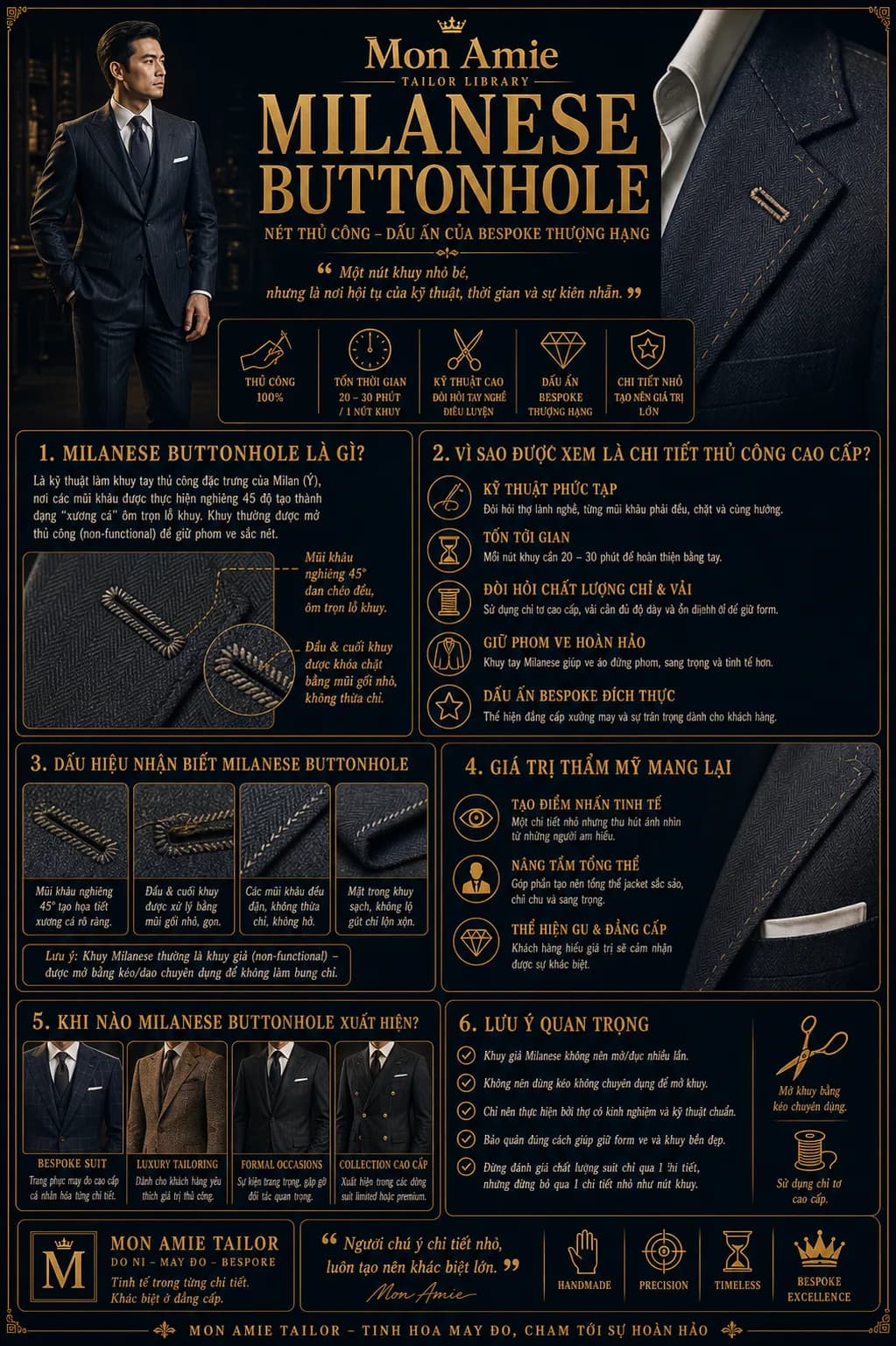
The Milanese buttonhole is a hand-sewn buttonhole technique native to Milan, in which the stitches are worked at a 45-degree angle to form a fine herringbone that wraps the entire opening. It is a very small detail, yet it gathers technique, time and patience into one place — and for that reason it is considered a hallmark of the finest bespoke.
What is a Milanese buttonhole?
Unlike an industrial machine buttonhole, which takes only seconds, the Milanese buttonhole is worked entirely by hand. The tailor uses a specialist silk gimp thread and lays each stitch at 45 degrees, perfectly even, firm and consistent in direction, so the thread hugs the edge of the opening like a delicate herringbone braid.
One detail many gentlemen do not know: the Milanese buttonhole on a lapel is often left non-functional — not cut all the way through, or opened only with a specialist blade when required. The purpose is to keep the lapel crisp, preventing the stitching from loosening or distorting over time.
Why the Milanese buttonhole is considered high craft
There are five reasons the tailoring world treats this small detail as a measure of a jacket's standing:
- Technical difficulty: it demands a skilled hand, with every stitch even, firm and consistently angled. A single stitch out of line and the whole buttonhole loses its refinement.
- Time: each buttonhole takes 20 to 30 minutes to complete by hand — the time an industrial machine needs for hundreds.
- Demands on thread and cloth: it requires fine silk thread, and cloth with enough body and stability to hold the shape.
- A perfect lapel: a hand-sewn Milanese buttonhole helps the lapel stand beautifully, adding elegance and refinement.
- A true bespoke signature: it reflects the standing of the workshop and its regard for the client.
Put differently, the Milanese buttonhole is not a detail to show off; it is a quiet promise from the maker about the standard of his hand.
How to recognise a Milanese buttonhole
With a jacket in hand, you can examine the lapel buttonhole against four signs:
- Stitches angled at 45 degrees, forming a clear herringbone along the edge.
- The ends finished with a small, neat bar tack — locked firmly, with no loose thread.
- Even stitching throughout, with no gaps or excess, firm and smooth to the touch.
- A clean reverse side with no untidy knots — the sign of a maker who respects even what is rarely seen.
By contrast, a machine buttonhole tends to show stitches perpendicular to the edge, uneven in density, with a less tidy reverse.
The aesthetic value of a Milanese buttonhole
- A refined focal point: a small detail that draws the eye of those who know — especially when you place a boutonnière through a perfectly hand-sewn buttonhole.
- Lifting the whole garment: it contributes to a jacket that reads sharp, considered and elegant; small details combine to create that hard-to-name sense of quality.
- An expression of taste: a client who understands value will feel the difference without needing it explained.
When you will find a Milanese buttonhole
Because it is laborious and demands genuine skill, the Milanese buttonhole is never commonplace. You will typically find it on:
- Bespoke suits: fine made-to-order garments, personalised down to the smallest detail.
- Luxury tailoring: for clients who value pure craftsmanship.
- Formal occasion wear: important events and meetings with partners, where every detail is noticed.
- Premium collections: limited or premium lines from established houses.
Important notes if you own a suit with a Milanese buttonhole
- A non-functional Milanese buttonhole should not be opened or pierced repeatedly — each intervention risks the stitching.
- Never use ordinary scissors to open it; only a tailor's specialist blade or shears.
- Opening should be carried out only by an experienced tailor with the correct technique.
- Proper care — hanging the jacket on a suitable hanger and avoiding harsh washing — preserves both the lapel and the buttonhole.
- Finally, never judge a suit by one detail alone, but do not overlook a detail as small as a buttonhole either: it says a great deal about the person who made the garment.
A word from Mon Amie's artisans
Those who attend to small details create the greatest difference — that is the philosophy Mon Amie follows with every stitch. When you receive a jacket, lift the lapel and look at the buttonhole: even stitching and a clean reverse are the marks of a serious workshop. And if you choose a fine cloth such as Canonico, Holland & Sherry, Dormeuil or Scabal, do ask for hand-sewn buttonholes — beautiful cloth deserves a beautiful buttonhole. Every Mon Amie suit comes with alteration coverage after delivery and a lifetime measurement record, so you can rest assured about every detail over the years.
The Milanese buttonhole is proof that a suit's standing lies in its smallest elements. If you would like to see hand-sewn buttonholes for yourself and experience our bespoke service at one of Mon Amie's five showrooms in Ho Chi Minh City, we invite you to book an appointment or call our hotline 0888.111.118 to speak with an artisan directly.