
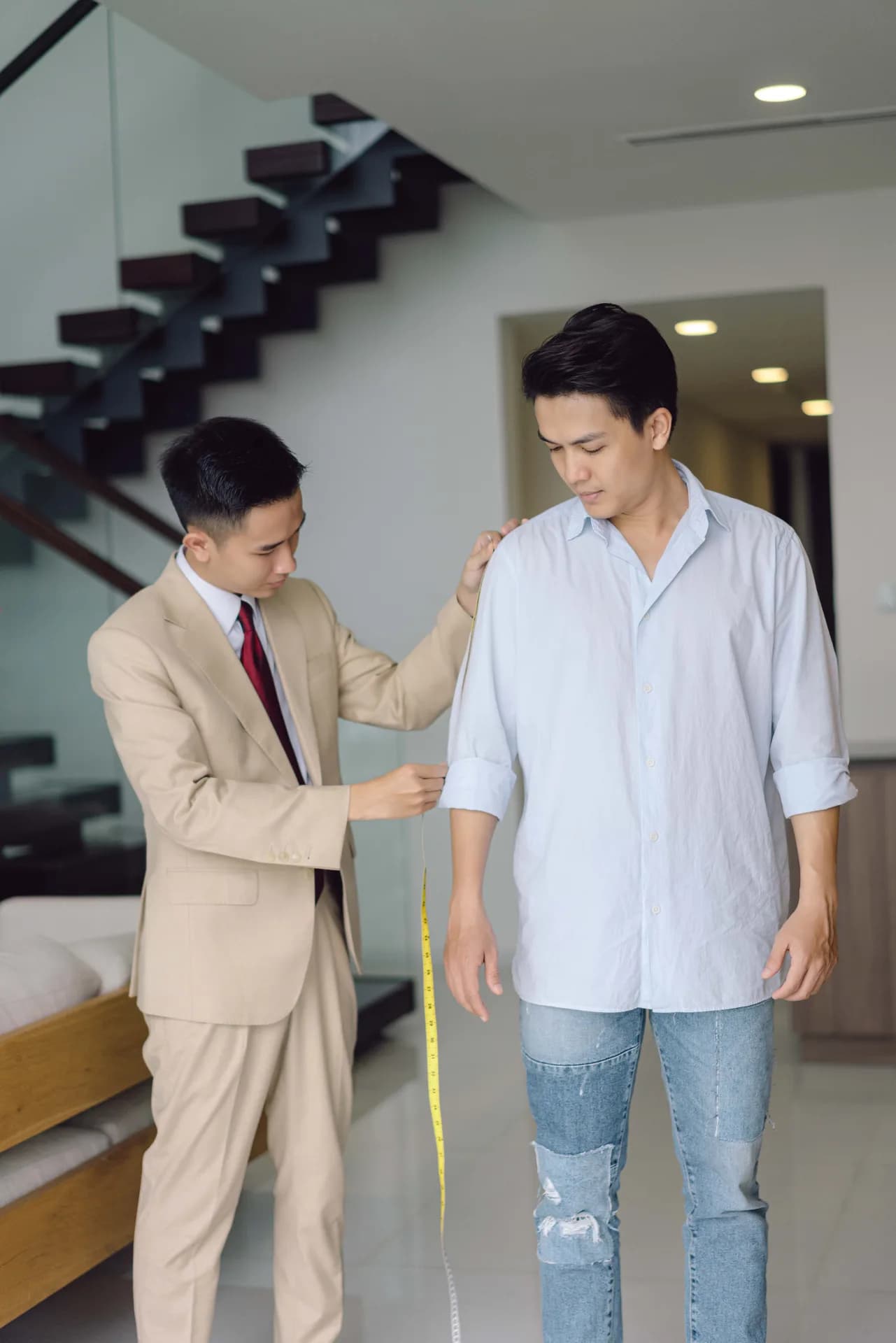
In your wardrobe hangs the suit jacket that has fitted you better than any other. The shoulders sit just right, the chest is comfortable, the sleeves are the right length. But the cloth has frayed at the cuffs, and you want to have exactly the same jacket made again. This is a very common story, and fortunately it can be solved with a soft tape measure and fifteen minutes. This article shows you how to measure a suit jacket you already own: each measurement, the permitted tolerances, and how to send your measurements when ordering online.
Quick answer
Here is how to measure a suit jacket: lay it flat on a table, button it and smooth it out. Use a soft tape measure to take five measurements: shoulder width, chest (armpit to armpit, doubled), waist (the narrowest point, doubled), jacket length and sleeve length. Measure each one twice; an acceptable tolerance is about 0.5 – 1 cm.
Preparing before you measure
Accurate measurements start with preparation:
- A soft tape measure, the kind tailors use. A steel ruler or a builder's tape is likely to give wrong numbers.
- A wide flat surface, such as a dining table or a bed. The jacket must lie completely open, not bunched up.
- A jacket that has been steamed or lightly ironed so the wrinkles are gone, because wrinkles throw measurements off.
- A phone to photograph each measuring step, very useful if you will send them to a tailor.
- Pen and paper to write down each number as soon as you take it.
Button the jacket and smooth the two fronts flat. Do not stretch the jacket or pull the tape taut; let both lie naturally.
How to measure a suit jacket: the 5 most important measurements
| Measurement | How to measure | Remember to double? | Permitted tolerance |
|---|---|---|---|
| Shoulder width | Lay the jacket face down and measure across the back, from the left shoulder seam to the right shoulder seam | No | 0.5 cm |
| Chest | Measure across the body of the jacket from one armpit to the other, about 2.5 cm below the armpit | Yes (chest circumference = measurement × 2) | 1 cm (equivalent to 2 cm of circumference) |
| Waist | Measure across the body at the narrowest point, usually level with the fastening button | Yes | 1 cm |
| Jacket length | From the back collar seam (where the collar joins the body) straight down to the hem, measured on the back | No | 1 cm |
| Sleeve length | From the top of the shoulder seam, along the outside of the sleeve down to the cuff edge | No | 0.5 – 1 cm |
Shoulder width
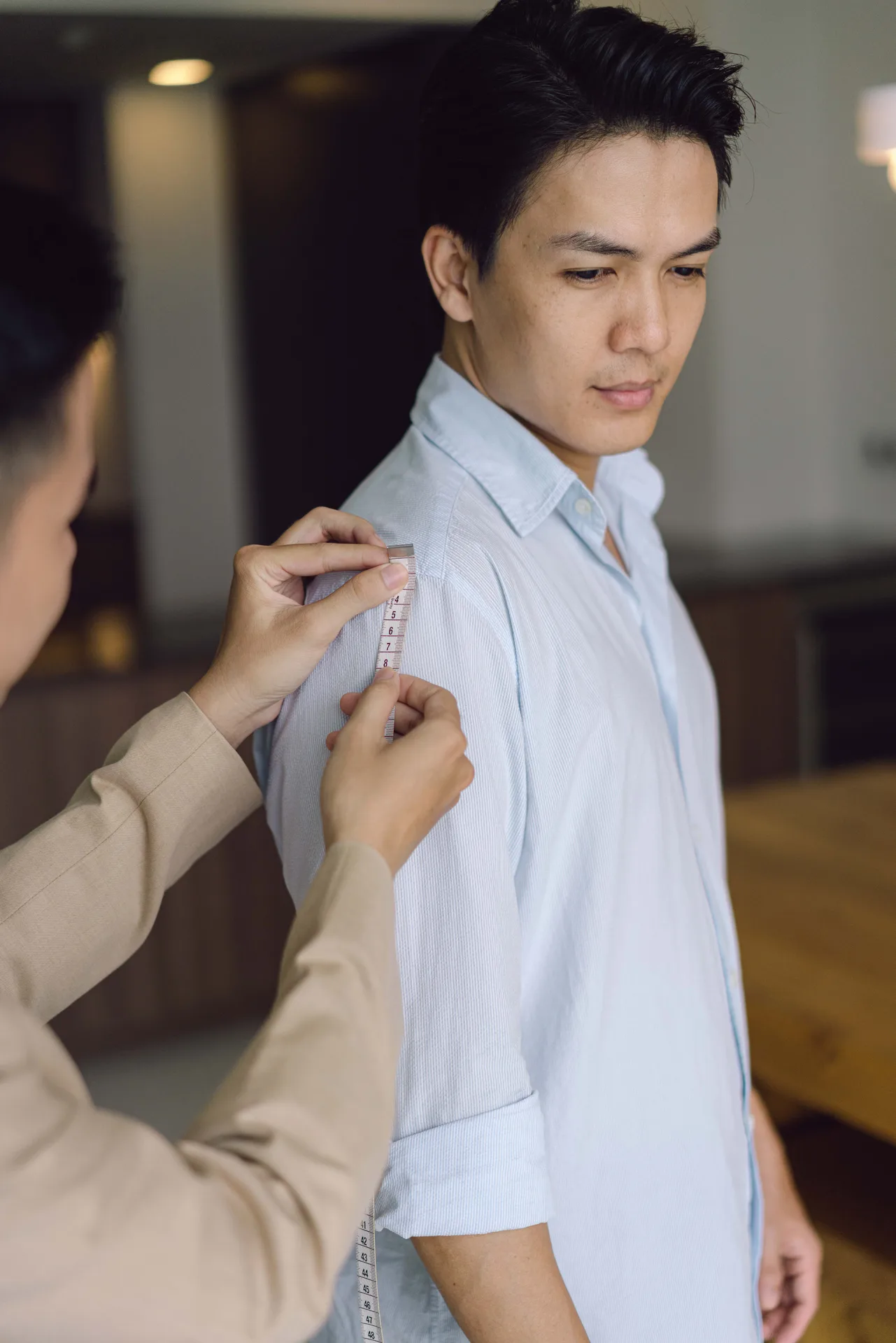
This is the most important measurement, because the shoulder can hardly be altered once the jacket is made. Lay the jacket face down or measure on the back, running the tape from the point where the sleeve joins the body on the left to the corresponding point on the right. Measure along the shoulder line, not around the neck.
Chest
Place the tape across the body of the jacket, from the armpit edge on one side to the armpit edge on the other, at a point about 2.5 cm below the armpit. This is a flat measurement, so you double it to get the finished chest circumference. For example, if you measure 52 cm, the finished chest circumference is 104 cm.
Waist
Find the narrowest point of the jacket body, usually level with the fastening button, measure across and then double it. This number shows how closely the jacket fits, and it matters a great deal if you prefer a closer or a more relaxed fit.
Jacket length
Measure from the back collar seam straight down to the hem. The easiest way to judge jacket length is to let your arms hang naturally: the hem usually reaches about the knuckles. If you want the new jacket longer or shorter than the sample, note the change you want.
Sleeve length
Measure from the top of the shoulder seam, following the outer edge of the sleeve down to the cuff. Remember to lay the sleeve straight, not bent. When worn, the jacket sleeve should stop just above the wrist bone, showing about 1 to 1.5 cm of shirt cuff.
Extra measurements worth taking
For greater accuracy, you can also measure:
- Upper-arm width: measure across the sleeve about 2.5 cm below the armpit, then double it.
- Cuff opening width: measure across the cuff edge, then double it.
- Hem circumference or hip width: measure across the widest point of the lower body, then double it.
- Back vent length: from the top of the vent down to the hem, if you want to keep the same vent style.
Don't forget to photograph the front, the back and close-ups of the lapels, pockets and buttons so the tailor can read the details carefully. To understand these parts better, see the finished measurement chart for men's suit jackets.
Measuring the trousers too: how to measure a complete suit
If you want the trousers made as well, the basic measurements are:
- Trouser waist: measure across the waistband, then double it.
- Hip (seat): measure across the widest part of the trousers, then double it.
- Thigh: measure across about 2.5 cm from the crotch point, then double it.
- Rise: from the crotch point up to the top edge of the waistband, measured on the front.
- Trouser length: from the top edge of the waistband down to the hem along the outer seam.
- Hem width: measure across the trouser hem, then double it.
The sample trousers should also be the pair that fits best, pressed flat.
Permitted tolerances and how to read the results
Tailors always allow a margin. For a jacket measured laid flat, the reference levels are:
- Shoulder width, sleeve length: tolerance 0.5 – 1 cm.
- Chest, waist, jacket length: tolerance about 1 cm on the flat measurement, that is 2 cm on the circumference.
- If two measurements differ by more than 1 cm, measure again, because the tape has most likely slipped or the jacket is not flat.
One important note: the measurements of an existing jacket are finished measurements, which already include ease for the wearer. The chest circumference of a suit jacket is usually about 8 – 12 cm larger than the wearer's chest, depending on whether the jacket is fitted or loose. So do not confuse jacket measurements with body measurements.
How to send your measurements for online tailoring
If you live far from a showroom or do not have time to visit, Mon Amie offers an online made-to-measure service: arrange a video call with a stylist at a convenient time, be guided through measuring step by step, or use measurements already on file. To make the consultation quick and accurate, prepare:
- Photos of the sample jacket laid flat, front and back, with a tape measure placed next to it for scale.
- The five main measurements, with the unit (cm) clearly stated, plus a note if you want the jacket closer-fitting or looser than the sample.
- Close-up photos of the details you want to keep: lapels, pocket style, buttons, vents.
- Photos of you wearing the sample jacket, full length from the front, the side and the back.
You can message via Zalo on the hotline number 0888.111.118 to book the video call.
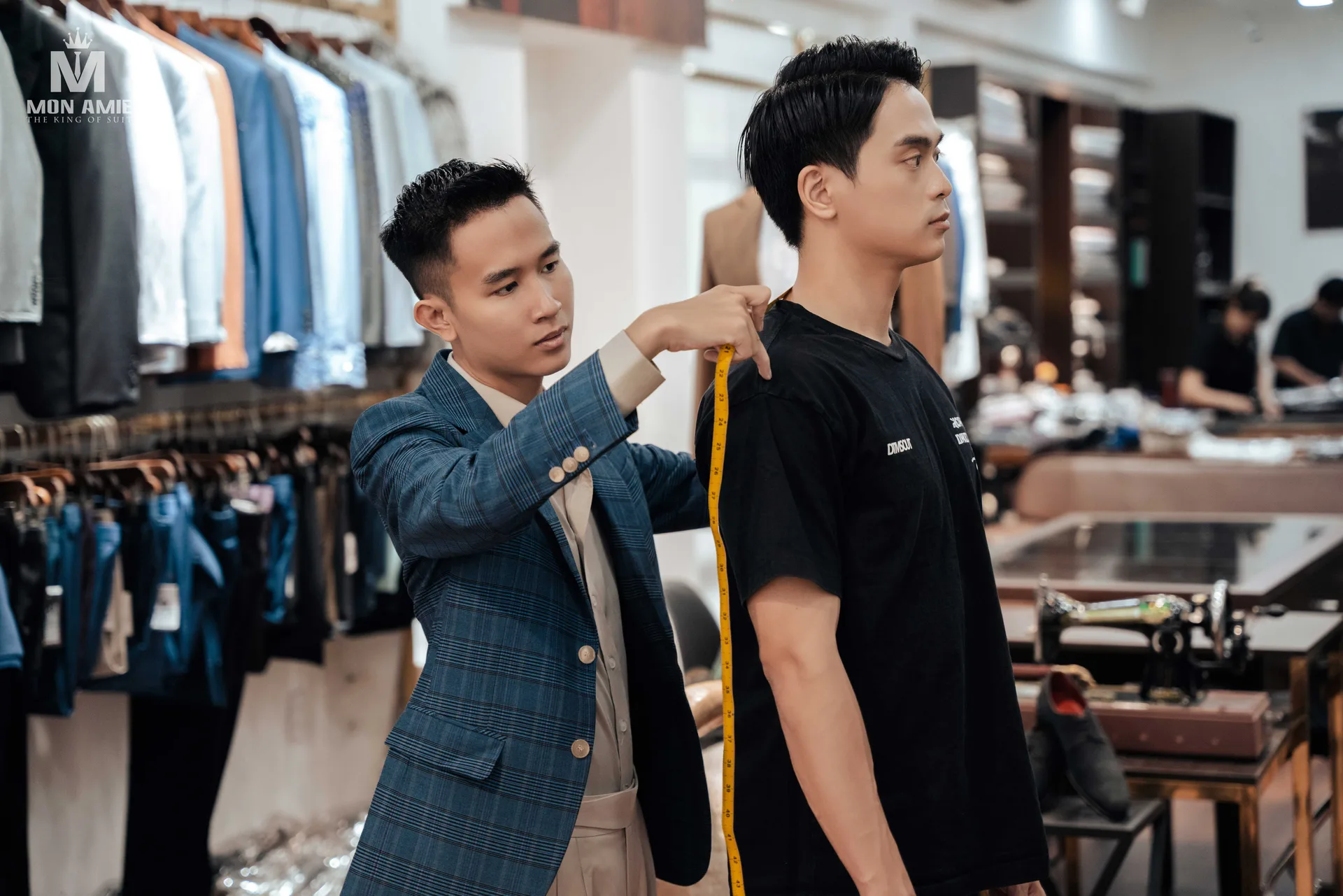
Common mistakes when measuring a suit jacket yourself
- Measuring while the jacket is still wrinkled or unbuttoned. A difference of a few centimetres is common.
- Using a rigid ruler. A steel ruler does not follow the line of the shoulder or sleeve.
- Forgetting to double the chest and waist measurements. This is the easiest mistake to make.
- Using a jacket that is too old, stretched or with sagging shoulders as the sample. Choose the jacket in its best condition.
- Measuring only, without noting what you want. If you want the jacket 2 cm closer than the sample at the waist, say so clearly so the tailor can handle it from the start.
Tips from Mon Amie's master tailors
The measurements of an existing jacket are only a starting point. With bespoke tailoring, the artisan takes more than 30 measurements of your own body and keeps them for life, then holds a baste fitting and adjusts until the fit is right. So if you have the chance, it is worth coming in to be measured in person at least once; afterwards you only need to reuse the saved measurements. You can learn about the 30 suit measurements or book a measuring appointment at a showroom.
Frequently asked questions
What is the most accurate way to measure a suit jacket?
Lay the jacket flat, button it, and use a soft tape measure to take five measurements: shoulder width, chest, waist, jacket length and sleeve length. Measure each twice and double the flat measurements of the chest and waist. Photograph each step so it is easy to cross-check.
How do you measure a man's suit jacket to know what size you wear?
Compare the finished measurements of a jacket that fits you with the brand's size chart. The most important are shoulder width and chest circumference. A reference chart for each size is in the article on finished measurement charts for men's suit jackets mentioned above.
Can you measure a man's suit at home by yourself?
With an existing jacket, absolutely. But for body measurements you should ask someone to help, because measuring your own shoulders, chest and back easily goes off. Standing straight, relaxed and not sucking in your stomach is also very important.
Do you need to measure the waistcoat when measuring a suit?
If you are having a three-piece suit made, the tailor needs the waistcoat measurements too: waistcoat length, chest width and waist width. You can measure from a waistcoat that fits well, laid flat, using the same method for chest and waist as for the jacket.
A final word
A jacket that fits well is a precious asset, because it already holds information about your body shape. Measure carefully, note everything down, then share it with Mon Amie through the online made-to-measure service, or bring the jacket straight to a showroom, and a master tailor will turn it into a new suit in exactly the right fit.