

Try one thing right in the shop: hold the white shirt up to the light. If you can see your hand clearly through the cloth, that is a shirt that will show your undershirt and your skin tone and look flimsy the moment you step out into the sun. A men's white shirt is the garment you wear most and think about least, yet it decides how the suit on top looks. The five criteria below will help you choose one that is truly worth the money.
Quick answer
A men's white shirt worth the money has cloth thick enough not to show through, a clean white that suits your skin, a collar balanced with your face and tie, even and fine stitching, and a fit right at the shoulder and chest. Because it is the garment you wear most and it shapes how the suit on top looks, the white shirt should be the first thing you have made to measure.
Criterion 1: Cloth thickness, one look against the light tells you
White is the most demanding cloth, because no colour or pattern hides thinness. The simplest test is the one from the opening: hold the cloth up to a light or press it against the back of your hand. Good cloth lets only a soft glow through, without clearly revealing skin colour or outlines.
Common weaves for a white shirt:
| Weave | Characteristics | Suited to |
|---|---|---|
| Poplin | Smooth, flat, thin and light, breathable | Everyday work, hot weather |
| Twill | A fine diagonal line, dense, shows through less and wrinkles less | Wearing under a suit all day |
| Herringbone | A herringbone weave, clear texture, refined | Occasions that call for polish |
| Oxford | Coarser, thick, slightly casual | Weekends, button-down collars |
If you want a thin white shirt that still does not show through, choose cloth with a high thread count and two-ply yarns, and wear a skin-tone (nude) undershirt instead of a white one, because a white outline under a white shirt shows more clearly than a nude one.
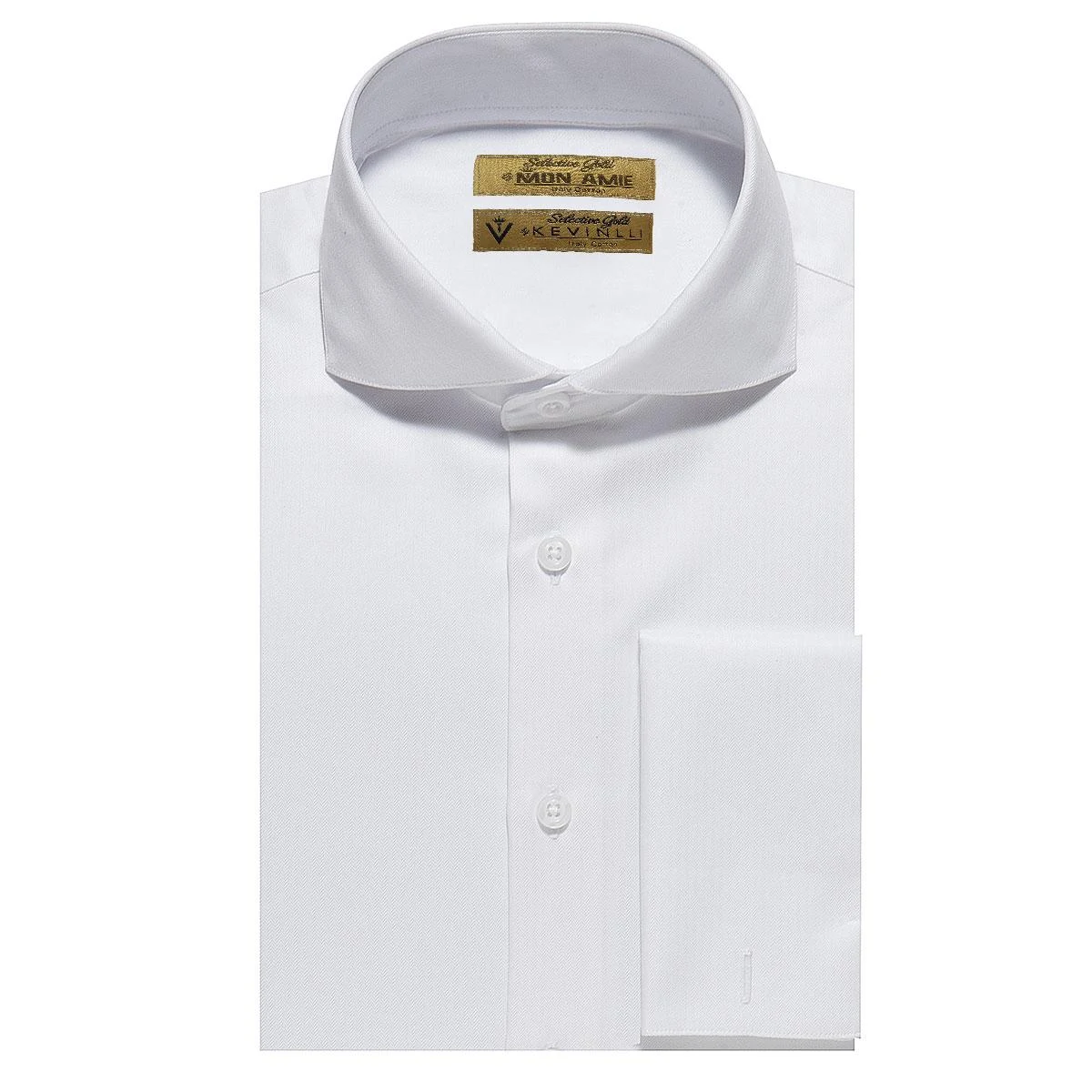
Criterion 2: The white itself, crisp or ivory
Not every white is the same. A crisp white (with a slightly cool blue cast) feels clean and sharp, and suits a fair complexion and office lighting. An ivory or cream white is warmer and softer, and usually suits tan or yellow-toned skin. A simple way to choose: try it on right up against the neck. If your face brightens, the white is right; if your skin looks dull, try another shade.
Keep in mind that a white shirt yellows gradually over time, so the quality of the yarn and the way it is washed determine how long the colour lasts.
Criterion 3: A collar balanced with your face and tie
The collar is the frame of the face. There are three main types:
- Point collar: the two collar points angle downward with a narrow gap between them. Classic and suited to many faces, especially round faces because it creates a vertical line.
- Spread collar (Italian wide collar): the two points open wide, suiting a larger tie knot and a long, slim face.
- Button-down collar: relaxed, suited to weekends or wearing no tie, less formal.
The collar needs to be firm enough to stand up all day under a jacket. Ask about the collar interlining and the collar stays, because a soft collar makes the tie sag. When choosing a collar style, also think about the tie knot you usually wear: a Half Windsor knot suits most business collars.

Criterion 4: Stitching, what a tailor looks at first
A high-quality shirt shows in its small details if you look closely:
- Small, dense, even stitches. A quality shirt usually has about 18 to 22 stitches per 2.5 cm. Sparse stitches burst easily and pucker the seam.
- Straight, flat seams. No puckering at the underarm, the shoulder or the armhole.
- Matching pattern. If the cloth has a woven-in stripe or a check, the lines should meet across the pocket, the shoulder and the sleeve join.
- Secure buttons. Mother-of-pearl buttons attached firmly with thread wound around the shank, not loose.
- Neat collar and cuffs. The two collar points symmetrical, the cuffs closing evenly.
Criterion 5: A fit right at the shoulder and chest
The fit decides whether a white shirt looks neat or sloppy. A few points to check:
- Shoulder: the shoulder seam sits at the end of the shoulder.
- Neck: with the collar button fastened, one finger slides between the neck and the collar.
- Chest and body: no strain at the buttons, no bunching at the back. A regular fit suits most builds; a slim fit suits a lean frame.
- Sleeves: the cuff sits right at the wrist bone, and when you wear a suit, about 1 to 1.5 cm of shirt shows.
- Length: long enough not to pull out of the trousers when you bend, but not longer than the seat.
If you would like to go deeper into pairing a shirt with a suit, the article how to wear a shirt with a suit will help you choose the collar, sleeves and length.
The wrinkle-free white shirt: what you should know
No cotton shirt is completely wrinkle-free. What you can do is choose cloth that wrinkles less (twill, herringbone or a more densely woven cloth), cloth with an anti-wrinkle finish, and care for it properly: wash gently, wring lightly, and dry on a shoulder hanger while still damp. Polyester blends wrinkle less but are usually stuffy and look less refined. For everyday office wear, a cotton twill shirt is the most balanced choice.
Why a white shirt should be the first thing you have made to measure
- You wear it most. A white shirt goes with almost every suit, so each flaw repeats every week.
- It touches your skin directly. The collar, the cuff circumference and the chest width affect how you feel all day.
- It sets the standard for the whole suit. The suit collar must sit close against the shirt collar, and the suit sleeve is calculated by how much shirt shows. A well-fitting shirt helps the tailor balance the suit more accurately.
- A small garment with a big effect. A made-to-measure shirt is the gentlest way to begin the made-to-measure journey. You can browse the fabric library or the styles in the product catalogue, then ask a stylist about the price and the amount of cloth a shirt needs.
For those interested in measurements, the article made-to-measure men's shirts: measurements and cloth allowance explains exactly which measurements are needed.
Common mistakes
- Choosing a white shirt that is too thin, showing the undershirt and its outline.
- Wearing a white undershirt under a white shirt; its edge shows more than a nude undershirt.
- Choosing a size by the neck and ignoring the shoulder. The neck fits but the shoulder is wide, making the whole shirt sloppy.
- Not ironing the collar and cuffs. These two places are exposed the most under a jacket.
- Washing with coloured clothes, which turns the white shirt grey.
Tips from Mon Amie's master tailors
- When trying on a shirt, raise your arms, reach forward and sit down: the shirt must not pull out of the trousers.
- Choose two or three white shirts in the same style to rotate; cloth that rests between wears lasts longer.
- If you often wear long sleeves in a cold office, choose a slightly roomier cuff so that a watch does not catch.
- The collar is a detail a made-to-measure tailor always adjusts to each person's neck; do not hesitate to mention whether you tend to lower your head or crane your neck.
Frequently asked questions
How does a premium men's white shirt differ from an ordinary shirt?
The differences are in the cloth (long staple, two-ply, high density), the stitching (small, even stitches), the buttons (mother-of-pearl) and the fit (right at the shoulder and chest). At a glance they look alike, but after a few months of wear the difference in durability and drape shows.
Does a thin men's white shirt show through?
It can, if the cloth is too thin or you wear a white undershirt. Choose cloth of enough weight (twill, herringbone) or a high-density poplin, and wear a skin-tone undershirt so nothing shows.
Which cloth should a men's white shirt for office wear be?
Twill or fine cotton poplin for everyday work. Twill is heavier and wrinkles less; poplin is lighter and more breathable in hot weather.
How long should the sleeve of a men's long-sleeved white shirt be?
The shirt cuff sits right at the wrist bone. When you wear a suit, the shirt shows beyond the jacket sleeve by about 1 to 1.5 cm. Measuring this position correctly keeps the whole outfit balanced.
Conclusion
A good white shirt is the one you forget you are wearing, yet still feel polished all day. If you would like to start with a small piece done right, book a measuring appointment so the tailor can measure your neck, shoulder and sleeve just for you, or look at Mon Amie's bespoke tailoring service for the full process.